

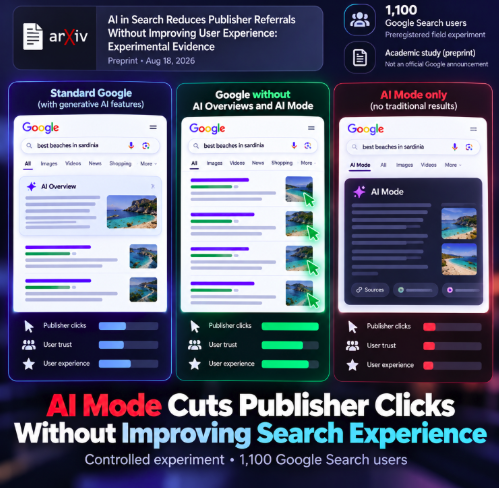

A preregistered field experiment involving 1,100 Google Search users found that removing AI Overviews and AI Mode increased click-through rates to publishers, while an AI Mode-only search experience reduced publisher referrals and also worsened user experience and trust.
The research, submitted to arXiv on August 18, 2026, is an academic preprint rather than an official Google announcement. Its title is AI in Search Reduces Publisher Referrals Without Improving User Experience: Experimental Evidence.
A controlled test of generative AI inside Google Search
The researchers designed a preregistered field experiment to estimate the causal effects of Google’s generative AI search features on user behavior, perceptions and publisher traffic.
This distinction matters. Much of the discussion around AI search and declining publisher traffic relies on observational data, where multiple changes can happen simultaneously. A controlled experiment is designed to isolate the effect of the tested search experience more directly.
Removing AI features increased publisher clicks
According to the study abstract, removing both AI Overviews and AI Mode increased click-through rates to publishers. That supports the concern that generative answers can absorb part of the informational journey that previously resulted in an external click.
The economic implication is straightforward: when fewer users leave Google for the websites supplying information, publishers can lose referral traffic even while their content remains part of the broader search ecosystem.
AI Mode alone performed worse on more than CTR
The most notable result is not simply that an AI Mode-only experience reduced click-through rates. The researchers also report that it eroded user experience and trust in information found on Google.
That challenges a common assumption behind zero-click AI search: lower outbound traffic might be considered an acceptable trade-off if users receive a clearly better experience inside the search product. In this experiment, the AI Mode-only condition did not produce that compensating improvement.
Why publishers should pay attention
For publishers, the study adds experimental evidence to a growing measurement problem around AI search. Visibility inside an AI-generated answer does not necessarily translate into referral traffic, and a user can complete more of the information journey without visiting the original source.
This makes traditional ranking metrics insufficient on their own. Publishers increasingly need to monitor citation visibility, brand mentions, external clicks and how different AI search interfaces change user behavior.
Important limitations
The paper is currently a preprint and should not be treated as a statement from Google or as proof that every query, market or user population will behave identically. The experiment measures a defined population and specific Google Search experiences at a particular point in time.
Its value is that it provides controlled experimental evidence about the direction of the effect rather than merely correlating the rollout of AI features with traffic changes.
The NetContentSEO view
The central finding is uncomfortable for the publisher ecosystem: in this experiment, generative AI features reduced referrals, and the AI Mode-only experience did not compensate by producing higher trust or a better perceived search experience.
That makes the publisher traffic question more than a simple debate about users preferring convenience. If future studies reproduce the result, search platforms will face a harder question: whether reducing outbound clicks is actually delivering enough additional value to users to justify the shift in attention away from the open web.