

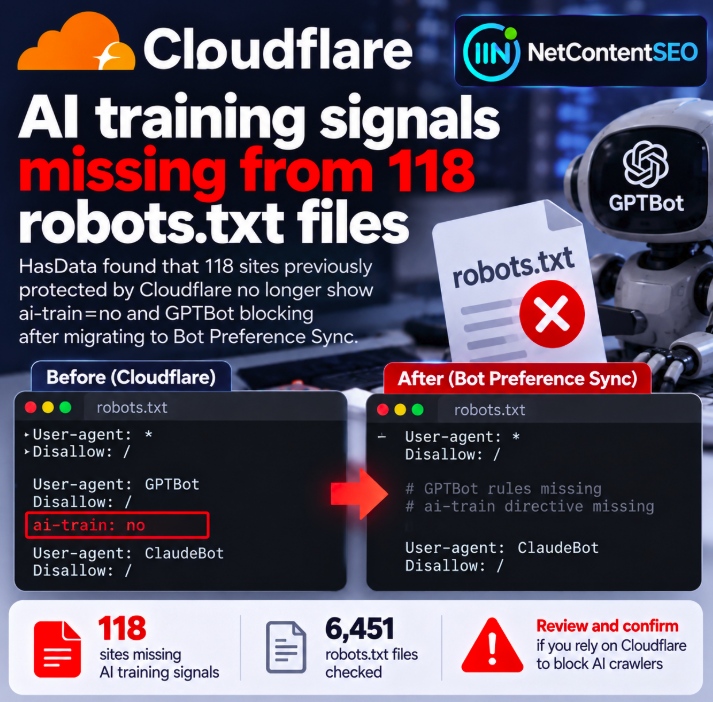

October 8, 2026 — An independent analysis by HasData reports that AI training preference signals disappeared from the publicly served robots.txt files of 118 websites that had previously relied on Cloudflare-managed rules. The observation relates to a transition toward Cloudflare's Bot Preference Sync system, but it should not be mistaken for a confirmed Cloudflare software bug or proof that AI crawlers regained access to those sites.
The underlying measurements were taken on September 16–17, 2026, and the analysis was published on October 8. HasData examined 6,451 robots.txt files. Among sites previously showing Cloudflare's AI-related directives, 118 no longer displayed the earlier ai-train=no signal and GPTBot blocking rule in the publicly visible file. According to the report, none of the 6,451 checked files showed the new system's signals at the time of the sample.
What exactly disappeared?
The finding concerns machine-readable declarations visible in robots.txt, not necessarily the enforcement of requests at Cloudflare's network edge. Two types of signals are relevant: the ai-train=no preference declaration used in the earlier Cloudflare-managed file, and User-agent: GPTBot rules instructing that crawler not to access certain paths.
These mechanisms should not be conflated. A robots.txt instruction communicates a preference or crawl directive to cooperative bots; it is not itself an access-control firewall. An infrastructure-level block can still deny requests even when a visible robots.txt instruction has disappeared.
Why the Cloudflare migration matters
HasData associates the change with Cloudflare's move toward Bot Preference Sync, a newer workflow for expressing and managing AI bot preferences. Existing users may need to review and confirm their preferences rather than assuming previously generated directives carry over unchanged. This is an operational audit issue, not yet a proven universal failure across Cloudflare customers.
118 sites versus 6,451 files: understanding the numbers
The report's 118 figure identifies previously protected sites in which visible signals disappeared during the comparison. The 6,451 figure is the larger sample of robots.txt files inspected. These numbers should not be presented as 6,451 affected sites, nor should the sample be treated as a census of every Cloudflare customer.
Did GPTBot suddenly gain access?
Not necessarily. The analysis indicates that many websites still had GPTBot blocked at the infrastructure layer. The disappearance of a robots.txt directive does not establish that a bot could successfully fetch the underlying content. Conversely, an edge-level block does not automatically restore the missing public preference declaration. Publishers concerned with both access control and signaling should verify each separately.
What does ai-train=no mean?
The ai-train=no string is a machine-readable AI training preference signal associated with the earlier Cloudflare-managed configuration. It is not a standard robots.txt directive universally enforced by all crawlers, and its presence or absence alone cannot establish whether content was or will be used for training. The separate GPTBot Disallow rule is a crawler-specific robots.txt instruction. Neither should be confused with a legal guarantee or a comprehensive technical access block.
How to audit your site after the transition
- Fetch the public file: open
https://yourdomain.example/robots.txtin a private browser session or retrieve it using a command-line HTTP client. Check the actual response for your production hostname. - Compare with a known baseline: look for missing AI-related preferences and user-agent groups, while distinguishing old generated rules from custom rules you manage yourself.
- Check Cloudflare settings: review the current AI bot management and Bot Preference Sync controls. If a confirmation or migration action is offered, assess and complete it according to your organization's policy.
- Verify edge enforcement separately: inspect Cloudflare bot-management settings and relevant security events or logs for GPTBot and other AI crawlers.
- Test carefully: do not infer crawler access from robots.txt alone. Use permitted diagnostics and available logs to confirm whether requests are blocked.
- Document the outcome: retain the observed robots.txt response, date, configuration and any subsequent changes so the next audit has a baseline.
- Recheck after updates: CDN settings and generated robots.txt content may change during migrations or deployments.
What this means for publishers and technical SEO
AI crawler governance now involves several independent layers: public crawl instructions, training-use preference signals, CDN bot policies and actual request enforcement. A migration that changes one layer can create a mismatch between what publishers believe they configured and what outside systems can observe. That mismatch matters for compliance workflows, editorial policy and AI visibility research even if the site remains technically protected.
NetContentSEO analysis: a missing signal is not the same as an open door
The strongest conclusion from the HasData investigation is an audit warning: do not assume historical Cloudflare-managed AI preferences are still present in the public robots.txt after a configuration transition. Publishers should verify both the machine-readable signal and the infrastructure controls before claiming their AI crawling policy is intact—or that it has failed.
At publication time, this should be described as an independent dataset finding, not a Cloudflare-confirmed bug.
Source
HasData — AI Crawler Block Index (analysis published October 8, 2026; measurements September 16–17, 2026).