

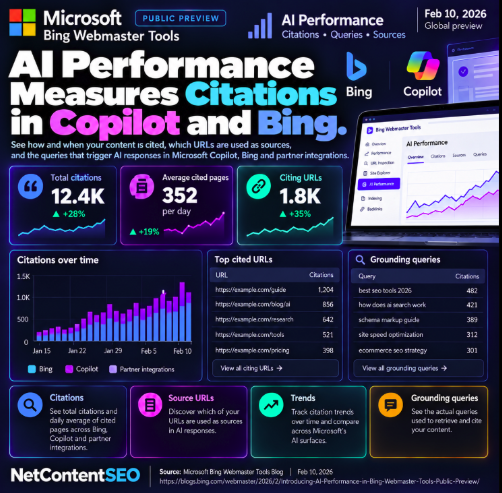

Microsoft has opened a new visibility layer inside Bing Webmaster Tools. AI Performance, launched in public preview on February 10, 2026, shows publishers when their pages are cited in Microsoft's AI-powered search and assistant experiences.
The report goes beyond a simple citation counter: it exposes cited URLs, citation trends and the grounding queries associated with AI responses that use a site's content.
Publishers can see total citations and cited pages
AI Performance provides a summary of how frequently a site's content appears as a source in AI-generated answers. Microsoft lists metrics including total citations and the average number of pages cited per day, giving publishers a way to track AI visibility over time.
The report also identifies the URLs that are being cited, allowing site owners to move from domain-level visibility to the specific pages supplying information to Microsoft's AI systems.
Grounding queries reveal what triggered retrieval
The most strategically interesting component for GEO is the grounding-query view. Microsoft describes grounding queries as the queries used to retrieve and ground information for AI responses.
That gives publishers a rare view into the retrieval layer: not only that a page appeared, but also the query context associated with its use as a source.
Citation trends can be tracked over time
AI Performance includes historical trend data so site owners can monitor changes in citations and cited pages. This makes it possible to identify gains, losses and shifts in the URLs being selected by Microsoft's AI experiences.
For GEO measurement, trend data is particularly useful because citation visibility can change independently from traditional blue-link rankings.
The data spans Microsoft's AI ecosystem
Microsoft says the report covers AI-powered experiences across Microsoft Copilot, Bing and partner integrations.
This means the dataset is broader than a conventional Bing Search performance report. It is intended to show how publisher content participates in generative answers across Microsoft's expanding AI distribution layer.
Microsoft calls this an early step toward GEO tooling
Microsoft explicitly frames AI Performance as an early step in helping publishers understand and improve visibility in AI search. The company says it plans to continue expanding the reporting as AI search evolves.
That makes Bing Webmaster Tools one of the clearest examples of a major search engine moving first-party webmaster reporting toward Generative Engine Optimization metrics.
The NetContentSEO view
The key development is not simply that Microsoft counts citations. It is exposing part of the retrieval chain connecting user intent, grounding queries, source URLs and generated answers.
Traditional SEO tools tell publishers which queries produced impressions and clicks. AI systems frequently obscure that relationship. Grounding-query reporting begins to restore it.
For publishers, this creates a practical GEO workflow: identify pages receiving citations, inspect the grounding queries associated with them, compare citation trends over time and study which content characteristics repeatedly cause Microsoft AI systems to retrieve the page.
It remains a public preview, so metrics and coverage may evolve. But the direction is clear: AI visibility reporting is moving from third-party estimation toward first-party data supplied directly by the search and AI platforms themselves.