

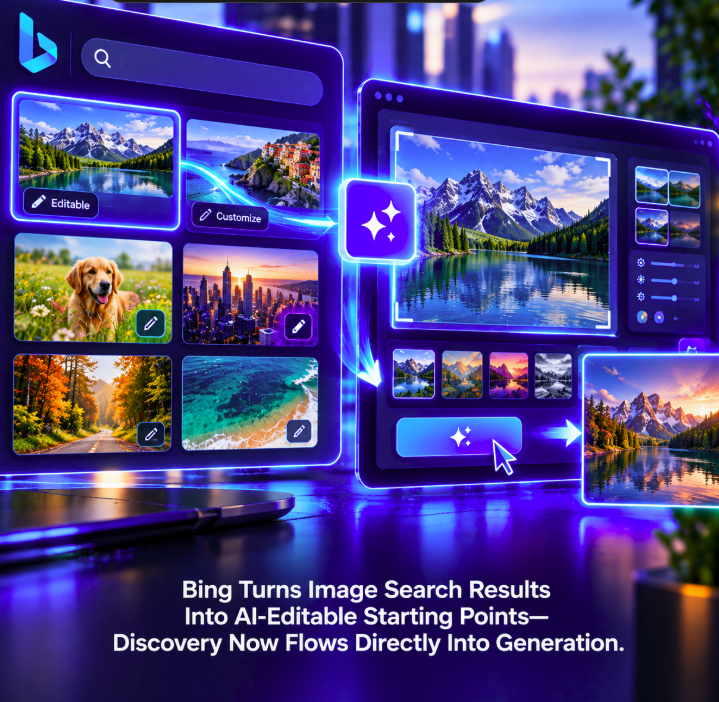

Bing is testing a new bridge between finding an image and generating a new one. Some results in Bing Image Search are appearing with labels such as “Editable,” a “Customize” control or a pencil icon that sends the selected result directly into Bing’s AI image creation experience. Instead of ending with discovery, the image result can become the starting material for a generative workflow.
The experiment was documented by Search Engine Roundtable on September 25 after multiple users spotted different versions of the interface. Sachin Patel reported an “Editable” label, Khushal Bherwani saw a customization button, and Barry Schwartz was able to reproduce a variation using an edit icon that displayed “Customize” on hover. Clicking the pencil icon opened Bing’s image creation tool.
Image Search is becoming an input layer for generation
The important change is the removal of a boundary. Traditional image search is fundamentally a retrieval experience: the user searches, browses thumbnails and opens an image or the page associated with it. Generative image tools begin somewhere else, usually with a prompt or an uploaded reference. Bing’s test connects those two stages directly inside the search result.
A result marked as editable is no longer presented only as something to view. It becomes an invitation to continue creating. The user can discover a visual reference and move into an AI editing environment without manually downloading, uploading or reconstructing the idea as a text prompt.
Microsoft has not announced the experiment as a broad product rollout, and the labels observed by different users are not identical. That variation is itself evidence that Bing is testing interface treatments rather than introducing one finalized design. The confirmed behavior is narrower: several users have seen editing or customization affordances attached to image results, and at least one variation routes into Bing’s AI image creation tool.
Discovery and creation are collapsing into one journey
Search has historically helped users locate existing material, while creative software helped them transform or produce new material. Generative AI weakens that distinction because an existing image can function as context for a new output. Once the editing action is embedded directly into search, retrieval becomes the first stage of generation.
This changes the user journey from “find an image” to “find a useful starting point.” A search result can supply composition, subject matter, color, visual style or other inspiration before the generative system produces a transformed result. Bing’s own Image Creator currently promotes the ability to upload an image and enhance, remix or reimagine it with AI, making the search integration a natural upstream entry point into capabilities Microsoft already exposes.
The result is a much shorter loop between inspiration and production. Search supplies the candidate, the AI tool supplies transformation, and the user can iterate without treating those as separate products.
The thumbnail is becoming an actionable object
For publishers and visual creators, this is a more consequential interface change than another button might suggest. Image-search thumbnails have traditionally represented destinations: clicking them leads toward a larger preview, a source page or related images. An “Editable” label gives the thumbnail a second role as an actionable object that can be passed into a generative system.
That creates a new type of visual discovery event. The user may encounter an image because Bing retrieved it for a query, but the next action is not necessarily a visit to the originating website. The next action can be transformation inside Microsoft’s own creative environment.
The available reporting does not establish how Bing determines which images receive the editing affordance, whether all source types are eligible, or what rights and safety checks apply at each stage. Those questions matter, but they should not be answered by inference from a UI test. Microsoft has not published a technical selection policy for the observed labels.
Visual search can now produce a generative branch
This experiment adds another branch to the increasingly complex search funnel. A visual result can still generate a publisher visit, lead to another image search or help the user refine a query. But it can also send the user into an AI creation flow, where the original search result becomes context rather than the final destination.
That is similar to what conversational search has done to text retrieval. A webpage can be found, summarized and incorporated into a generated answer without the user following the traditional sequence of search result, click and page view. In image search, Bing is testing an analogous transition from retrieval to transformation.
The difference is that the output is creative rather than explanatory. Instead of synthesizing information from retrieved documents, the system can use the discovered visual as a starting point for a newly generated or modified asset.
This could change how image-search visibility is measured
Image SEO has usually been evaluated through impressions, rankings, clicks and traffic from visual search. AI editing introduces another possible outcome that those metrics do not describe well: an image can be discovered and become useful to the user even when the publisher receives no conventional visit.
That does not mean every editable result is being consumed without attribution, nor does the current test reveal whether Microsoft will expose new analytics around these interactions. It means the interface creates a user action that sits between an impression and a website click. The image has influenced the session, but the next destination is a generative tool.
For visual publishers, ecommerce sites and brands, that makes machine-readable image context more important while also making downstream value harder to observe. A product photograph, destination image or design asset may participate in discovery even when the user’s ultimate objective is to create something new rather than visit the source.
The experiment also changes the competitive surface
Once image search and image generation are linked, Bing is no longer competing only with other visual search engines for the discovery stage. It is also competing with standalone creative tools for what happens immediately after inspiration. The faster Microsoft can move a user from a useful search result into editing, the less reason there is to leave the Bing environment before beginning the creative task.
This follows a broader platform pattern in which search products absorb the next step in the user journey. Shopping results increasingly include comparison and filtering. Local results support calls, bookings and directions. Generative search can answer and continue a conversation. AI-editable image results extend the same logic to visual creation.
The strategic advantage is continuity. Bing already knows the query that produced the image and which visual the user selected. Passing that context directly into an AI creation tool can make the transition more fluid than starting from an empty prompt box.
Publishers should not assume every image is becoming editable
The current evidence remains limited to a UI test. Search Engine Roundtable documented several variations and independently reproduced one of them, but Microsoft has not announced general availability, eligibility criteria or a permanent product name for the feature. The appearance of “Editable,” “Customize” and pencil-only treatments suggests the interface is still being evaluated.
It would therefore be premature to redesign an image SEO strategy around the experiment or assume that Bing intends to make arbitrary indexed images generatively editable. The test demonstrates a product direction, not a complete policy framework.
That direction is nevertheless clear enough to matter. Bing is experimenting with treating visual search results as inputs to an AI creation experience rather than only endpoints in a retrieval interface.
The next search result may be something the user can rewrite
Generative AI is changing the definition of a search result. In text search, retrieved pages can become evidence for synthesized answers. In product search, catalog entities can be reorganized into personalized collections. Bing’s image experiment applies the same transformation to visual discovery: the retrieved object can become raw material for the next generated object.
That collapses two formerly separate intents—finding and making—into one interface. A user can search for an image because they want to see what already exists, then immediately decide to customize it because the result is close to what they actually need.
If Microsoft expands the test, image-search optimization will have to account for a world in which visibility can lead not only to a click but to a creative action. Bing is testing the first part of that future now: the search result is no longer necessarily the end of discovery. It can be the beginning of generation.