

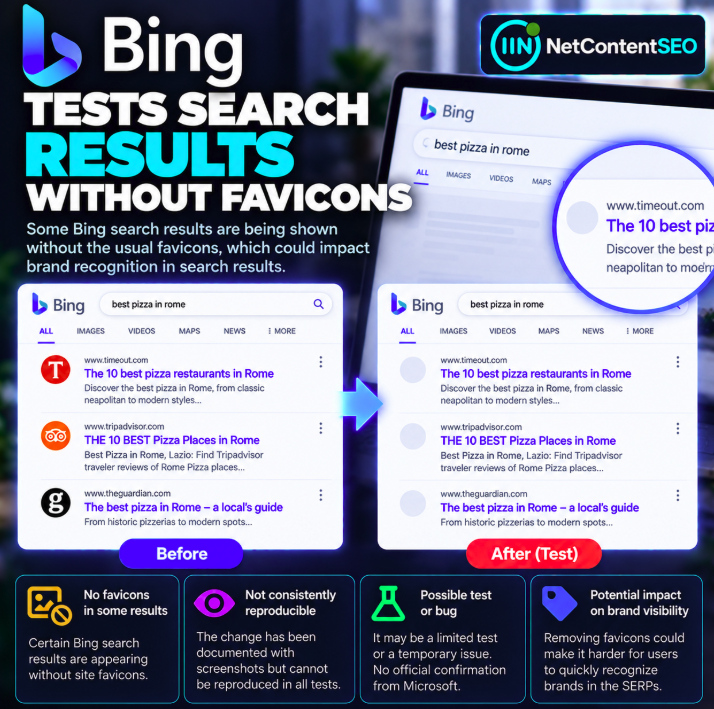

Some Microsoft Bing search results have been observed without the favicons that normally appear beside website listings. The unusual presentation was first reported on October 6, 2026, with additional coverage published October 9. Screenshots document the appearance, but observers have not been able to reproduce it consistently.
That distinction matters: Microsoft has not officially confirmed a favicon-removal experiment, and the behavior could be a limited user-interface test or a temporary bug. There is also no evidence of a change to organic ranking or indexing rules.
Source: Search Engine Roundtable — Bing Search Results Without Favicons.
What was observed in Bing's search results?
In screenshots shared by search observers, certain Bing results appear without the small site icons typically displayed near the listing. The rest of the search-result presentation may still include the familiar elements users rely on, such as a page title, URL or site name and descriptive snippet.
The observation is limited to the reported examples. It should not be generalized to all searches, users, countries or devices.
Why favicons matter in search interfaces
A favicon is a compact visual identifier associated with a website. When a search engine displays it alongside a result, it can help users recognize a familiar publisher, store or service at a glance.
For brands that invest in distinctive visual identities, a favicon may contribute to recognition within a crowded results page. However, the available Bing report does not measure whether removing icons changes clicks, trust or conversion rates. Any such impact remains a hypothesis.
Test or bug? What is actually known
| Question | Current evidence |
|---|---|
| Have favicon-free Bing results been observed? | Yes, documented in screenshots |
| Can the behavior be reproduced consistently? | No, not according to the reported follow-up |
| Has Microsoft confirmed a test? | No official confirmation cited |
| Is there a general rollout? | Not established |
| Have ranking or indexing rules changed? | No evidence of such a change |
| Is the effect on click-through rate known? | No measured effect published in the cited report |
Could missing favicons affect brand recognition?
Potentially. A visual icon is one of several cues that can help readers distinguish results from competing websites. Without it, users may rely more heavily on the domain, site name, headline and snippet to identify the source.
But the magnitude and direction of any effect are unknown. Some users may barely notice the difference; others may depend on visual branding. The current observation does not justify claiming a measurable loss of brand visibility.
Does the observation mean Bing has stopped supporting favicons?
No. A handful of results displayed without icons does not establish that Bing has removed favicon support. The lack of systematic reproducibility and official confirmation makes a broad conclusion premature.
Website owners should continue maintaining accessible, appropriate favicon assets as part of normal technical and brand hygiene. There is no reason to remove them because of this report.
Could this be caused by a temporary rendering issue?
Yes, a rendering or interface issue is one plausible explanation. Other possibilities include a controlled layout experiment or behavior limited to certain accounts, browsers or search contexts.
Without a Microsoft statement or reproducible testing across environments, it is not possible to choose confidently among those explanations.
What SEO teams should monitor
- Save exact queries. Record the search terms associated with favicon-free results.
- Document environment. Note device, browser, country, account state and time.
- Capture full-page screenshots. Preserve enough context to distinguish a missing icon from a cropped image.
- Repeat tests. Check whether the same presentation appears across sessions and devices.
- Keep favicon assets healthy. Ensure the site's own icon remains available and technically valid.
- Separate appearance from performance. Do not attribute ranking or traffic changes to the observation without supporting data.
How to distinguish a site-specific favicon issue from a Bing UI change
If only one website is missing an icon, a site-level asset or retrieval issue may be worth investigating. If many unrelated domains lose icons simultaneously in the same results interface, a presentation-level change becomes a more plausible explanation.
Even then, screenshots alone cannot establish why the change occurred. A controlled comparison across sessions, browsers and locations is more informative than an isolated observation.
What does this mean for SERP monitoring tools?
Tools that analyze search-result screenshots or depend on visual markers should account for interface variation. A missing icon may change how a result is detected or labeled by an image-based workflow, even if the underlying listing remains present.
This is a potential measurement consideration, not evidence that a particular rank tracker or scraper is malfunctioning.
Is there any connection to Bing ranking changes?
No ranking update has been confirmed in connection with the favicon observation. A visual difference in search results does not by itself imply that Bing has changed how it evaluates page relevance, quality or authority.
Similarly, there is no established connection to AI-generated answers, citations or indexing policy.
FAQ
Is Bing removing favicons from all search results?
No general removal has been confirmed. Only some favicon-free results have been documented.
When was the behavior first reported?
October 6, 2026, with follow-up coverage on October 9.
Has Microsoft announced a favicon-free layout?
Not in the cited reporting.
Could this be a bug?
Yes. A temporary rendering problem remains one possible explanation.
Will removing favicons hurt website rankings?
No ranking impact has been established by the observation.
Should site owners change their favicons?
No special change is indicated. Keep existing favicon files valid and accessible.
NetContentSEO analysis
The Bing favicon observation is worth tracking as a potential SERP presentation change, but it is not yet a confirmed product test. Favicons contribute to the visual identity of website listings, so their absence raises reasonable questions about brand recognition. For now, the evidence supports cautious monitoring—not claims of a rollout, lost clicks or altered search rankings.
Source: Search Engine Roundtable, October 9, 2026.