

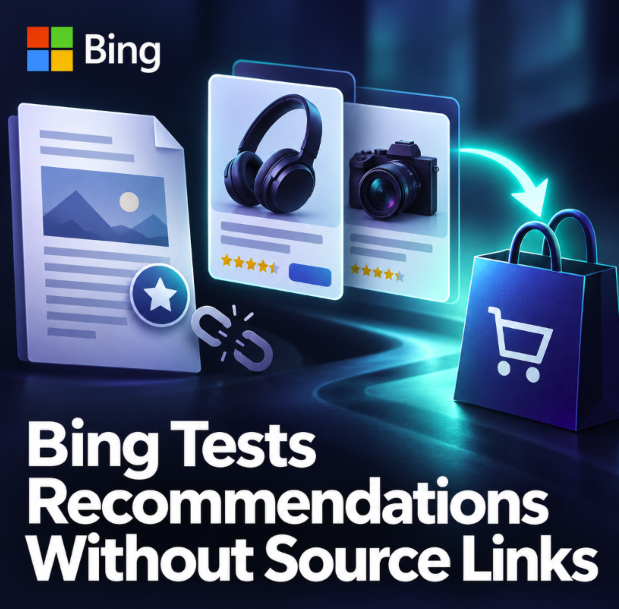

Bing is testing a product-results presentation that names a recommendation source while directing product clicks to retailers. The reported layout raises a useful distinction for publishers: a brand can appear as an authority cue without receiving a direct route back to its underlying work.
What the reported test shows
In an October 2 report, Search Engine Roundtable's Barry Schwartz describes a “Recommended by” section spotted by Sachin Patel and replicated in some browsers. His example names GearLab, but the product thumbnails lead to retailers, and he found no link to the recommendation source. He also reports no mention of GearLab on those destination pages.
This establishes the reported interface behavior, not whether the named publisher actually recommended every displayed item. The article does not provide a Bing-confirmed rollout, a complete explanation of recommendation sourcing or evidence of a measured traffic loss.
Attribution and verification serve different purposes
A publisher name can help a shopper recognize a familiar source. A link serves an additional purpose: it allows that shopper to inspect the review, understand the testing method and check any qualifications behind a recommendation.
Without that route in the module, a user may need to run another search to find the original evaluation. That extra work matters particularly where a review distinguishes between versions, budgets or use cases. A product praised for one task is not necessarily the right choice for every buyer.
The appropriate editorial concern is therefore traceability. The observation alone does not justify accusing Bing of inventing an endorsement. It does justify asking how a shopper can verify the association presented in the result.
What publishers should measure
Publishers can record appearances of their brand separately from referral visits. A useful observation log would include the query, market, browser, product model, named source and destination of each clickable element. This creates evidence for future discussions about attribution without equating every visible mention with a lost click.
For the publisher's own review pages, make the recommendation specific enough to interpret outside its original context. Identify the exact product version, explain who it suits and state the limitations close to the conclusion. Clear editorial records also make it easier to investigate a questionable association if a search module presents one.
These are practical publishing recommendations, not documented requirements for inclusion in this Bing test. Nor can a publisher assume that a formatting change will secure a source link.
What merchants and AI Search teams can learn
Retailers should check that landing pages describe the precise product a search result displays. If a destination references an external recommendation, keep the attribution and supporting evidence clear rather than relying on a search label as proof.
For AI Search teams, the broader measurement lesson is relevant even though this report does not establish that the module is AI-generated. Track brand mentions, source links and commercial destinations as separate observations. They describe different relationships between visibility, evidence and traffic.
A recommendation module can make a publisher recognizable while routing the transaction elsewhere. Whether that tradeoff helps or harms a particular business requires data. For now, the reported Bing test offers a concrete reason to audit link paths alongside the presence of a brand name in search.