

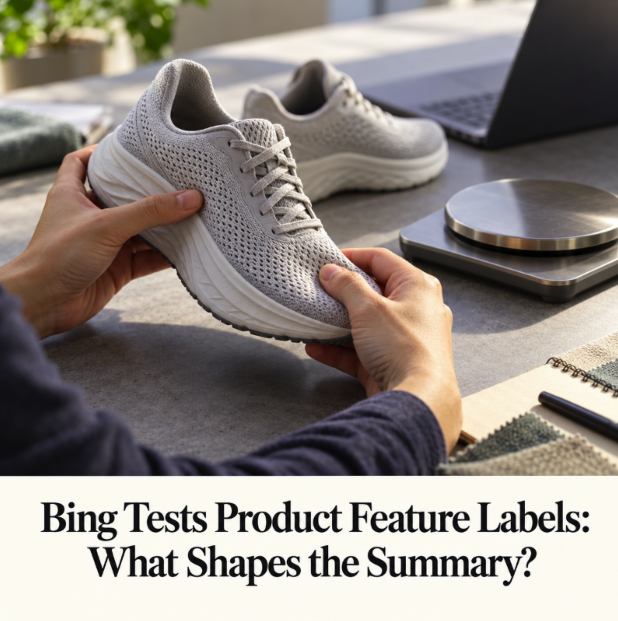

Bing has been reported showing short product-feature labels when users hover over items in a search-result grid. The sighting raises a useful question for merchants: how does a search interface turn product information into a brief statement about what an item is good for?
The observed interface and the mechanism behind it need to be kept separate. As of October 1, 2026, our verification found no official Microsoft announcement confirming AI generation, the source material or general availability of this particular format.
What the reported test shows
Search Engine Roundtable’s September 30 report, by Barry Schwartz, describes labels including “great for…”, “effective”, “performs well” and “lightweight”. It credits Khushal Bherwani with multiple sightings and says the text appears as an overlay when hovering over the product grid.
Schwartz also cautions that the presentation may not be entirely new. The report therefore supports describing a reported product-label test, with uncertainty about its novelty. It does not establish a launch date, rollout geography, account eligibility or the method used to produce the wording.
In particular, the report does not identify whether the phrases come from merchant descriptions, manufacturer specifications, reviews, another source or a combination. Calling the labels AI-generated remains an unconfirmed interpretation. Assigning them to merchant feeds would add a second assumption.
Merchant feeds provide context, not proof of provenance
Microsoft’s official shopping-ad guide explains that Shopping Campaigns use uploaded product catalogues and that product ads display information such as images, prices, titles and the business name. This establishes a documented role for merchant data in shopping advertising. It does not identify the data source for the reported hover labels or confirm that every item in the observed grid is an ad.
The Microsoft Advertising product schema includes titles, descriptions, identifiers and variant-related attributes. It also documents custom-label fields used to filter products for campaigns. Those campaign-management fields should not be confused with the consumer-facing feature labels in this sighting: sharing the word “label” does not make them the same feature.
A short phrase can make a larger claim
Our editorial interpretation is that a feature label deserves scrutiny as a representation of a product. Some labels can be checked against measurable attributes. Others express an evaluation or a suitability judgment that depends on a use case. Treating both as equivalent factual descriptions would obscure what a shopper is being told.
Consider a hypothetical running shoe labelled lightweight. The relevant evidence might include the shoe’s mass, size and comparison category. A label saying it is suitable for long-distance running would require a different kind of justification. This is an illustration of how to evaluate summaries, not evidence that either claim appeared in the reported test.
For NetContentSEO, the research interest lies in whether important conditions survive compression. A statement about one size, variant or test setting can become misleading if presented as a property of every version. That question applies whether the text is generated, extracted or manually supplied.
What a merchant can inspect now
We propose recording any reproducible occurrence before changing product content. Preserve the query, date, market, device, product destination and exact visible wording. Note whether the item is marked as sponsored and whether the label provides a source or explanatory link. Keep an occurrence log rather than assuming a single observation represents all shoppers.
Next, compare the statement with the correct product variant and the evidence available on the destination page. Distinguish a supported attribute, a broadly worded judgment and a claim that cannot yet be verified. If public sources disagree, record the conflict instead of choosing the version that best matches the label.
A merchant can review its own catalogue for consistent names, units and variant identifiers while this test remains uncertain. Those checks improve the inspectability of product information; they do not guarantee a particular Bing label. Adding promotional phrases solely to imitate an observed badge would offer little evidence of causation or accuracy.
What would establish the next step
The useful next evidence would be Microsoft documentation of the source-selection process, independently reproduced examples and a clear way to identify or correct inaccurate wording. Until then, the reported labels are an interface observation with an unresolved data pipeline.
The commercial opportunity is worth investigating, but the claim should stay precise: Bing has been reported testing concise product-feature labels. Whether AI generates them and whether merchant data determines their wording remain open questions.