

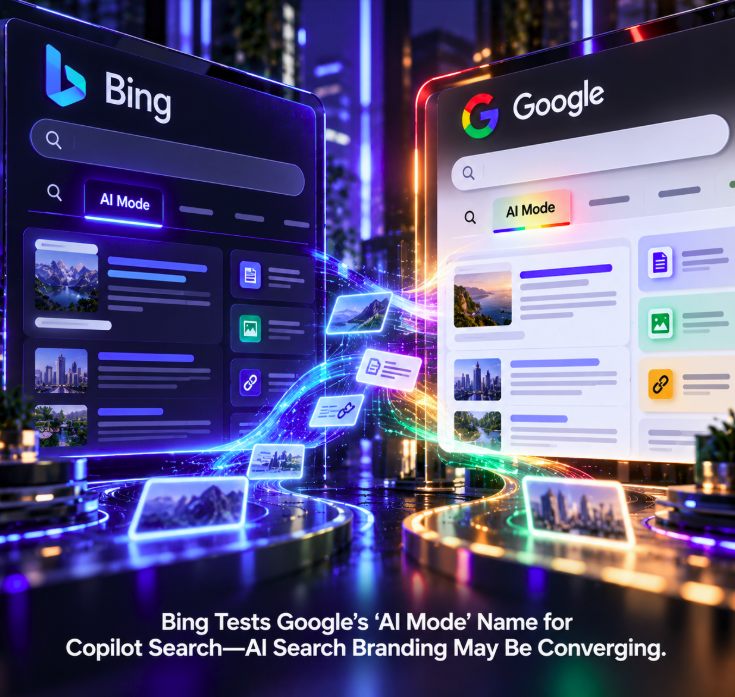

Bing appears to be testing a deceptively small change with potentially larger implications for how generative search is presented to users. In a newly spotted interface experiment, the dedicated Copilot Search tab is labeled “AI Mode”—the same expression Google uses for its conversational search experience.
The test was reported by Search Engine Roundtable on September 25 after Sachin Patel shared a screenshot of the interface. Outside the experiment, Bing continues to use the Copilot Search name. Microsoft has not announced a rename, and there is no evidence yet that “AI Mode” will replace Copilot Search broadly, so the observed label should be treated as a UI test rather than a confirmed branding change.
Bing is testing a generic label where it normally uses the Copilot brand
The significance lies in what Microsoft would be giving up if the experiment became permanent. “Copilot Search” ties Bing’s generative search experience directly to Microsoft’s broader Copilot brand. “AI Mode,” by contrast, describes a type of search behavior rather than a Microsoft product family.
Google already uses AI Mode as the name of its dedicated generative search experience. The label has become increasingly visible across Google Search as the company adds conversational follow-ups, query fan-out, multimodal capabilities and links from other AI surfaces into AI Mode. Bing adopting the same words—even experimentally—would make two competing search engines look more linguistically similar at the moment users choose between conventional and generative search.
There is no indication that Microsoft and Google are coordinating terminology, and a limited UI test cannot establish that “AI Mode” is becoming an industry standard. But it does suggest Microsoft is at least evaluating whether a descriptive phrase can communicate the experience more directly than the Copilot product name.
This is not Bing’s first experiment with Google’s AI terminology
The new test is more notable because it follows another naming experiment documented in August. Search Engine Roundtable reported that Bing was testing the label “AI Overview” on the generative answer normally identified as Copilot Search. The Copilot logo remained visible, but the text moved toward the terminology associated with Google’s AI Overviews.
That earlier experiment involved the answer module itself, while the September test concerns the search tab. Taken together, they show Microsoft testing Google-associated terminology in at least two distinct parts of Bing’s generative search interface. They still do not prove that Microsoft intends to adopt either name permanently.
What they do show is that AI search naming remains unsettled. Microsoft has invested heavily in Copilot as a master brand across productivity, enterprise agents and search, yet the company is still testing whether users may respond better to generic descriptions of the search experience.
“AI Mode” may be becoming a category users already understand
Product language often becomes generic when a new interface pattern matures. Users learned what “Images,” “Maps,” “Shopping” and “News” tabs meant without needing a unique brand for each search engine’s implementation. Generative search may be entering a similar phase in which the useful distinction is simply between ordinary results and an AI-driven mode.
Google has spent considerable product and marketing effort establishing “AI Mode” as that distinction. If Bing determines through testing that the same wording is immediately understandable, the incentive to preserve a differentiated label could weaken. The cost would be reduced branding uniqueness; the benefit could be lower cognitive friction.
That interpretation remains speculative until Microsoft comments or rolls the change out. The observable fact is narrower: Bing has tested the label in the search tab, and the wording exactly matches Google’s established product terminology.
The interfaces are already converging even when the names differ
The naming experiment also reflects a deeper convergence in search behavior. Both Google and Bing increasingly combine generated answers, cited sources, follow-up exploration and conventional web results. The visual implementations differ, but the underlying user journey is moving away from a single query followed by ten links.
NetContentSEO has documented how Google is pushing that model further. In Google’s recent AI Mode follow-up test, the system can generate another query from a user response and continue the search journey as a sequence of conversational steps. Another experiment turns query fan-out into visible controls, letting users actively steer how the search branches.
Bing’s Copilot Search similarly exists as a dedicated generative-search experience rather than merely a summary pasted above conventional results. If the interaction models become familiar across engines, standardized language becomes easier to imagine even while ranking systems, retrieval pipelines and source selection remain different.
Search branding matters because it teaches users how to behave
A tab name is not only a branding decision. It tells the user what kind of interaction is expected after the click. “Copilot” can imply an assistant with a broader identity and product ecosystem. “AI Mode” implies that the user is still in search but has switched search modes.
That distinction can shape behavior. Someone entering a named assistant may expect a chatbot, memory and broader task execution. Someone selecting an AI search mode may expect the familiar information-retrieval job to continue through a different interface. For Bing, choosing between those mental models matters as Microsoft simultaneously expands Copilot into persistent agents, enterprise software creation and workplace automation.
A generic “AI Mode” label could therefore help separate Bing’s generative search product from the increasingly expansive meaning of Copilot elsewhere in Microsoft. Again, Microsoft has not stated that this is the rationale for the test; it is one plausible product implication of the observed wording.
Convergence does not mean the search engines are becoming identical
For SEO teams, similar naming should not be mistaken for identical search systems. Bing and Google can present experiences called “AI Mode” while using different indexes, retrieval strategies, ranking systems, citation mechanisms and interfaces. A shared label tells us almost nothing about whether the same content will be selected or cited.
The distinction is visible elsewhere in Bing’s experiments. NetContentSEO recently covered Bing testing Google-like shopping filters in its main search results. The interface moved closer to a pattern familiar from Google, but the underlying marketplace, ranking environment and advertising ecosystem remained Bing’s own.
The same caution applies here. Interface convergence is a user-experience story, not evidence that the retrieval layers underneath are converging at the same rate.
AI search may be becoming a standard search mode rather than a standalone product
The most interesting possibility is that generative search is becoming ordinary enough that it no longer needs a distinctive branded identity. In the early phase of a technology shift, platforms often emphasize novelty through names. As the behavior becomes familiar, the terminology can collapse into a generic category.
Google’s use of “AI Mode” already points in that direction: it frames generative search as one mode within Search. If Bing eventually adopts the same expression, the industry could be moving toward a simple vocabulary in which users understand “AI Mode” as a conversational, synthesized alternative to conventional results regardless of the engine underneath.
One Bing test is not enough to establish that transition. Microsoft has not confirmed a rename, the experiment may disappear, and the company could retain Copilot Search precisely because Copilot remains strategically important. But the test is still revealing. Search engines are not only competing over which AI experience works best; they are still deciding what to call the experience in the first place.
If “AI Mode” survives that competition as the generic label, Google may have done more than name a product. It may have supplied the vocabulary through which users understand the next interface of search.