

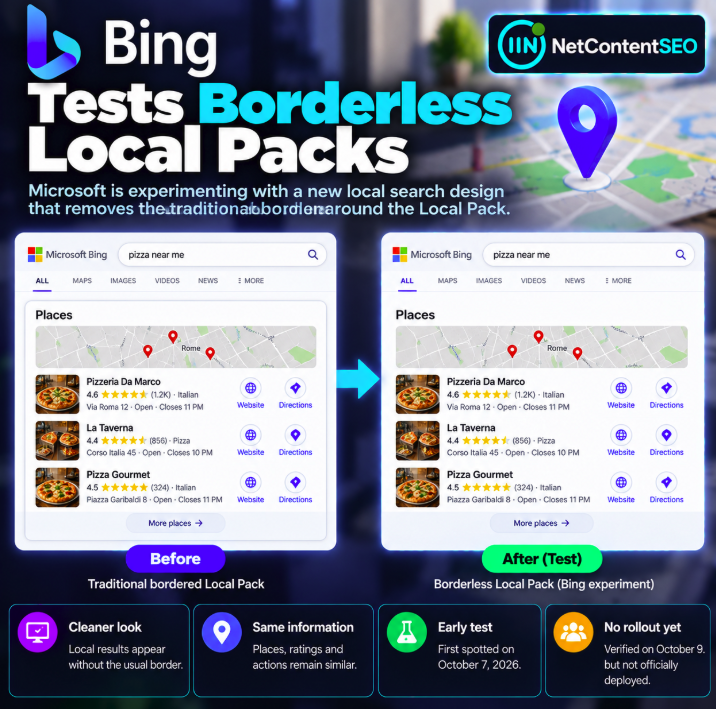

Microsoft Bing is testing a version of its Local Pack without the usual surrounding border. The visual change was first spotted by SEO observer Khushal Bherwani on October 7, 2026, and independently reproduced by Barry Schwartz, who published a report on October 9.
The observation establishes that the alternative layout exists in testing. It does not establish a general rollout, a change to local business ranking or a different set of eligibility rules for local listings.
Source: Search Engine Roundtable — Bing Local Pack Without Borders.
What is Bing testing?
Bing's Local Pack is a search results feature that presents nearby or relevant businesses for location-oriented queries. It commonly groups local listings and supporting map information within a recognizable visual module.
In the newly observed experiment, the usual enclosing border is absent. That can make the local results module appear more integrated with the surrounding search page, even when the underlying purpose of the feature remains the same.
Because this is an interface experiment, the safest description is a change in presentation. The available evidence does not demonstrate a change in which businesses qualify for the pack or how they are ordered.
How the borderless design differs from the conventional Local Pack
| Element | Conventional presentation | Observed experiment |
|---|---|---|
| Module outline | Local results are visually enclosed by a border | The familiar outer border is removed |
| Relationship to surrounding results | Local Pack appears as a distinct boxed unit | Local Pack appears less visually separated |
| Business ranking | Determined by Bing's local search systems | No ranking-system change established |
| Rollout | Established presentation in relevant contexts | Limited observed test; general availability unannounced |
Who first reported the test?
Khushal Bherwani shared the initial observation on October 7. Barry Schwartz later reproduced the borderless presentation and documented it in Search Engine Roundtable on October 9. That second observation makes the experiment more credible than a single isolated screenshot, while still falling short of evidence for a widespread rollout.
Why a small visual change matters to Local SEO
Search results pages are interfaces as well as ranking systems. Borders, spacing and grouping can affect how clearly a result module stands out from organic listings, ads and other search features.
Removing a container border could influence visual attention, but the available reporting provides no measured click-through rate, engagement or conversion effect. Any claim that the design increases or decreases traffic to local businesses would be speculative without testing.
Does a borderless Local Pack change local rankings?
No ranking change has been established. The reported difference concerns the visual treatment of the module. There is no official announcement in the cited report that Bing changed how it ranks local businesses, handles reviews or determines proximity and relevance.
Local SEO teams should avoid conflating a different-looking results page with an algorithm update. The two can occur independently.
Does the test affect Bing Places?
The observed interface change does not establish new requirements for Bing Places business profiles. Businesses should continue keeping their information accurate and consistent, but there is no evidence that the borderless design requires profile owners to change their listings.
How to monitor the experiment
- Record the query. Save the precise local search phrase used during the test.
- Record location and device. Local result layouts can vary by geography and platform.
- Capture the interface. Take screenshots showing the Local Pack and surrounding results.
- Repeat over time. A layout seen once may belong to a limited experiment.
- Track ranking separately. Do not assume a changed border indicates a changed business order.
- Avoid traffic claims without data. Look for measurable evidence before attributing performance changes to the new design.
What is still unknown?
Microsoft has not announced a general rollout in the supplied reporting. The scope of the test, the share of users who see it, the exact conditions that trigger it and whether the layout will become permanent remain unknown.
There is also no verified evidence in the report of a change to the number of businesses displayed, the ranking criteria, the click behavior or the availability of business actions.
What this means for multi-search-engine visibility tracking
For teams tracking local visibility across Google, Bing and other search engines, this experiment is a reminder that SERP appearance can change without an underlying ranking update. Monitoring systems that depend on visual containers or CSS selectors may need to tolerate layout variation.
That is a technical implication for measurement tools, not proof that a particular scraper or rank tracker has broken. Analysts should validate their own collection methods against observed layouts.
FAQ
Is Bing removing borders from all Local Packs?
No general rollout has been announced. The borderless presentation has been observed as a test.
When was the experiment spotted?
Khushal Bherwani reported it on October 7, 2026, and Barry Schwartz documented an independent reproduction on October 9.
Does the design change Bing local rankings?
No ranking change has been confirmed.
Will the new design increase clicks for local businesses?
There is no published measurement in the cited report establishing an increase or decrease in clicks.
Should businesses change their Bing Places profiles?
No special profile changes are established by this visual experiment.
NetContentSEO analysis
Bing's borderless Local Pack is a verified interface experiment, not a confirmed local search algorithm update. The practical takeaway for Local SEO professionals is to document SERP presentation changes carefully while keeping ranking, traffic and business-profile signals separate. If Microsoft expands the experiment, its effect on visibility and user behavior will need to be measured rather than assumed.
Source: Search Engine Roundtable, October 9, 2026.