

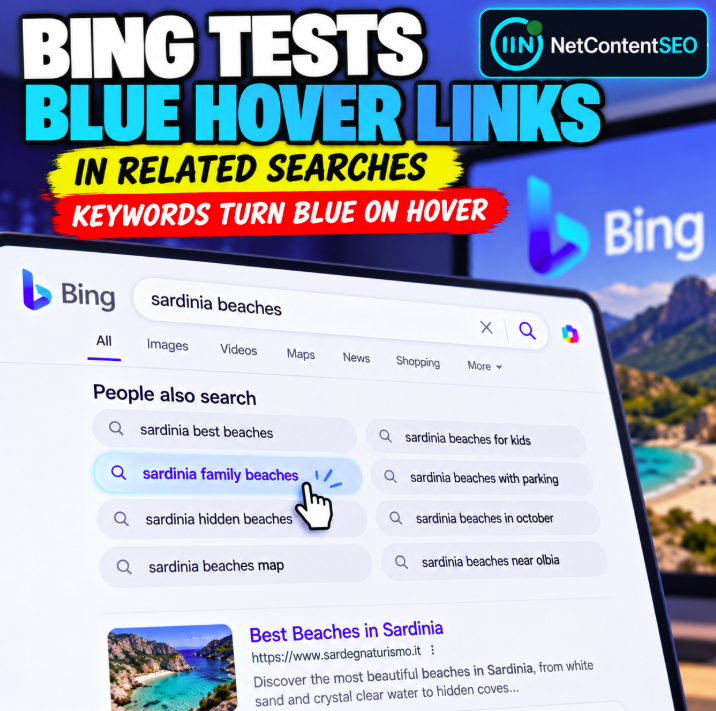

Bing may be testing a small visual change to its related-search interface: keywords in the “People also search” section turn blue when users hover over them. The behaviour was reported on October 6, 2026, by Search Engine Watch. It appears to make the interactive nature of those terms more obvious, but the observation is a UI test—not confirmation of a general rollout.
What the Bing hover test shows
According to the report, terms in Bing's “People also search” area change to blue on hover. The visual response resembles a conventional link affordance: it signals that a term can be selected to launch another search.
The reported observation is limited to the interface behaviour seen in the test. It does not establish how widely the change is being tested, whether it is available to all users, or whether Bing plans to release it broadly.
Why a small hover change can matter
Related-search features help users refine or redirect a query without having to compose a new search from scratch. A clearer hover state may make clickable terms easier to recognise, particularly for users who otherwise might read the section as informational text rather than navigation.
That is a plausible usability rationale, not a measured outcome. The report does not provide evidence that the test increases clicks, changes query behaviour or affects search rankings.
What is confirmed—and what is not
- Reported observation: “People also search” keywords turn blue on hover in a Bing UI test.
- Source and date: Search Engine Watch reported the test on October 6, 2026.
- Not confirmed: a general rollout to all Bing users.
- Not established: any measurable change in click-through rate, query refinement, rankings or traffic.
Keeping these distinctions explicit matters. A test captured in a search interface is useful product intelligence, but it should not be described as a confirmed product launch unless Bing or another authoritative source confirms that status.
Potential implications for SEO and search behaviour
If a clearer hover state helps users recognise related queries as clickable, it could make query refinement more discoverable. Users might explore adjacent intents or start a new search directly from the suggestions. However, this remains a hypothesis until supported by broader observation or data.
For SEO teams, the practical response is to watch for repeat sightings and assess the feature in context. Do not infer ranking changes from a colour shift alone, and do not treat the test as evidence that Bing has changed how it ranks pages.
What search professionals should monitor
- Repeatability: check whether the hover effect appears across multiple sessions and devices.
- Scope: record browser, region, account state and the specific result page where the behaviour appears, where known.
- Interaction: verify that selecting a related-search term actually launches a new query.
- Official confirmation: look for a statement or documentation from Bing before describing the test as a rollout.
- Performance data: use actual analytics or research data before making claims about engagement or traffic impact.
Frequently asked questions
What is Bing testing in “People also search”?
The reported test changes related-search keywords to blue when users hover over them, making their interactive behaviour more visible.
Has Bing confirmed a full rollout?
No general rollout is confirmed by the cited report. The observation should be treated as a UI test.
Does the blue hover effect change rankings?
There is no evidence in the report that it changes rankings. It is a visual interaction detail, and any ranking impact would require separate evidence.
Could the change influence query refinement?
It could make related searches easier to recognise as interactive, but the report does not measure whether users click them more often or change their search behaviour.
What should SEO teams do now?
Record repeat sightings, verify the interaction and wait for stronger evidence before making claims about rollout or performance effects.
The takeaway
Bing is reportedly testing a blue hover effect for keywords in “People also search,” but a broad rollout has not been confirmed. The change may improve the discoverability of related-search links; its effect on user behaviour remains unknown. For now, treat it as a limited UI observation—not an algorithm update or a confirmed ranking change.
Source
Search Engine Watch — Bing People Also Search Hover Test (October 6, 2026).