

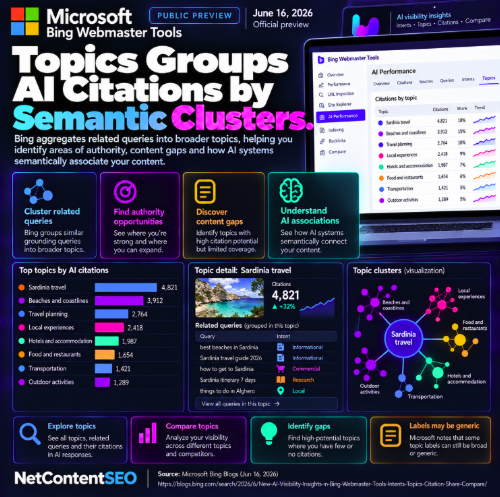

Microsoft is adding a semantic layer to AI visibility reporting. The Topics feature inside Bing Webmaster Tools' AI Performance preview groups related grounding queries into broader themes, showing publishers how their content is associated with topics rather than only individual keywords or prompts.
The feature was introduced in Microsoft's June 16, 2026 expansion of AI Performance alongside Intents, Citation Share and Compare.
Related grounding queries become broader topics
Instead of forcing publishers to analyze every grounding query independently, Bing clusters related queries into broader topics. This creates a higher-level view of the subjects for which Microsoft's AI systems retrieve and cite a site.
A collection of queries about beaches, itineraries, transport and accommodation, for example, can reveal distinct semantic areas inside a broader travel footprint.
Topics can reveal where a site has AI authority
When citations repeatedly concentrate around a topic, publishers gain a clearer indication of the areas in which their content is being selected by Microsoft's AI experiences.
This does not mean Microsoft is exposing an internal “authority score.” Rather, the reporting shows observed citation concentration around semantic themes, which publishers can use to identify areas where their content is already performing strongly.
Semantic gaps become easier to identify
The inverse is equally useful. A site may have substantial citation visibility in one cluster while appearing rarely in an adjacent topic.
That creates a practical GEO content-gap workflow: compare related topics, identify areas with limited citation coverage and investigate whether the site lacks relevant pages, sufficient depth or clear semantic connections.
Topics show how AI retrieval associates content
Traditional keyword reporting is largely query-centric. Topic clustering provides a different perspective by revealing the broader concepts that emerge from groups of grounding queries associated with citations.
For GEO teams, that can help answer a strategically important question: what does the AI retrieval ecosystem appear to associate this publisher with?
Microsoft warns that some labels may still be generic
Because Topics remains part of a preview product, Microsoft cautions that some generated topic labels may be broad or generic. Publishers should therefore use the clusters as an analytical aid rather than treating every label as a definitive description of Microsoft's internal knowledge representation.
The underlying query and citation data remain important context when interpreting each cluster.
Topics complements Intents
The combination of Topics and Intents creates a richer view than either dimension alone. Topics describes what subject area is associated with the citation, while Intents helps explain why the underlying grounding query was made.
Combined with source URLs, citation trends and grounding queries, Bing is gradually exposing several dimensions of the retrieval process that were previously opaque to publishers.
The NetContentSEO view
This is another important step away from keyword-only GEO measurement. AI systems retrieve information through semantic relationships, and Bing is beginning to expose those relationships in first-party publisher reporting.
The practical opportunity is not to chase a topic label as if it were a ranking factor. It is to use citation clusters to understand where a site's content is repeatedly useful to AI systems, where coverage is thin and how neighboring content areas connect.
Together, grounding queries, Intents and Topics are starting to make AI citation analysis look less like a raw mention tracker and more like a genuine search-performance dataset built for generative retrieval.