

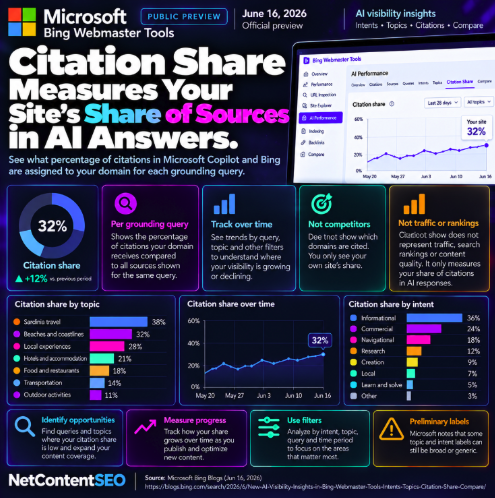

Microsoft has introduced Citation Share inside Bing Webmaster Tools' AI Performance preview, giving publishers a first-party percentage metric for measuring their presence among the sources cited in Microsoft's AI answers.
For each grounding query, Citation Share represents the percentage of citations assigned to the publisher's domain compared with all citations shown for that same query.
From citation counts to share of AI sources
A raw citation count tells a publisher how often its content appears. Citation Share adds competitive context by measuring how much of the available citation space the site receives for a grounding query.
If an AI response repeatedly cites multiple sources, the metric can show whether a publisher receives a relatively small or large portion of those citations across the measured responses.
Citation Share is calculated at grounding-query level
The grounding query is important because Microsoft is not presenting Citation Share as a universal domain score. The percentage is tied to the citations associated with the same grounding query and can then be analyzed through the broader AI Performance reporting environment.
This gives GEO teams a way to identify queries where their site already captures substantial source visibility and queries where citation presence remains limited.
It does not reveal the competing domains
Microsoft explicitly limits what the metric exposes. Citation Share tells publishers their percentage of citations, but it does not identify which competing domains received the remaining citations.
The metric therefore provides relative visibility without turning the report into a complete list of every competing source selected by Microsoft's AI systems.
It is not traffic, rankings or a quality score
Citation Share should not be interpreted as organic traffic, ranking position, click-through rate or a judgment of content quality.
A higher percentage means the domain received a larger share of measured citations for the relevant grounding query. It does not automatically mean the site ranked higher in conventional Bing Search, received more visits or produced objectively better content.
A practical GEO progress metric
The metric becomes particularly useful over time. Publishers can monitor Citation Share after expanding or updating content and observe whether their presence within relevant AI answers changes.
Combined with Topics and Intents, the same reporting environment can help identify which semantic areas and user needs correspond with stronger or weaker citation presence.
The NetContentSEO view
Citation Share is significant because it moves first-party GEO reporting from absolute counts toward share-of-visibility measurement inside generated answers.
Traditional SEO has long used metrics such as impression share, visibility indexes and ranking distributions to add context to raw impressions. Citation Share begins creating an analogous layer for AI retrieval — but based specifically on source citations.
The limitation is equally important: publishers see their share, not the identities of all other cited domains. That makes the metric valuable for tracking a site's own progress, but insufficient by itself for reconstructing the entire competitive citation landscape.
Together with grounding queries, Topics and Intents, Citation Share makes Bing Webmaster Tools increasingly resemble a first-party performance console built specifically for generative search visibility.