

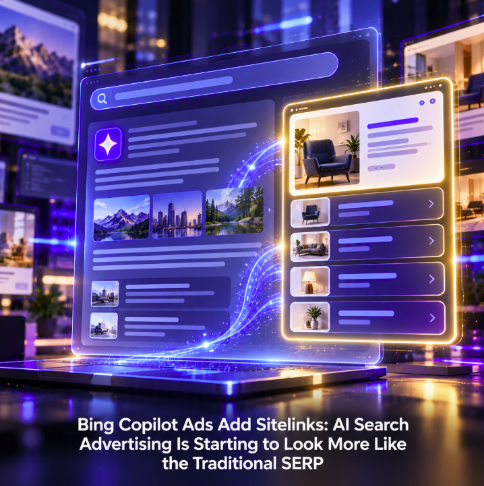

Bing’s AI search experience is beginning to inherit one of the most familiar expansion mechanisms from conventional paid search. Ads appearing inside Copilot results have now been spotted with sitelinks, giving a sponsored placement multiple additional destinations instead of relying on a single headline link.
The change was documented on September 28 by Search Engine Watch, which published a screenshot of the format and described sitelinks appearing on ads within Copilot results. Microsoft has not announced the feature, so the observation should be treated as a live test or limited rollout rather than a confirmed global Microsoft Advertising launch.
Even with that caveat, the format is strategically revealing. As AI search creates a new kind of results page built around synthesized answers, citations and follow-up exploration, its advertising layer is starting to borrow the visual and navigational vocabulary that advertisers already know from the traditional SERP.
The observed ad adds multiple destinations inside Copilot
Search Engine Watch reports that Bing is now showing sitelinks with ads appearing in Copilot results. The additional links give users more information and more possible destinations directly from the sponsored unit.
That sounds like a small interface change, but sitelinks have historically done more than add links to a search ad. They expand the footprint of the placement, expose additional commercial intents and let an advertiser route different users toward more specific pages.
Inside an AI-generated search environment, those properties become especially important because the ad is competing not only with conventional links but with a synthesized answer designed to satisfy much of the query without a click.
This is an observation, not a Microsoft product announcement
There is currently an important evidence boundary around the feature. The September 28 report documents the sitelinks visually, but Microsoft has not published an announcement confirming a general rollout, advertiser eligibility rules, controls, reporting changes or geographic availability.
That means advertisers should not assume every Copilot Search campaign can already activate sitelinks or that the format will remain unchanged. Bing frequently tests search interfaces before deciding whether to expand, modify or retire them.
The safest interpretation is therefore that Microsoft is experimenting with a richer sponsored format inside its AI-search results.
Copilot Search is already a hybrid answer-and-search interface
Microsoft describes Copilot Search in Bing as an AI-powered search and answer experience that reads, compiles and reasons over information available on the web, cross-checks sites and produces a summarized response with cited sources and suggestions for further exploration.
That architecture is fundamentally different from a classic ten-blue-links page. The generated answer occupies the central informational role, while links and sources support exploration around it.
Advertising inside that environment therefore has a design problem: a standard compact text ad can look relatively weak beside a rich generated response. Sitelinks offer one familiar way to make the commercial unit more navigable and visually substantial without turning it into a completely different advertising product.
Sitelinks increase the number of commercial paths from one impression
A single destination forces an advertiser to choose one landing page for the query. A sitelink-enabled unit can expose several paths: a product category, pricing page, service line, location, offer or other destination can sit beneath the main sponsored message.
That creates a closer match between the multi-intent nature of an AI answer and the structure of the advertisement beside it. A user asking a broad question may still be deciding whether they need product information, pricing, comparison material or a specific service. Multiple links let the ad acknowledge that ambiguity.
The format also increases the amount of interface space devoted to the advertiser. Search Engine Watch specifically notes the potential for added detail and visibility compared with a standard ad.
AI search advertising is rediscovering SERP extensions
The broader pattern is becoming clearer. Generative search changed the organic information layer first, but the commercial layer does not need to abandon everything traditional search advertising learned over two decades.
Sitelinks are a good example. Their usefulness does not depend on the page being a classic SERP. They solve a more general advertising problem: one ad can represent a business with multiple relevant destinations, and additional links can reduce the distance between the user’s intent and the appropriate landing page.
As AI answer interfaces mature, other familiar search-ad principles can travel with them even when the surrounding organic experience looks radically different.
Microsoft is simultaneously experimenting with the identity of the AI search surface
The sitelink observation arrives while Microsoft is also testing “AI Mode” branding for the same Bing experience. Search Engine Watch reported on September 27 that an AI MODE tab has been appearing in Bing and that clicking it leads to bing.com/copilotsearch, the same destination Microsoft uses for Copilot Search. Edge is separately testing an AI Mode entry point.
Microsoft has not announced that Copilot Search is being renamed. Its official Bing page still calls the consumer product “Copilot Search in Bing” and describes it as an AI-powered search and answer engine.
This means the advertising experiment is happening while the surrounding consumer interface itself remains fluid. The product name, entry point and ad presentation can all be tested independently.
Ads are becoming a visible part of the AI Mode-style experience
Another September 28 observation reinforces that commercial results are being integrated deeply into the experience. Search Engine Watch documented Bing Copilot displaying ads even before a user completed a CAPTCHA verification step. The publication cautioned that this could be a display quirk or simply the order in which Bing loads advertising and verification components.
The incident does not establish anything about ad ranking or eligibility, but it does show sponsored results loading as a native component of the current Copilot/AI Mode-style results environment.
Combined with sitelinks, the direction is toward an AI answer surface with an increasingly developed advertising layer rather than a separate experimental chat product with occasional ads attached.
The advertiser implication is more landing-page specialization
If sitelinks become a standard part of Copilot advertising, advertisers will need to think beyond whether they can appear in an AI answer environment. The next question becomes which destinations deserve to appear within the same sponsored unit.
That favors landing-page architectures that map cleanly to distinct user intents. A generic homepage is less useful when the interface can offer several direct paths. Pricing, product families, use cases, comparisons and other high-value destinations become candidates for the limited real estate attached to the ad.
It also raises a measurement question Microsoft has not yet answered publicly for this observed format: whether Copilot sitelinks will inherit familiar Microsoft Advertising asset reporting or receive AI-search-specific reporting and controls.
The organic and paid sides of AI search are evolving differently
Copilot Search’s organic experience is designed around synthesis. Microsoft says the system reads and reasons over web information, provides cited sources and encourages deeper exploration.
The observed paid experience, by contrast, is acquiring more explicit navigational choices. The AI answer compresses information; the expanded ad creates additional outbound paths.
That difference matters for marketers. Organic AI visibility depends on whether a source or brand becomes part of the evidence and synthesis process. Paid visibility can increasingly be engineered as a structured commercial unit with multiple destinations and a larger interface footprint.
The traditional SERP is not disappearing—it is being decomposed and rebuilt
Generative search is often described as a replacement for the traditional results page, but Bing’s current experimentation suggests a more complicated transition. The old SERP is being broken into components and recombined around a generated answer.
The ranked list of organic links becomes citations, source panels and exploration paths. The search box becomes a conversational prompt. Follow-up queries become part of a continuous research session. Yet proven advertising mechanics such as sitelinks can survive because they remain useful inside the new interface.
That is why the Bing observation matters even before Microsoft confirms a rollout. It is evidence that AI search advertising may not evolve as an entirely new medium. Some of its most valuable formats could be adaptations of search-ad components advertisers already understand.
For now, treat sitelinks in Copilot as a format to monitor, not a guaranteed capability
There is not yet enough public information to build a definitive implementation checklist. Microsoft has not documented whether advertisers opt into these sitelinks, whether existing sitelink assets are being reused automatically, which markets receive them or how frequently the format appears.
What can be said is narrower and more useful: on September 28, sitelinks were observed on sponsored ads inside Bing’s Copilot results, and the resulting unit provides more information, more destinations and more visual presence than a basic sponsored link.
If Microsoft expands the format, AI-search advertising will have taken another step toward a recognizable search-ad ecosystem. The generated answer may be new, but the competition for attention around it is beginning to look increasingly familiar.