

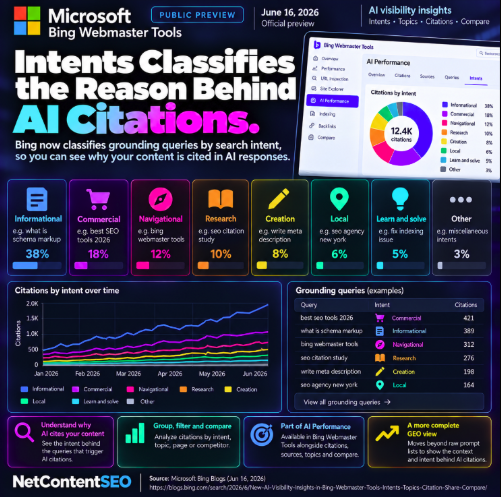

Microsoft is adding an intent layer to AI citation reporting. In the June 16, 2026 expansion of Bing Webmaster Tools' AI Performance preview, grounding queries can be grouped by the underlying intent they represent, helping publishers understand why their content is being retrieved and cited in AI responses.
The update moves first-party GEO reporting beyond lists of prompts and citations toward a more structured view of user needs.
Grounding queries now carry intent
AI Performance already exposed grounding queries associated with citations. The Intents view adds classification so publishers can analyze those queries according to what the user appears to be trying to accomplish.
Microsoft lists categories including Informational, Commercial, Navigational, Research, Creation, Local, Learn and Solve, alongside additional intent groupings.
Why intent matters more than a raw prompt list
A list of prompts can show the language associated with AI retrieval, but it does not automatically explain the purpose behind those requests. Intent classification adds that missing layer.
A publisher may discover, for example, that its pages are disproportionately cited when users are researching a topic, solving a problem or evaluating commercial options. Those patterns can be more actionable than citation volume alone.
AI citations can now be analyzed by user need
Connecting citations with intent gives SEO and GEO teams a way to ask a different question: not simply “which prompts cite us?” but “for which kinds of user needs does Microsoft AI choose our content?”
That distinction can help publishers understand where their content has authority or utility within AI retrieval workflows and where competitors may be receiving greater citation exposure.
Intents joins Topics, Citation Share and Compare
The June update is broader than intent classification. Microsoft introduced additional AI visibility insights including Topics, Citation Share and Compare, expanding the AI Performance preview into a more complete competitive and thematic reporting environment.
Together, these features connect citations with the subject matter, user intent and competitive context surrounding AI retrieval.
A new layer for content strategy
Traditional SEO has long used search intent to decide what kind of page should answer a query. Microsoft's new reporting begins applying a similar framework after retrieval: publishers can inspect which intents are actually associated with their citations in AI-generated experiences.
That can create a feedback loop between content strategy and observed AI visibility. If a site is frequently cited for research but rarely for commercial queries, for example, the gap becomes measurable rather than anecdotal.
The NetContentSEO view
This is an important evolution of first-party GEO analytics. AI visibility is becoming multidimensional: citation count, source URL, grounding query, topic, intent and competitive share can increasingly be analyzed together.
That is much closer to the diagnostic depth publishers expect from conventional search analytics. Instead of treating every AI citation as equivalent, Bing is beginning to expose the context that caused content to become useful to an AI system.
The feature remains in preview, so classifications and reporting may evolve. But the direction is significant: GEO measurement is moving from counting mentions toward understanding the retrieval intent behind them.