

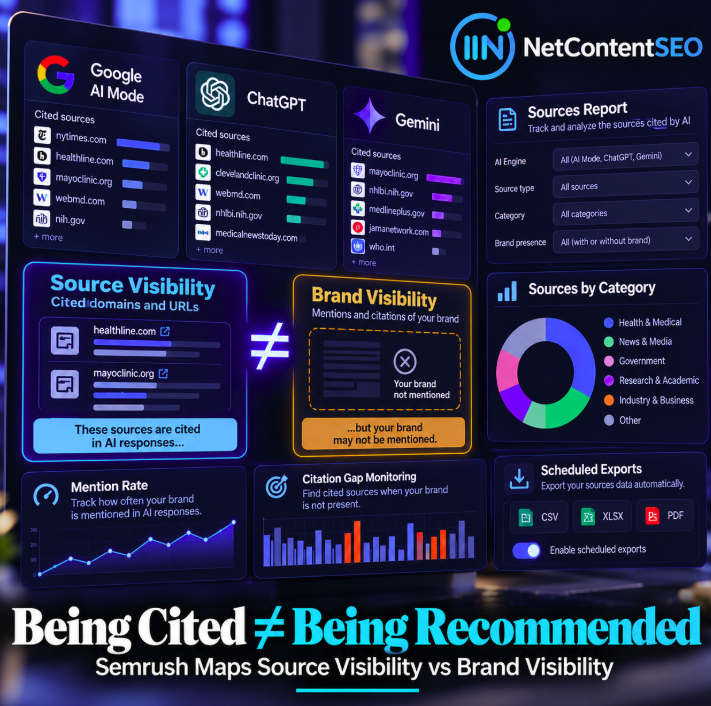
A website can be repeatedly cited by an AI system without the associated brand ever being recommended. And a brand can appear in an AI answer even when its own website is not cited.
That distinction is the foundation of a new Semrush guide published on October 7, 2026 explaining how to use the Sources report inside Prompt Tracking.
The workflow separates two metrics that are often incorrectly treated as interchangeable in AI visibility reporting: source visibility and brand visibility.
A citation and a brand mention measure different things
Semrush defines a citation as a link to a page used as a source in an AI-generated answer.
A brand mention means the brand name actually appears in the generated response.
The two can overlap, but they do not have to.
Your page can provide information that an AI system cites while the answer recommends a competitor. Conversely, your brand can be named in an answer whose supporting citations point to third-party publishers.
That is why counting citations alone can produce a misleading picture of commercial AI visibility.
Semrush's Sources report maps the pages behind AI answers
The Sources report is part of Semrush Prompt Tracking.
Users define a set of prompts relevant to their market and monitor the AI answers generated for those prompts.
The Sources tab then surfaces the domains and individual URLs cited across those answers, allowing teams to see which websites are influencing the AI responses that matter to their customers.
The report starts with three core measurements
At the top of the Sources report, Semrush shows the number of tracked prompts, the number of source pages found across the answers and the number of associated answers in which the monitored brand appears.
That creates an immediate comparison between the size of the citation ecosystem and the brand's presence inside it.
If dozens of source pages repeatedly shape answers while the brand appears only occasionally, the problem is not simply “we need more citations.” It is a broader visibility gap.
You can compare Google AI Mode, ChatGPT and Gemini
Semrush documents the same basic workflow across Google AI Mode, ChatGPT and Gemini.
Teams can track comparable prompt sets and switch between AI platforms to inspect the sources each system uses.
The differences can be substantial.
In Semrush's example campaign, ecommerce and retail sources account for 76% of sources in AI Mode but 38% in ChatGPT, while knowledge bases account for 6% in AI Mode and 33% in ChatGPT.
That is a useful warning against assuming one universal AI citation strategy.
Source categories reveal what each AI system trusts for a prompt set
The Sources by Category view groups cited pages into types.
Semrush's filters include categories such as the user's own domain, competitors, social platforms, knowledge bases and other domains.
This can reveal whether an AI platform is primarily grounding a topic in retailers, publishers, documentation, social platforms or specialist knowledge sources.
For GEO teams, that category mix can inform both content strategy and outreach.
Pages and domains answer different questions
The report can be analyzed at URL level or domain level.
The Pages view identifies the individual URLs most frequently cited across tracked prompts.
The Domains view provides a broader competitive picture, showing which sites repeatedly contribute sources across the prompt set.
Users can expand a domain to inspect the actual pages responsible for its citation footprint.
Mention Rate connects citations with brand presence
One of the most useful metrics is Mention Rate.
For a cited page, Semrush calculates how often the monitored brand appears in the associated AI answers.
Importantly, Mention Rate refers to the generated answers — not whether the brand is literally present on the source page.
A third-party page could already discuss your company while the AI system still fails to mention it in the answer.
The citation gap is where the workflow becomes actionable
Semrush recommends looking for sources with a high number of citations across relevant prompts but a low Mention Rate for the brand.
Those pages are already influencing AI answers, but the monitored brand is failing to benefit from that influence.
That is a citation gap.
The next step may be outreach to the cited publisher, improving an existing page, creating a stronger first-party alternative or ensuring the brand is accurately represented in the sources AI systems already rely on.
This changes AI outreach prioritization
Traditional digital PR and link building often prioritize sites using authority metrics, relevance and backlink potential.
AI citation tracking introduces another prioritization signal: is this page actually being retrieved and cited for the prompts our customers ask?
A niche page repeatedly cited across ten commercial prompts can potentially be more strategically interesting for AI visibility than a much larger publisher that never appears in the relevant answer set.
This does not replace traditional authority assessment. It adds observed AI retrieval behaviour to the decision.
Semrush includes a “Get mentions” workflow
For cited pages worth investigating, Semrush provides a Get mentions panel.
It shows the prompts for which a page was cited, whether the monitored brand appeared in the associated answers and recommendations for improving visibility.
In Semrush's example, one URL is cited across ten tracked prompts while the monitored brand appears in only one associated answer, producing a 10% Mention Rate.
That turns an abstract AI visibility problem into a concrete page-level research target.
Daily monitoring matters because citations are unstable
Prompt Tracking collects daily snapshots.
Semrush explicitly warns that earning a citation or mention on one day does not guarantee continued presence in future answers.
AI responses can change as models, retrieval systems, source indexes and web content change.
For serious monitoring, a one-time manual prompt test is therefore insufficient.
Reports can be exported and scheduled
Semrush says Sources data can be exported to Excel, CSV or Google Sheets.
Reports can also be scheduled on a daily, weekly or monthly basis.
This makes citation monitoring easier to integrate into recurring SEO, PR and AI visibility workflows rather than treating it as an occasional research exercise.
Source visibility is not recommendation visibility
This is the larger strategic lesson.
A publisher might celebrate because its domain appears in ten citations. But if the generated answers consistently recommend competitors, those citations are not producing the same commercial outcome as ten brand mentions.
Likewise, a brand may have strong recommendation visibility while relying heavily on third-party sources rather than its own domain.
Those situations require different strategies.
Four AI visibility states
The citation/mention distinction creates four useful diagnostic states.
Cited + mentioned: the brand and a supporting source both appear.
Cited + not mentioned: the source influences the answer but the brand is absent.
Not cited + mentioned: the brand appears, but the supporting citations come from elsewhere.
Not cited + not mentioned: neither the brand nor its source presence is visible.
Tracking movement between these states can be much more informative than reporting a single “AI visibility score.”
Do citations prove causal influence?
Care is still required when interpreting the data.
A visible citation tells us that the AI interface surfaced a page as a source for that answer. It does not expose every internal model signal, every retrieved document or the precise causal weight assigned to that source.
Similarly, improving a cited page does not guarantee that the AI platform will mention a specific brand on the next run.
Prompt Tracking measures observable outputs. It does not reverse-engineer the model.
NetContentSEO take
AI visibility needs two dashboards: what sources the machine uses and what brands the user actually sees.
Semrush's Sources workflow formalizes that distinction across AI Mode, ChatGPT and Gemini and makes citation gaps measurable at both page and domain level.
For GEO and AI visibility teams, the opportunity is particularly valuable when a third-party page is repeatedly cited for important prompts while the brand remains absent.
That is no longer just a backlink prospect. It is an observed source shaping AI answers.
Being cited is useful. Being recommended is useful. But in AI search, they are not the same KPI.