

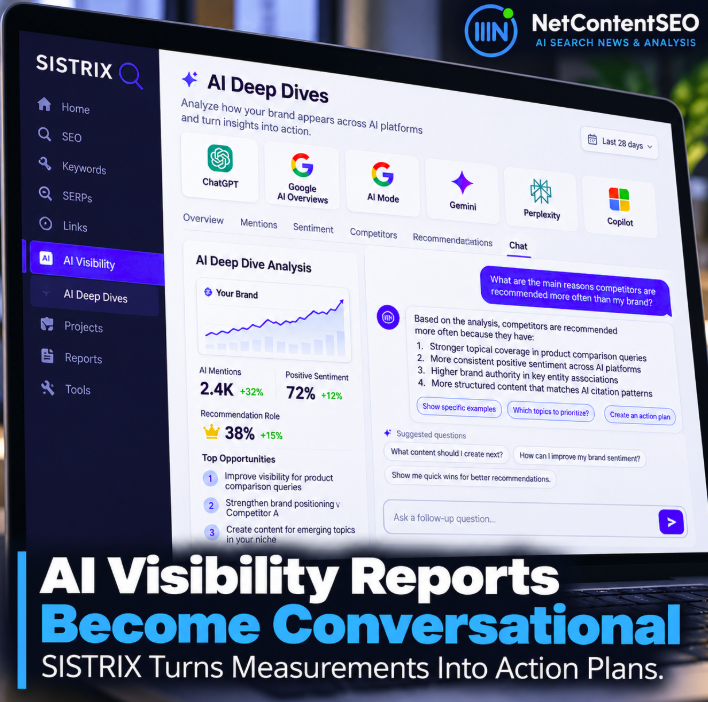

SISTRIX is making AI visibility analysis conversational. Completed AI Deep Dives now include a contextual chat that allows users to ask follow-up questions about the analysis, request priorities and turn the findings into specific next steps.
The update was announced in SISTRIX's official Q3 2026 changelog published on October 5. According to SISTRIX, every completed Deep Dive now includes its own chat, while the system also suggests useful follow-up questions automatically. SISTRIX Q3 2026 changelog
The report no longer ends when the analysis is generated
Traditional analytics workflows usually separate measurement from interpretation. A platform produces charts and metrics; the user then has to determine what matters, investigate the underlying data and translate those observations into actions.
Contextual chat changes that workflow. Because the conversation sits directly alongside the completed analysis, the user can continue interrogating the same dataset rather than starting a separate research process.
Users can ask what to do next
SISTRIX says the new dialogue can be used to ask follow-up questions about the results and identify which actions should be prioritized.
That means a Deep Dive showing weak visibility around a topic does not have to stop at reporting the gap. A user can ask which areas should be addressed first, which competitors are performing better or which findings deserve immediate attention.
The interface also proposes additional questions, reducing the need for users to know exactly how to interrogate the report.
Context is the important part
A generic AI chatbot can explain SEO concepts, but it does not automatically know the analysis a team has just completed. SISTRIX's approach is more useful because the dialogue is tied to the context of the specific Deep Dive.
That creates a bridge between analytics and decision support: the conversation begins with the measured findings rather than with an empty prompt box.
AI visibility tools are moving from dashboards to advisors
The development reflects a wider change in SEO software. Dashboards traditionally compete on how much data they collect and how clearly they visualize it. AI interfaces add another layer: helping users decide what the data means and what they should do next.
For AI visibility in particular, this can be valuable because the datasets are multidimensional. Teams may be comparing mentions, citations, sentiment, competitors, recommendation roles, prompts and differences between several generative platforms.
A conversational layer can make those relationships easier to explore without requiring dozens of manually configured filters.
It follows SISTRIX's expansion of AI Check
The conversational Deep Dive update arrives alongside broader AI visibility improvements from SISTRIX. AI Check now includes brand sentiment, competitive perception and recommendation mapping, and its coverage spans ChatGPT, Google AI Overviews, Google AI Mode, Gemini, Perplexity and Microsoft Copilot.
Those new measurements increase the amount of interpretation required. Knowing that a brand has negative sentiment or is usually positioned as an alternative is useful; understanding why that happens and what to prioritize next is the natural follow-up problem.
From measurement to an action plan
The most interesting use case is not simply asking the report to summarize itself. Teams can use contextual follow-ups to turn broad observations into narrower operational questions.
For example: Which topics produce the weakest recommendation rate? Which competitor is consistently preferred? Are negative brand descriptions concentrated around one product attribute? Which prompts should be investigated first? Which content gap appears repeatedly across the analysis?
Those questions move AI visibility monitoring closer to an optimization workflow.
Suggested questions reduce the blank-prompt problem
Generative interfaces often suffer from a usability issue: users are given an empty text field but may not know what the system can answer.
SISTRIX addresses that by suggesting further questions after an analysis. This is a small interface decision with practical consequences because it teaches users how to continue exploring the data.
The underlying evidence still matters
Conversational interpretation should not replace inspection of the source data. SISTRIX's AI visibility tooling retains access to original prompts, statements and citations, allowing users to move from aggregate findings back to the evidence behind them.
That audit trail becomes even more important when an AI layer is recommending actions. Teams should be able to verify why a recommendation was made rather than accepting a generated action plan without context.
The NetContentSEO takeaway
The AI-search analytics market is moving through a clear progression: first count mentions and citations, then measure perception and recommendations, and finally help users decide what to change.
SISTRIX's contextual chat for AI Deep Dives represents that third step.
AI visibility reports are becoming interactive decision systems. The competitive advantage will increasingly come not from producing another dashboard, but from connecting observable AI-search evidence to the next action a brand should take.