
For decades, public-relations teams have treated media prestige as a hierarchy. A national newspaper or global financial title sits at the top, while a specialist trade publication is often placed in a lower tier even when its readers are closer to the company’s actual customers.
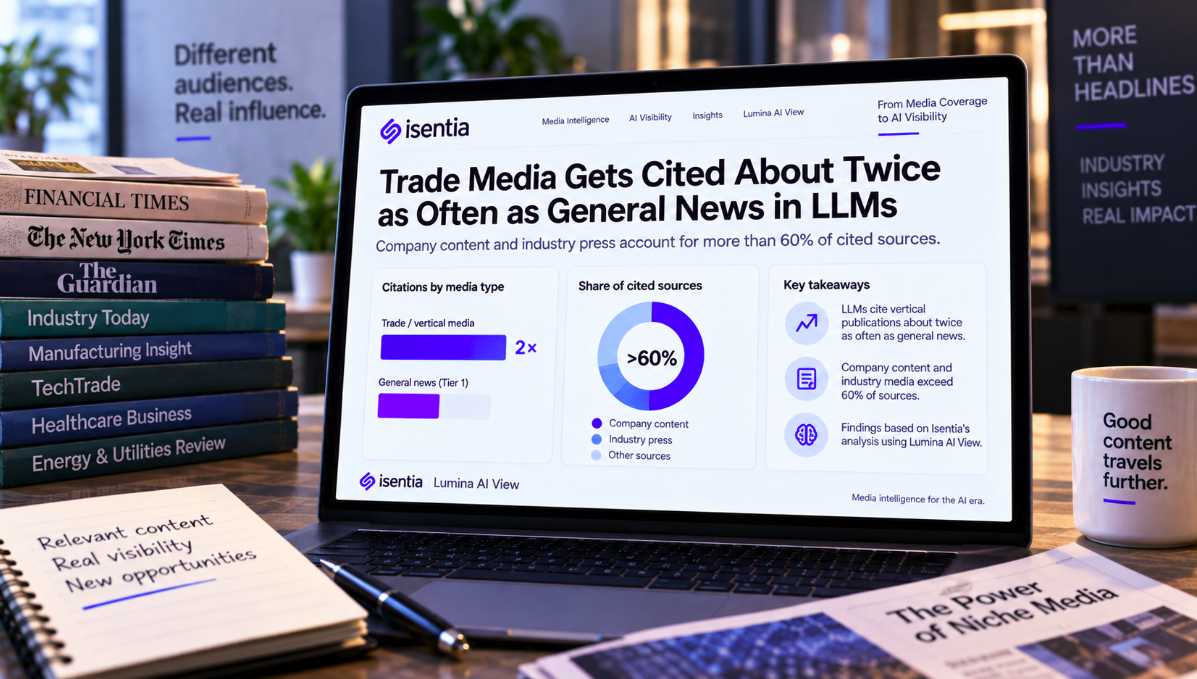
Generative AI may be disrupting that hierarchy. In an analysis published September 9, media-intelligence company Isentia says large language models cite industry and trade publications roughly twice as often as traditional news sources. The company also says corporate content and industry press together account for more than 60% of the source share in the research it cites.
The findings are commercially relevant to Isentia: the company sells Lumina AI View, a product designed to measure how organizations appear in AI answers and which sources those systems cite. The public article also does not disclose enough of the underlying report methodology to independently reproduce the headline percentages. The numbers are therefore best treated as vendor-reported directional evidence rather than universal citation rates for ChatGPT, Gemini, Claude or other models.
Even with those limitations, the analysis raises a useful question for communications teams. If AI systems select sources according to accessibility and relevance rather than an internal PR tier list, a niche publication that once looked secondary may become unusually important in AI-mediated discovery.
The traditional media hierarchy was built for human attention
Tiering has always been a communications shorthand rather than a technical standard. Agencies and in-house teams classify publications according to factors such as reach, prestige, audience, editorial influence and strategic importance, but there is no universal definition separating Tier 1 from Tier 2.
That system makes intuitive sense when the objective is human exposure. A front-page story in a globally recognized publication can influence investors, executives, policymakers and millions of readers in ways a smaller vertical title cannot easily reproduce.
LLMs introduce a different intermediary. The model does not necessarily need the publication with the largest audience; it needs information capable of supporting an answer to the user’s particular question. That can change the relative value of specialist material.
Isentia says trade publications receive about twice the citation share
Isentia’s central claim is that LLMs cite industry and trade publications approximately twice as often as traditional news sources in the research behind its September analysis. It further says company content and industry press account for more than 60% of the source share considered.
Those figures challenge the assumption that the biggest general-news brands must automatically dominate AI answers. A specialist publication may have less total audience reach while containing more directly relevant material about a narrow industry, technology, regulation or product category.
However, the public September article does not provide the full underlying prompt set, citation count, model distribution, sector mix, geographic coverage or statistical uncertainty behind the headline figures. Without those details, it would be a mistake to conclude that trade media will receive exactly twice as many citations for every brand or industry.
The stronger conclusion is that Isentia observed a substantial trade-media presence in its own LLM analysis and believes conventional media tiers do not map cleanly onto AI citation behavior.
Accessibility may matter alongside prestige
Isentia points to paywalls as one possible reason for the difference. A highly authoritative article can be valuable to human subscribers while remaining difficult for a retrieval system to access in full. A specialist publication with open, crawlable pages may expose more of the concrete information needed to build an answer.
This does not establish a universal rule that LLMs prefer free websites. Models differ in training data, licensing relationships, web-search infrastructure and retrieval methods, while access can change over time. A paywalled publisher may also have licensing or technical arrangements that make some content available to particular AI providers.
Still, accessibility creates an obvious practical constraint. Information that a system cannot retrieve during a web search cannot serve the same real-time evidentiary role as information it can access directly.
Specificity can make trade reporting unusually useful
The second explanation offered by Isentia is specificity. Trade publications often cover a narrower subject in greater operational detail than general-news organizations because that is what their specialist audiences expect.
An industrial publication might report a product specification, regulatory requirement or supply-chain development that receives only a sentence in a national newspaper. A healthcare trade title may preserve terminology and context that would be simplified for a general audience.
For an AI system answering a narrow question, those details can make the specialist article a useful citation candidate. The model is solving an information problem, not awarding a journalism prestige prize.
Isentia points to research from Vuelio on UK supermarkets as a similar example, saying trade publications such as The Grocer and Grocery Gazette appeared prominently among cited sources. That offers contextual support for the hypothesis, although it does not establish the same pattern across every sector.
Tier 1 coverage has not suddenly become irrelevant
None of this means companies should stop pursuing major media coverage. Isentia itself acknowledges the continuing influence of Tier 1 exposure, particularly for senior executives and reputation.
A prominent national or international story can create awareness far beyond the audience of a specialist publication. It can influence subsequent reporting, attract links and commentary, shape investor perceptions and become part of the broader information environment from which AI systems operate.
The more defensible strategic change is to stop treating Tier 2 as automatically inferior for every objective. Human prestige and AI retrievability are different dimensions of media value.
The most important distinction may be cited versus consulted
Isentia’s article also highlights a measurement problem that extends beyond media tiers: the sources visible in an AI answer are not necessarily all the sources that influenced it.
An AI system can retrieve or process many documents while displaying citations to only a small subset. Some information may also derive from model training rather than live retrieval. The user sees the final answer and its visible references, not a complete provenance map of every signal involved.
This means citation monitoring measures something important but incomplete. A publication that is rarely shown as a citation may still contribute to the information ecosystem surrounding a topic, while a highly visible citation can become disproportionately important because users can actually see the source attribution.
PR teams should therefore avoid treating citation counts as a perfect measure of causal influence.
AI search changes the job of media-list prioritization
Traditional media lists are often built around historical relationships and institutional assumptions. The same outlets remain in the highest tier because they have always been considered the highest tier.
AI visibility creates a reason to add behavioral evidence to that process. Communications teams can ask which publications repeatedly appear when models answer questions that matter to the organization, its customers and its competitors.
A niche publication that repeatedly supplies citations for important category questions may deserve more attention even if its conventional traffic is modest. Conversely, a prestigious outlet may remain essential for reputation while contributing relatively little to a particular set of AI answers.
The result is not necessarily a replacement tier list. It can be a second map showing how media influence changes when an LLM sits between the source and the audience.
Owned content remains part of the source mix
The reported figure that company content and industry press together exceed 60% is also significant because it prevents the story from becoming purely about earned media.
Organizations still control their own websites, documentation, newsroom pages, reports, product information and executive material. Those assets can provide primary evidence that third-party publications then contextualize or validate.
For AI visibility, consistency between owned and earned information may be particularly important. If the company website states one thing while multiple third-party sources contain another version, an AI system must reconcile conflicting evidence.
Isentia argues that communications teams should coordinate owned, earned, shared and paid media more closely because models encounter information across organizational silos that humans often manage separately.
Accessible does not mean low quality
There is a risk of misreading the trade-media finding as a recommendation to pursue any easily crawlable website. That would miss the point.
Accessibility only helps if the content is relevant and credible enough to support the answer. A technically crawlable page containing vague, derivative or inaccurate information is not automatically a strong source.
The more useful target is accessible expertise: pages that combine specialist knowledge, clear facts, identifiable authorship or sourcing and enough context to be independently useful.
For communications teams, that can make a respected niche analyst, regional publication or trade journalist strategically valuable even when conventional reach metrics make the outlet appear small.
Isentia has a commercial reason to promote this measurement model
The research should also be read in the context of Isentia’s product strategy. The company introduced Lumina AI View in June 2026 specifically for PR and communications teams seeking to monitor their representation in AI systems.
According to Isentia’s current product description, AI View tracks which sources models such as ChatGPT, Gemini, Claude and Perplexity cite when discussing an organization. It also compares citation footprints with competitors, monitors changes over time and applies proprietary scoring to AI visibility.
The September Tier 1 versus Tier 2 analysis naturally supports the business case for that product: if traditional media metrics no longer reveal which publications matter to AI systems, communications teams have a reason to buy a new layer of monitoring.
That commercial alignment does not invalidate the findings, but it makes methodological transparency particularly important. Independent replication would strengthen the broader claim.
Negative sentiment adds another complication
Isentia also reports that traditional news was twice as likely to generate negative sentiment in the research it references. That finding should be interpreted cautiously because the public article does not expose enough methodology to determine how sentiment was classified or how sector and story selection affected the result.
It nevertheless illustrates why citation volume alone is an incomplete reputation metric. A brand can be highly visible because AI systems repeatedly cite critical reporting, regulatory disputes or a past crisis.
For communications teams, the objective is not simply to maximize the number of citations. It is to understand which narratives those sources support and whether the resulting AI answers represent the organization accurately.
PR is becoming part of AI information architecture
The larger strategic shift is that earned media can now have two audiences.
The first is the familiar human audience: readers, customers, journalists, investors, employees and policymakers. The second is the retrieval layer used by AI systems to construct answers for those people later.
Those audiences value overlapping but not identical characteristics. Humans can respond to reputation, storytelling and editorial prestige. Retrieval systems need accessible information that matches the question and can be extracted with enough context to support an answer.
A strong communications strategy increasingly has to satisfy both.
The old Tier 1 versus Tier 2 distinction is becoming too simple
Isentia’s research does not prove that specialist publications have replaced major news organizations as the dominant source of AI knowledge. The disclosed methodology is too limited for such a broad conclusion, and citation behavior varies across models, prompts, sectors and time.
What it does provide is another reason to question a media hierarchy based almost entirely on prestige and audience size.
For AI search, a smaller publication can have advantages that traditional tiering underweights: subject specificity, open access, current information and direct relevance to a narrow question. Major outlets retain substantial human influence and can still become important AI sources, but their brand prestige alone does not guarantee citation prominence.
That changes the practical question for PR teams. Instead of asking only, “How prestigious is this publication?”, they may increasingly need to ask, “Is this where authoritative, accessible information about our category actually lives?”
If Isentia’s directional findings hold across broader independent research, the future media list will not simply rank publications from Tier 1 downward. It will map different forms of influence — including which sources AI systems can find, understand and confidently put in front of the next audience.