

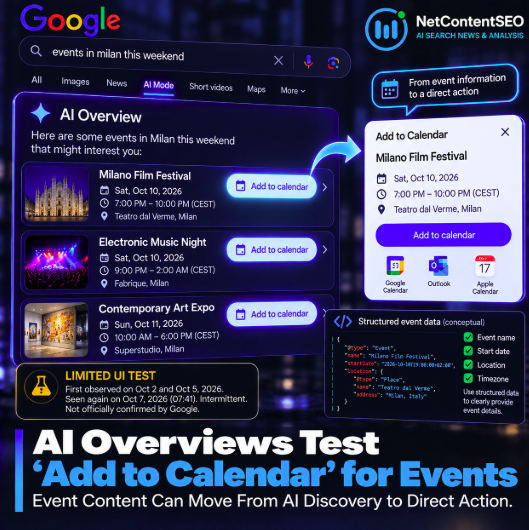

Google is testing an “Add to calendar” action on event dates shown inside AI Overviews and AI Mode, potentially turning event information from a search result into a direct user action.
The interface has been observed several times since October 2, including additional sightings on October 5 and October 7. The behavior remains intermittent: in at least one documented example, the calendar option disappeared after the search result was refreshed.
Google has not announced the feature as a broad rollout, so it should currently be treated as a limited UI test, not as a guaranteed AI Overview or AI Mode capability.
AI search is beginning to act on event information
The important part of the test is not the calendar itself. Google has supported event discovery and calendar-related actions elsewhere in Search before.
What changes here is the placement: an actionable event date is appearing directly inside an AI-generated search experience.
If this interaction expands, a user researching concerts, conferences, festivals, sports or local activities could move from an AI answer to a saved calendar event without following the conventional sequence of opening a result, visiting an event page and manually copying the details.
Event information needs to be machine-actionable
This creates a practical SEO and GEO implication.
When a search system only summarizes an event, slightly ambiguous information may still be understandable to a human reader. When the system is expected to create an action from that information, precision becomes more important.
An event needs a clear name, date, start time, location and — where a time is supplied — an unambiguous timezone.
Google's existing event documentation already emphasizes these fields. Its Search Console guidance says a valid event should include a name, date and location, while its event guidance recommends supplying the start date and time in the local timezone.
Structured data becomes operational, not merely decorative
Event structured data has traditionally been discussed as a way to help Google understand event pages and potentially make them eligible for richer search presentations.
Agentic interfaces increase the potential value of that machine-readable information.
If Google can confidently identify an event's title, date, time and venue, those facts can potentially support actions rather than only presentation.
This does not mean Google has confirmed that Event schema is the direct trigger for the experimental Add to calendar button. No such causal relationship has been announced.
But Google's existing documentation makes clear that structured event information helps its systems understand event details, making clean markup and consistent visible information a sensible foundation for any future action-oriented experience.
Timezone accuracy becomes a conversion issue
Timezone data deserves particular attention.
A wrong timezone in a conventional snippet can confuse a user. A wrong timezone in an action that creates a calendar event can produce a much more concrete failure: the event may be saved at the wrong time.
Google Calendar itself converts events between timezones, and Google's documentation recommends providing the correct timezone when a time is specified.
For international events, livestreams and conferences serving travelers, timezone consistency between visible page content and structured data should therefore be treated as operational data quality.
Event pages should avoid conflicting dates
Pages about events often contain many dates: publication dates, ticket-sale deadlines, early-bird deadlines, event dates, schedule dates and update timestamps.
Google has long recommended making dates consistent and using appropriate structured data so its systems can understand what each date represents.
If AI interfaces increasingly transform dates into actions, ambiguity between those date types becomes more costly.
The event's actual start and end information should be prominent, consistent and clearly separated from editorial or promotional dates.
Location becomes part of the action layer
Google's event guidance also treats location as a core event attribute.
That means publishers should provide a specific venue and address where appropriate rather than relying on vague geographic language buried inside prose.
A calendar action becomes more useful when it can carry not only the correct time but also a destination that the user's calendar, Maps or another downstream application can understand.
This could change how event SEO conversions are measured
If users can save an event directly from an AI Overview, some successful event discovery journeys may generate no traditional organic click.
That creates another zero-click measurement problem.
An event publisher could gain awareness, attendance intent or a saved calendar entry from Google while seeing little or no corresponding referral session in analytics.
For event businesses, success metrics may therefore need to extend beyond organic traffic toward ticket purchases, branded search, calendar actions where measurable, venue interactions and other downstream signals.
Do not optimize for the button yet
The feature is still too limited and unstable to justify building an SEO strategy around it.
There is no official Google announcement, no confirmed eligibility documentation and no evidence that adding a particular markup property guarantees the action.
The right response is therefore not to chase the experimental UI. It is to make event information as accurate, structured and internally consistent as possible.
The NetContentSEO takeaway
The Add to calendar test is another sign that AI Search can evolve from an answer layer into an action layer.
For event publishers, that makes data quality more consequential. Event name, date, time, timezone and location are not simply fields that help Google display a result — they are the raw material an AI system may eventually use to perform an action for the user.
The test is not a confirmed rollout, and Event structured data has not been confirmed as its trigger.
But the direction is worth watching: when AI discovery can become a calendar action in one step, machine-readable event information becomes part of conversion optimization.