

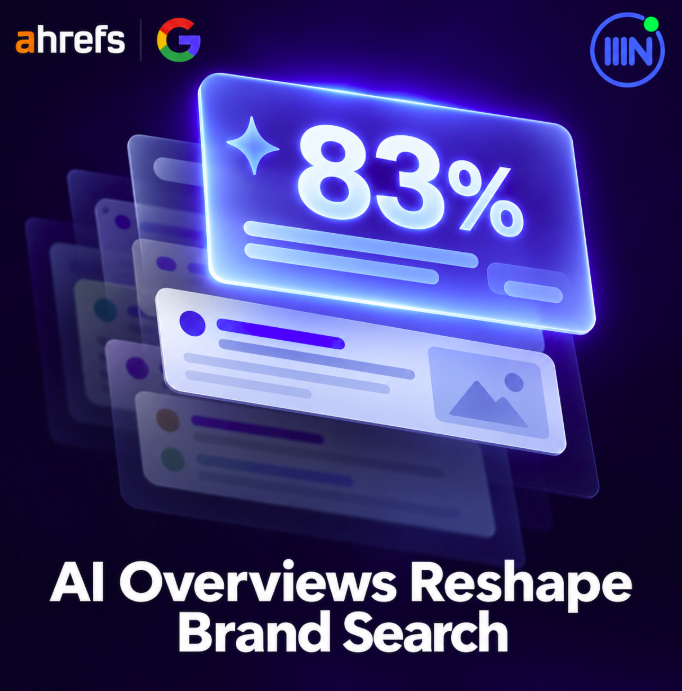

AI Overviews appeared in 82.91% of the branded US desktop search results measured by Ahrefs on September 29, 2026. The study published October 2 analysed 232.8 million Google SERP crawls between July and September, including 92.5 million branded-keyword crawls. Those are observations, not a count of unique searches or people.
A separate panel examined exact-name queries for 100 brands at 14 weekly checkpoints. At the September 30 checkpoint, 63 queries displayed an AI Overview; 48 of those answers occupied position one, producing the reported 76.2%. Wikipedia, YouTube and LinkedIn were the most common external citation domains in that panel.
The figures describe a proprietary Ahrefs study of US desktop results, not an official Google rollout announcement or a universal rate across countries and devices. They nevertheless give brands a concrete reason to inspect the answer appearing around their own name.
The two samples answer different questions
The broad sample measures branded-keyword results, which can include more than a bare company name. The smaller panel focuses on exact brand-name queries. The position statistic should therefore not be presented as meaning that 76.2% of all branded searches place an AI answer first.
For an internal report, preserve the query definition and denominator alongside every percentage. A comparison becomes difficult to interpret if one monitoring run includes product and support queries while another includes only brand names. Changes to the query set can look like changes to visibility.
Our recommendation is to maintain a stable panel for your own brand and label additional exploratory queries separately. Record country, language, device and observation time. That makes the next measurement easier to compare without assuming that one snapshot represents every user.
Monitor the narrative as well as the official link
A brand audit should examine what the answer says, which pages it cites and where the official website appears. These observations serve different purposes. A prominent official result does not by itself establish that the surrounding AI description is accurate, while a citation does not necessarily imply endorsement.
Consider a hypothetical software brand whose answer cites an older video discussing a retired product tier. The useful finding would be the outdated statement and its supporting URL, rather than simply the number of citations. An analyst could then check whether the official documentation clearly describes the current offer and whether the cited material has an appropriate correction channel.
Separate factual discrepancies from opinions. A wrong launch date, obsolete price or confused corporate identity can be checked against evidence. An independent review’s assessment may reflect legitimate editorial judgment. Treating both as errors would weaken the audit.
Turn observations into an evidence-led workflow
Start with a modest set of exact-name and important branded queries. Save the answer text, visible source links and result placement for each observation. Classify findings by factual accuracy, recency, entity confusion and missing context. Assign each issue to the team able to investigate it.
For owned pages, make the relevant facts easy for readers to establish: clearly scoped product information, dates where they matter, and a consistent explanation of the organisation. For external sources, pursue transparent factual corrections where justified. No process can guarantee that Google will select a particular source or adopt a requested narrative.
Measure visits and business outcomes independently. The frequency and placement of an AI Overview do not quantify the traffic effect on your site. Compare relevant performance data over time and account for other changes before attributing a decline to the answer module.
The study’s practical contribution is a measurable question for brand teams: what does the search result now tell someone who already knows our name? Answering that question requires a record of the claims and sources users see, alongside the familiar monitoring of rankings and clicks.