
Manufacturing search is already saturated with AI-generated answers, but that does not mean factories, industrial suppliers and B2B brands are suddenly receiving meaningful volumes of traffic from AI assistants.
New Semrush research puts numbers on that disconnect.
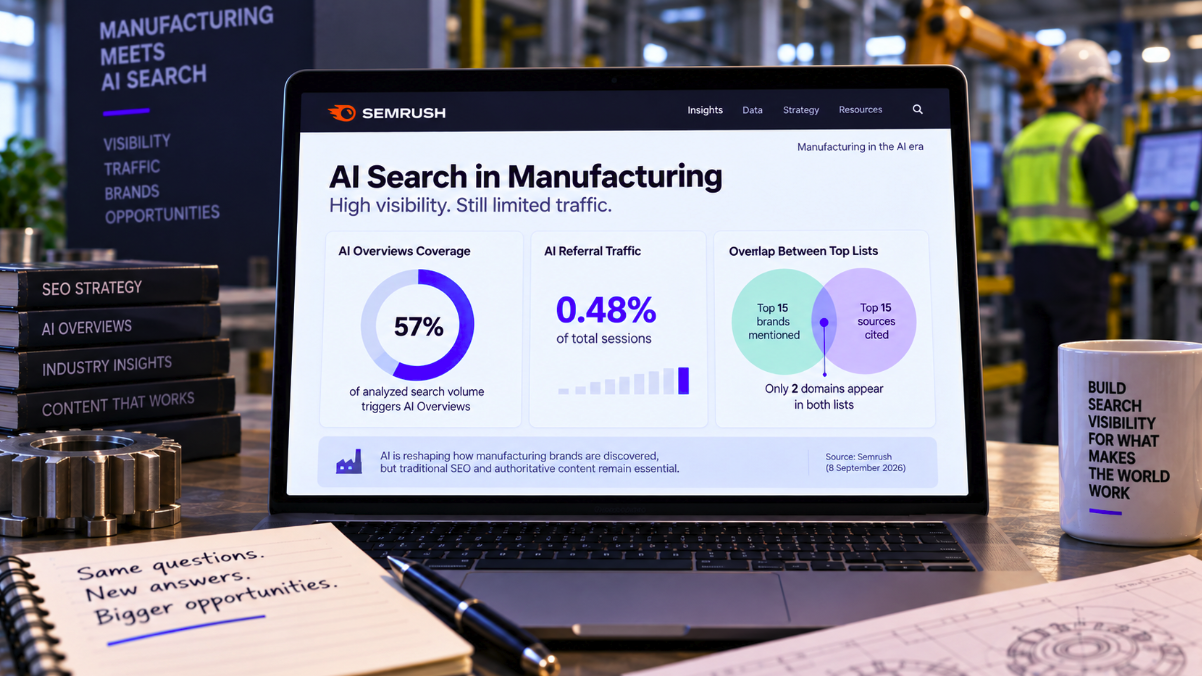
Across a tracked set of manufacturing and industrial queries, Google AI Overviews appeared across 57% of search volume in July 2026, up from 38% in January. Yet across Semrush’s separate clickstream dataset, AI Mode and AI assistants combined accounted for only 0.48% of sessions to manufacturing sites.
The study, published September 8, also found that the brands most frequently named by AI systems were largely different from the websites those systems used as sources. Only two domains appeared in both the top 15 most-mentioned brands and top 15 most-cited sources.
Together, the findings illustrate why “AI visibility” is becoming difficult to express as one metric. An AI Overview can occupy the search results without generating a referral. A brand can be mentioned without being cited. A site can be heavily cited without receiving proportionate traffic.
The 57% figure is weighted by search volume, not a count of all manufacturing queries
The headline AI Overview number needs precise framing.
Semrush did not measure every manufacturing search performed on Google. It built a controlled keyword set from major sites in the sector.
The researchers started with the top 20 manufacturing domains in Semrush’s Trending Websites ranking, collected the top 1,000 keywords from each and retained queries where at least two of those domains held a top ranking. That process produced 458 manufacturing and industrial keywords.
Semrush then collected historical monthly SERP snapshots from January through July 2026 and measured AI Overview presence using search volume as the weighting factor.
On that basis, AI Overviews expanded from 38% of the tracked search volume in January to 57% in July — an increase of 19 percentage points.
So the correct conclusion is that AI Overviews covered 57% of search volume represented by Semrush’s monitored 458-keyword manufacturing set. It is not evidence that exactly 57% of every manufacturing query worldwide produces an AI Overview.
AI Overviews are moving beyond basic informational questions
Semrush also observed AI Overviews on queries that are not obviously top-of-funnel educational searches.
Examples gaining AI Overviews during the measured period included product-oriented terms such as “pneumatic cylinder” and specific part-like queries, as well as searches for established manufacturing brands such as National Instruments.
That matters for industrial marketers because product and brand queries sit closer to commercial evaluation than broad questions such as “what is a transformer.”
AI-generated search experiences are therefore not confined to informational content at the edge of the buyer journey. They can appear where engineers, procurement teams and buyers are researching actual suppliers and products.
But appearing on those SERPs and sending measurable traffic are two different things.
AI referrals accounted for only 0.48% of manufacturing sessions
For traffic, Semrush used a separate dataset.
The company analyzed U.S. clickstream sessions from January through July across ten industrial categories, including chemicals, machinery, equipment and supplies, manufacturing, renewable energy, transportation and logistics, warehousing and related sectors.
Direct and organic search together still accounted for nearly 80% of sessions.
AI Mode and AI assistants combined represented just under half of one percent: 0.48%.
The contrast with 57% AI Overview coverage is striking, but the percentages measure fundamentally different things.
The 57% figure describes how much tracked Google search volume encountered an AI Overview. The 0.48% figure describes sessions attributed to AI-driven referral channels across the manufacturing-site traffic dataset.
One cannot be subtracted from the other to calculate an AI “click-through rate.”
AI influence can exist without an AI referral
The low referral share also does not prove AI has only a 0.48% influence on industrial purchasing.
A buyer can ask an AI assistant for suitable suppliers, close the conversation and later type a company name into Google. Another can navigate directly to the manufacturer’s website. A procurement professional can copy a brand name into an internal document and return days later from a different device.
None of those journeys necessarily preserves an AI referral in conventional analytics.
Semrush describes this measurement gap through the idea of a “dark SEO funnel,” where AI can inform discovery even when the eventual visit arrives through direct or branded search.
That interpretation is plausible, but marketers should avoid using unmeasured influence as permission to attribute every increase in direct traffic to AI.
Direct traffic and branded search can move for many reasons. AI influence needs stronger evidence wherever possible.
The most-mentioned brands are not the most-cited sources
The study’s second major finding comes from Semrush’s AI Visibility database.
For the U.S. manufacturing and industrial vertical, the researchers examined ChatGPT, Gemini, Google AI Mode and AI Overviews from January through July. Each month they pulled the top 25 domains by mentions and the top 25 by citations, then aggregated the results.
Semrush defines a mention as a brand name appearing in an AI answer. A citation is a link the AI system provides as a source.
The two leaderboards barely matched.
Only Vevor and Grainger appeared in both the top 15 most-mentioned brands and the top 15 most-cited sources.
That distinction is fundamental to AI search measurement.
Legacy brands dominate mentions
The most-mentioned names included familiar industrial companies such as 3M, John Deere and Boeing.
Semrush notes that many of these businesses existed long before generative AI and operate across broad portfolios of products and industries.
Their presence in AI answers is therefore not surprising.
A model answering questions about agriculture, machinery, aerospace, industrial materials or equipment can have many opportunities to mention established brands whose names are already strongly associated with those categories.
But being known well enough to enter an answer does not mean the company’s website will be selected as evidence for that answer.
The citation leaderboard contains a much more diverse group of sites
The most-cited sources looked different.
Semrush’s top list included reference site Engineer Fix, retailer and manufacturer Vevor, Thermo Fisher, Sigma-Aldrich, Made-in-China, RS Online, The Blue Book, Grainger, Thomasnet, Procore, the Royal Society of Chemistry, Pro Tool Reviews, GlobalSpec, Carrier and EnergySage.
That is not a list of the 15 most famous manufacturing brands.
It includes distributors, marketplaces, directories, professional organizations, editorial sites, software companies and manufacturers.
The diversity suggests that citation visibility can reward a different role in the information ecosystem from brand visibility.
A company may be famous enough to be recommended while another site provides the explanatory page an AI system chooses to cite.
Brand authority and citation authority may not be the same thing
Semrush compared the two groups using its proprietary Authority Score, which combines signals involving backlinks, organic traffic and spam indicators.
The most-mentioned brands showed more consistently strong Authority Scores than the most-cited sources.
The citation group was much more uneven.
Engineerfix.com, the most-cited source in the study, had an Authority Score of only 17, while Made-in-China scored 77 — higher than any of the top-mentioned brands in the comparison.
Semrush interprets this as evidence that conventional website authority may correlate more consistently with AI mentions than with citations.
That is an interesting directional observation, not proof of causation or a documented ranking mechanism. Authority Score is itself a Semrush metric, and AI providers do not disclose a rule saying they use it.
The practical lesson is narrower: high traditional authority was not a prerequisite for appearing among the most-cited domains in this dataset.
Engineer Fix shows how differently ChatGPT and Google can choose sources
The study’s most unusual example is engineerfix.com.
Semrush says the engineering reference site was cited disproportionately often by ChatGPT but did not appear among the leading cited sources on Google’s AI platforms, including Gemini, AI Mode and AI Overviews.
Its conventional Google footprint also looked modest in Semrush’s SEO database, with around 3,700 ranking keywords and little estimated Google traffic.
Yet Semrush Traffic Analytics estimated close to 300,000 monthly organic-search visits. Its Traffic Journey data attributed more than 68% of the site’s overall traffic to DuckDuckGo, Bing and Yahoo, while Google represented less than 2%.
That discrepancy is a reminder that Google rankings are not a complete proxy for the information environment available to every AI product.
Semrush discusses OpenAI’s partnerships and collection methods as possible context, but the study does not establish a specific causal mechanism explaining why ChatGPT cited Engineer Fix so heavily.
Winning ChatGPT citations does not guarantee winning Google AI citations
The Engineer Fix example reinforces a pattern increasingly visible across independent AI citation studies: platforms can disagree sharply about which sources deserve attribution.
A page that performs well as a ChatGPT source may have little presence in AI Overviews. A source preferred by Google’s systems may not be equally visible in another assistant.
That makes “AI rankings” a potentially misleading shorthand.
Manufacturers need to know which platform they are measuring, which prompts or queries are involved and whether the KPI is a mention, citation or visit.
Combining all of those into one score can hide important differences.
More citations did not reliably produce more AI traffic
The study also tested one of the most important assumptions in generative engine optimization: if a site earns more citations, does it receive more AI referral traffic?
Not consistently.
Engineer Fix dominated ChatGPT citations but received only a fraction of the AI-referred traffic seen by some domains lower on the citation list.
Grainger, by contrast, was one of the only two domains present in both the mention and citation leaderboards and also showed comparatively strong AI traffic. Made-in-China and the Royal Society of Chemistry were among the cited sources with more meaningful AI-referred traffic as well.
The differences make sense when the purpose of the destination page is considered.
A citation can answer the question without earning the click
Engineer Fix publishes detailed engineering guides and FAQ-style reference content.
If an AI system extracts the necessary explanation and cites the article, the user may have no reason to visit the page. The generated answer has already completed the informational task.
A Grainger product page or Made-in-China marketplace listing can create a different incentive.
If the user needs to inspect specifications, compare products, check availability or make a purchase, following the citation can move the task forward.
This means citation volume alone is not equivalent to referral potential.
The page behind the citation matters.
Manufacturing may be especially vulnerable to zero-click AI answers
Industrial search contains a large volume of factual questions that are relatively easy to summarize.
Definitions, specifications, tolerances, compatibility questions, process explanations and troubleshooting steps can often be answered in a compact response.
If an AI Overview or assistant provides a satisfactory answer and cites a source, the publisher can gain visibility without receiving the visit.
That creates a familiar zero-click problem in a new format.
For manufacturing marketers, content therefore needs to do more than be extractable. Where appropriate, it should also give qualified buyers a reason to continue to the site.
That could mean deeper technical documentation, configurable specifications, CAD files, product availability, calculators, compliance data, engineering support or a clear purchasing path.
Directories and distributors remain important in an AI-mediated buying journey
The citation leaderboard also shows why manufacturers should not think only about their own domains.
Thomasnet, GlobalSpec, The Blue Book, RS Online, Grainger and Made-in-China represent different forms of third-party discovery infrastructure.
If AI systems repeatedly retrieve those sources, accurate and competitive representation there can become part of AI visibility strategy.
This resembles traditional digital PR and marketplace optimization more than on-page SEO.
A manufacturer may not control the citation source, but it can still influence whether authoritative directories, distributors and industry publications contain accurate information about its products and brand.
AI discovery can therefore make off-site presence more strategically important rather than less.
The three Semrush datasets should not be merged into one funnel
The study is strongest when its methodological boundaries are preserved.
The AI Overview figure comes from 458 tracked keywords weighted by search volume. The 0.48% traffic figure comes from U.S. clickstream sessions across ten industrial categories. The mention and citation rankings come from Semrush’s separate AI Visibility database across four generative surfaces.
These datasets illuminate different stages of discovery, but they do not follow the same individual users from query to AI answer to website visit.
That means the study cannot say that a particular AI Overview caused a particular session, or that a particular citation generated a particular amount of revenue.
It is a high-level directional picture of a changing market.
Traditional search still supplies most measurable manufacturing traffic
The 0.48% number provides useful perspective at a moment when AI visibility can dominate marketing discussions.
For the manufacturing sites in Semrush’s clickstream analysis, direct and organic search still represented nearly four-fifths of sessions.
AI referrals are growing from a much smaller base.
That makes abandoning conventional SEO to pursue AI citations a difficult strategy to justify from this dataset.
In fact, many of the fundamentals that help industrial websites in traditional search — clear product information, topical expertise, technical accessibility, credible links and a recognizable brand — can also support the information ecosystem from which AI systems retrieve.
The channels are diverging, but the underlying asset is still the quality and authority of the information available about the business.
Manufacturers need three AI metrics, not one
The study suggests a useful reporting framework.
First, measure answer visibility: does the brand appear when buyers ask relevant questions?
Second, measure citation visibility: which domains and pages are being used as evidence, and is the manufacturer’s own site among them?
Third, measure attributable traffic and downstream outcomes: do AI platforms actually send qualified visitors, leads or transactions?
Those numbers should not be expected to move together.
A famous manufacturer can earn many mentions but few citations. A reference site can earn many citations but few visits. A distributor can receive fewer citations yet capture more commercially valuable clicks.
Each outcome reflects a different role in the buyer journey.
57% visibility and 0.48% traffic describe the new measurement problem
Semrush’s manufacturing study captures a paradox that is likely to become familiar across B2B search.
AI can be highly visible while remaining a tiny measurable referral channel.
Google AI Overviews already occupy a majority of the search volume in Semrush’s monitored manufacturing query set, yet direct AI traffic is still below half a percent of sessions in its industry clickstream data.
At the same time, the brands AI systems talk about and the sites they cite are largely different groups.
For industrial marketers, that means the old equation — rank higher, receive more clicks — is no longer enough to describe discovery.
Search visibility, AI mentions, citations and traffic are becoming separate layers.
The challenge is not choosing one metric to replace SEO. It is learning which layer matters for a particular business objective — and measuring each one without pretending they are the same thing.