

Ranking number one in Google no longer tells you how visible — or clickable — your result really is.
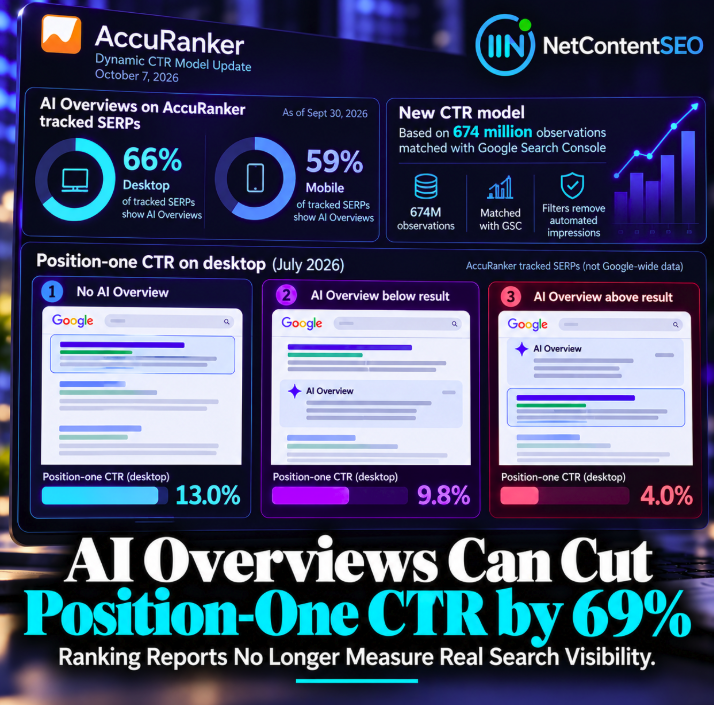
AccuRanker's new Dynamic CTR model, announced October 7, 2026, quantifies just how large that disconnect has become. In its July data, a desktop result at organic position one earned a 13.0% CTR when no AI Overview was present. When an AI Overview appeared below that result, CTR fell to 9.8%. When the AI Overview appeared above it, CTR collapsed to 4.0%.
That is roughly a 69% reduction in position-one CTR between the no-AIO case and the AIO-above case — without changing the organic rank itself.
AI Overviews now appear on most SERPs AccuRanker tracks
AccuRanker reports that on September 30, 2026, AI Overviews appeared on 66% of its tracked desktop SERPs and 59% of mobile SERPs.
In July, the corresponding figures were 48% and 38%.
The company says the largest expansion occurred during September, including a sharp increase across commercial and transactional searches.
These percentages describe AccuRanker's tracked SERP dataset, not a claim that exactly 66% of every Google desktop search worldwide contains an AI Overview.
The position of the AI Overview matters enormously
The study's most useful finding is not simply that AI Overviews reduce clicks.
It is that where the AI Overview appears can change the impact dramatically.
For desktop position one in July, AccuRanker's Google Search Console data showed:
- No AI Overview: 13.0% CTR
- AI Overview below position one: 9.8% CTR
- AI Overview above position one: 4.0% CTR
On mobile, the equivalent figures were 13.6%, 13.5% and 6.8%.
So an “AIO present” flag alone is not enough to model organic click opportunity accurately.
Position one can remain position one while losing most of its clicks
Traditional rank reporting treats organic position as the central visibility metric.
But rank only tells us where a result sits relative to other organic results. It does not tell us how much of the screen is occupied before the user reaches it.
A position-one result underneath a large AI Overview is still technically organic position one, yet its physical and visual position can be hundreds of pixels lower than the same rank on a simpler SERP.
That is why the same ranking can produce radically different CTR.
AccuRanker rebuilt its model around the entire SERP
The previous Dynamic CTR system used information about each result plus a summarized view of surrounding SERP features.
The new model stores the page in sequence, including pixel coordinates for organic results, ads, AI Overviews, featured snippets, local packs, People Also Ask and other elements.
AccuRanker says the model receives 104 signals for each tracked result.
Those include pixel position, the element immediately above the result, AI Overview placement and characteristics, other SERP features, sitelinks, title and URL information, keyword characteristics and rank.
The new training set contains 674 million matched observations
The model is trained using 674 million observations in which AccuRanker matched its tracked SERPs with Google Search Console data between January 15 and September 24, 2026.
This is particularly important because the dataset includes the rapid September expansion of AI Overviews.
AccuRanker trains separate desktop and mobile models because the click impact differs substantially by device.
AccuRanker filters impressions it believes are automated
The company also introduced a filter intended to remove Search Console impressions that cannot plausibly be explained by human search demand.
AccuRanker says automated clients can load Google results without behaving like normal searchers, disproportionately inflating impressions for low-volume queries.
The filter removed 26% of desktop data and 17% of mobile data from the training set.
That methodological detail matters because inflated impressions can artificially depress measured CTR, particularly on long-tail queries.
The new model predicts much lower CTR for many rankings
When AccuRanker's updated model becomes operational on October 21, its average estimated CTR for a tracked desktop keyword at rank one moves from 22.6% to 10.6%.
On mobile, the equivalent estimate changes from 18.2% to 11.2%.
For desktop positions 2–10, the average estimate falls from 4.0% to 1.4%.
These are model estimates across tracked keywords, not a claim that every individual rank-one result receives exactly 10.6% CTR.
Share of Voice will appear to fall by about half
Because AccuRanker's Share of Voice can use Dynamic CTR, the model change has a large downstream effect.
The company tested 3,414 tracked domains and says the median domain's Share of Voice falls by approximately 48% under the new model.
Half of domains fall between 32% and 64%.
The median reduction is larger on desktop at 62%, compared with 39% on mobile.
That October 21 drop is not a ranking loss
This is crucial for agencies and reporting teams.
AccuRanker explicitly says the October 21 model change does not change rankings or actual Google Search Console and analytics traffic.
It changes the estimated click opportunity assigned to those rankings.
Historical values before October 21 remain calculated with the previous model, so reports using Dynamic CTR will show a visible step on that date.
Teams should annotate the methodology change rather than telling clients that organic performance suddenly collapsed overnight.
Competitor order barely changes
Although absolute Share of Voice estimates decline sharply, AccuRanker says relative competitive ordering remains almost unchanged.
Its test produced a rank correlation of 0.98 between domains before and after the model update.
That suggests the revised metric is primarily recalibrating the expected amount of available click traffic rather than rewriting which domains are strongest within the tracked keyword set.
The old model underestimated the AIO impact
AccuRanker tested its previous and new models against July data that the models had not seen during training.
When an AI Overview appeared, the old model estimated that the top three desktop organic results would retain 68% of their normal clicks.
The observed value was only 44%.
The new model predicted 45%, much closer to the actual Search Console behavior.
Rank itself carries surprisingly little unique weight
AccuRanker says the rank number accounts for only about 2% of the model's signal weight.
That does not mean ranking is unimportant. Higher organic positions naturally correlate with higher physical placement, so multiple model inputs encode overlapping information.
But the result illustrates why “position 3” alone is an incomplete description of a modern SERP.
What sits above the result and where the result physically begins can carry far more information about likely clicks.
Pixel position and surrounding elements dominate
The largest group of model signals concerns where the result appears and what is immediately above it.
AccuRanker assigns roughly 43% of model weight to this group on desktop and 45% on mobile.
Keyword-level signals such as advertiser competition, CPC and search volume account for another 22% on desktop and 24% on mobile.
The result's own presentation, especially sitelinks, contributes another meaningful portion.
AI Overview citation status is part of the model too
The new system does not only detect whether an AI Overview exists.
It also records where the overview sits, how many pages it cites, how much text it contains and whether the tracked domain itself is cited.
That creates an interesting convergence between classic organic visibility and AI visibility.
A domain can simultaneously have an organic ranking and an AI Overview citation, and both can influence how the final SERP is experienced.
Ranking reports need a second visibility layer
Rank tracking is still useful. Moving from position eight to position two remains meaningful.
But a modern visibility report needs to describe the environment around that ranking.
At minimum, teams should monitor AI Overview presence and placement, pixel depth, major SERP features, device type and actual Search Console clicks.
Otherwise a report can show a stable number-one ranking while the real click opportunity has deteriorated dramatically.
Desktop and mobile should not be blended blindly
AccuRanker's data shows that AI Overviews can affect desktop and mobile results very differently.
In July, an AIO below position one barely changed the mobile CTR in the observed data: 13.6% without AIO versus 13.5% with the AIO below.
On desktop, the same broad configuration produced a much clearer decline from 13.0% to 9.8%.
A single cross-device CTR assumption can therefore hide meaningful differences.
NetContentSEO take
The headline is not simply that AI Overviews reduce CTR. It is that organic rank has become an increasingly incomplete proxy for real search visibility.
AccuRanker's 674-million-observation model demonstrates why: a number-one result can receive 13% CTR on one desktop SERP and 4% on another while retaining exactly the same organic rank.
For SEO reporting, the next baseline should combine rank with pixel visibility, SERP composition, AI Overview position, citations and observed click behavior.
Ranking reports are not obsolete. But a ranking without the page around it no longer tells the whole story.