
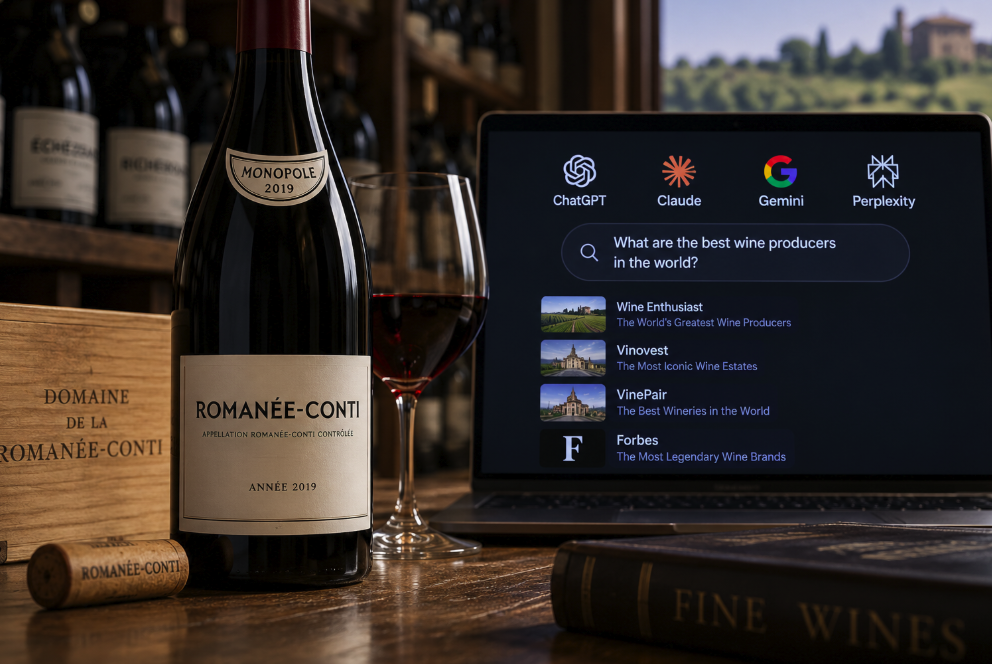
A brand can be one of the names artificial intelligence recommends most often and still be almost absent from the evidence those systems show users. That distinction is becoming increasingly important as ChatGPT, Claude, Gemini and Perplexity evolve from conversational tools into discovery engines that influence what consumers research, compare and eventually buy.
The wine industry offers a striking example. According to the Wine AI Visibility Index 2026 published by 5WPR, Domaine de la Romanée-Conti appeared in 36.9% of the AI-generated answers measured, the highest appearance rate in the study. Yet the producer's own domain accounted for 0% of the citations behind those mentions. In other words, the AI systems knew the brand, recommended the brand and discussed the brand, but did not rely on the brand's website as supporting evidence.
Being mentioned and being cited are two different forms of AI visibility
The study examined 24 stratified consumer prompts across ChatGPT, Claude, Gemini and Perplexity, running each prompt three times. Of 288 attempted responses, 268 were returned and used to calculate appearance rates. The analysis then looked at retrieval evidence to determine which domains were actually being cited.
The gap between recognition and citation was not limited to one famous Burgundy producer. Château Lafite Rothschild appeared in 27.2% of responses but recorded an owned-domain citation rate of only 1.5%. Château Margaux also received a 1.5% owned-domain citation rate despite appearing in 23.5% of answers, while Penfolds appeared in 21.6% and reached just 3% for citations to its own domain. Screaming Eagle appeared in 17.9% of answers while receiving no owned-domain citations at all.
Those figures expose a weakness in the way marketers often talk about AI visibility. A mention measures whether a model brings a company or product into the conversation. A citation measures something different: whether the brand controls, or at least directly supplies, part of the information layer the system presents as evidence. A company can perform exceptionally well on the first metric while effectively disappearing on the second.
Third-party publishers are becoming the evidence layer
The most consequential finding may therefore be where the citations went. In the study, Wine Enthusiast supplied evidence in 35.8% of answers carrying retrieval evidence, followed by Vinovest at 29.9%, VinePair at 25.4% and Forbes at 21.3%. 5WPR reports that those four publishers collectively represented a larger share of citations than all wine producers' own websites combined.
Wine-Searcher provides another revealing comparison. Although it is not a wine producer, its domain achieved a 19% citation rate, the highest owned-domain rate among the entities measured. That suggests AI search visibility is not simply a reflection of prestige, heritage or brand awareness. Websites that function as useful information resources can occupy a stronger position in the retrieval layer than the companies whose products are actually being discussed.
This changes the competitive landscape of search. In conventional SEO, ranking a brand-owned page can bring the user directly into a company's digital property. In AI-mediated discovery, the brand may win the recommendation while a publisher, marketplace, database or specialist information site wins the citation and the click. The consumer encounters the brand through an information chain partly controlled by someone else.
The new challenge is not just ranking, but becoming evidence
For marketers, this is where generative engine optimization becomes more concrete. The objective cannot simply be to make a brand name appear in AI answers. Companies also need to consider whether their digital properties contain authoritative, accessible and reusable information that retrieval systems can confidently surface, and whether credible third parties independently publish material that reinforces the same facts.
For a wine producer, that could mean making vintage information, tasting notes, provenance, technical details, food-pairing guidance, production data and other reference material easier to discover and interpret. The principle extends well beyond wine. A software company may be widely recommended while AI assistants cite review sites and technical publications. A hotel chain may appear frequently while travel publishers supply the supporting evidence. A consumer electronics brand may be named while comparison sites and media reviews dominate the citations.
The lesson is not that third-party coverage is undesirable. Quite the opposite: authoritative independent sources can strengthen a brand's presence in AI-generated answers. The strategic problem arises when a company has no meaningful representation in the citation ecosystem at all. At that point, its reputation may be visible while the factual narrative surrounding it is disproportionately mediated by external sources.
AI engines also disagree about which brands matter
The research adds another complication: visibility is not uniform across platforms. 5WPR found that Gemini named the wine trading platform Liv-ex in 25 of 67 returned answers, while Perplexity and Claude did not name it in the measured set. ChatGPT, meanwhile, mentioned Château Latour in 20 of 66 answers, substantially more often than the other engines in the study.
That variability makes single-platform monitoring increasingly unreliable. Checking one chatbot and asking whether a brand appears can produce a misleading picture of its broader AI footprint. Brands need to think in terms of an ecosystem of models, retrieval systems and source preferences rather than a single universal ranking.
Brand authority no longer guarantees source authority
The Domaine de la Romanée-Conti result captures the emerging paradox neatly. A company can possess extraordinary real-world reputation and enough machine-recognized authority to be recommended repeatedly, yet its website can remain invisible when the AI system needs evidence to support the answer.
For the next phase of search strategy, that distinction matters. The question is no longer only, “Does AI know our brand?” It is also, “When AI talks about us, whose information does it trust?” The companies that answer both questions successfully will have more than visibility: they will have a stronger position in the information infrastructure shaping AI-driven discovery.