

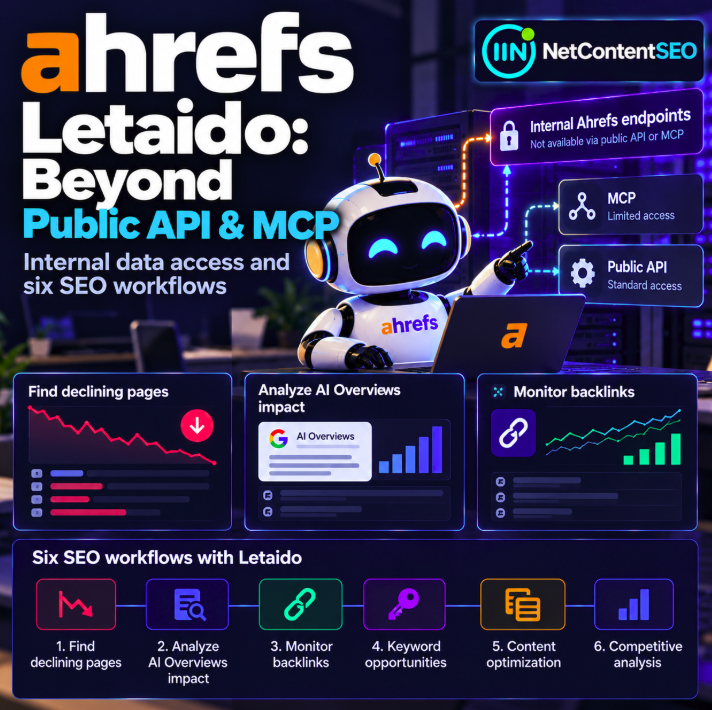

Ahrefs has published a practical guide to SEO automation with Letaido, highlighting a significant difference between the company's own marketing agent and external integrations. According to the October 8, 2026 article, Letaido can access certain internal Ahrefs endpoints that are not available through the public Ahrefs API or Model Context Protocol (MCP) integrations.
This is a description of existing product capabilities and workflows, not a newly announced Letaido launch or a public API expansion. The primary reference is Ahrefs: Automatiser son SEO avec Letaido. The source page could not be directly retrieved during preparation; details beyond those provided in the editorial brief should be verified against the live article before publication.
The key distinction: internal agent access versus public integrations
Many SEO teams connect Ahrefs data to scripts, dashboards and AI assistants using officially documented APIs or MCP tools. These integrations expose specific functions and data according to their supported interfaces and access controls.
Ahrefs' new explanation indicates that Letaido, as its own agent, can work with internal endpoints outside those publicly exposed interfaces. In practice, this means a workflow shown inside Letaido should not automatically be assumed reproducible through the public API or MCP using identical calls.
That distinction matters for technical planning. An internal capability is not evidence that an undocumented endpoint is available, supported or appropriate for third-party use. Developers should rely on officially documented and authorized interfaces.
Six SEO workflows: what the article establishes
The Ahrefs article is described as documenting six automatable SEO workflows. The supplied summary identifies three explicitly: finding declining pages, analyzing the impact of AI Overviews, and monitoring backlinks. The names and details of the other three workflows are not included in the supplied brief, so they are not presented here as confirmed examples.
1. Identify pages losing visibility
Declining-page analysis helps teams prioritize investigation instead of manually scanning large performance reports. The central task is to identify URLs whose search performance has weakened and then examine potential explanations, such as changes in query demand, competition, technical accessibility or content freshness.
A detected decline is a starting point for analysis, not proof of a particular Google algorithm update. Reliable workflows should preserve date ranges, metrics and source context.
2. Analyze the impact of AI Overviews
AI Overviews are a major research area for publishers because their presence can change the appearance of search results and the way users interact with them. Letaido's documented workflow addresses analysis of that impact, according to the supplied summary.
However, the brief does not specify the exact metrics, causal method or underlying endpoint used. It would be inaccurate to claim that Letaido can isolate the precise number of clicks lost to AI Overviews without evidence of such a measurement method. Correlation and causal attribution must remain separate.
3. Monitor backlinks
Backlink monitoring can help SEO teams review newly discovered links, disappearing references and changes in linking patterns. An agent can potentially assist with recurring comparisons and flag changes that warrant human review.
Teams should distinguish when a link was first observed by a data provider from when it was actually created or removed. Indexing delays, crawling coverage and data refresh cycles can affect apparent changes.
4–6. Additional workflows require source-level confirmation
Ahrefs describes six workflows in total, but the remaining three are not named in the supplied editorial brief. Rather than inventing examples or attributing generic SEO automation tasks to Ahrefs, this report leaves those details for verification against the complete article.
Why internal endpoints matter for AI-agent architecture
The practical difference between first-party agents and external tools can be substantial. A first-party agent may be designed to operate within the vendor's own application environment, using internal services that are not part of its public developer contract.
That does not mean external integrations are inferior in every respect. Public APIs and MCP tools provide documented interfaces, permission boundaries and predictable integration points. They can be valuable for multi-vendor workflows, auditing and systems that require explicit control over data flow.
What matters is capability parity: before committing to an automation design, teams should check whether the exact data, filters and actions they need are exposed through their chosen interface.
What this means for Ahrefs MCP users
For developers using Ahrefs through MCP, the reported internal-access difference is a reason to validate assumptions. If a demonstration shows Letaido performing a sophisticated analysis, that does not establish that the same operation is available as an MCP tool.
- List the tools and data fields available through the current official MCP integration.
- Compare those capabilities with the specific workflow shown in Letaido.
- Identify any missing inputs, metrics or operations.
- Use only supported interfaces and authorized data access.
- Document limitations rather than promising identical results across tools.
Internal endpoint references should not be treated as instructions to bypass API restrictions or attempt unsupported access.
Implications for SEO and AI visibility research
The Letaido article illustrates a broader trend: SEO platforms are evolving from data providers into workflow-executing agents. The distinction between possessing a dataset and being able to automate an analysis across that dataset is increasingly important.
For AI visibility work, this creates two separate questions. First, what can a vendor's first-party agent analyze within its own product? Second, what can independent researchers reproduce using publicly available integrations? Those answers may differ, affecting reproducibility and the design of external dashboards.
Nothing in this application guide establishes a new Google ranking factor, a change to AI Overview source selection or a new public Ahrefs data entitlement.
Questions teams should ask before choosing Letaido or API/MCP
- Does the workflow require internal-only metrics or actions?
- Can results be exported with dates, filters and source definitions?
- Are recurring tasks supported in the relevant product plan?
- Can an external API or MCP integration reproduce the output?
- How are permissions, account access and auditability handled?
- Which conclusions are observed data and which are agent-generated interpretations?
FAQ
What is Letaido?
Letaido is the Ahrefs marketing agent discussed in the company's SEO automation guide.
Can Letaido access data unavailable through Ahrefs' public API and MCP?
According to the October 8 article summary, Letaido can use internal Ahrefs endpoints that are not exposed through those public integration interfaces.
Does this mean Ahrefs launched new public endpoints?
No. The supplied article is an application guide, not an announcement of new public API or MCP endpoints.
Which SEO workflows are confirmed in the brief?
Identifying declining pages, analyzing AI Overview impact and monitoring backlinks. The article reportedly covers six workflows in total, but the remaining three require direct source verification.
Can third-party agents automatically reproduce every Letaido workflow?
Not necessarily. Developers need to confirm whether the required operations are exposed through supported public interfaces.
Is this a new Letaido product launch?
No. The October 8 publication describes existing applications rather than announcing a new launch.
NetContentSEO analysis
Ahrefs' most important disclosure is the gap between first-party agent capabilities and public integration surfaces. As AI agents become part of SEO operations, access to the right underlying functions matters as much as the quality of the assistant's reasoning. For researchers and developers, the lesson is to check what an API or MCP server actually exposes—and to avoid assuming that a vendor's own agent can be replicated feature-for-feature outside its platform.
Primary source: Ahrefs — Automatiser son SEO avec Letaido, October 8, 2026 (as dated in the supplied brief).