
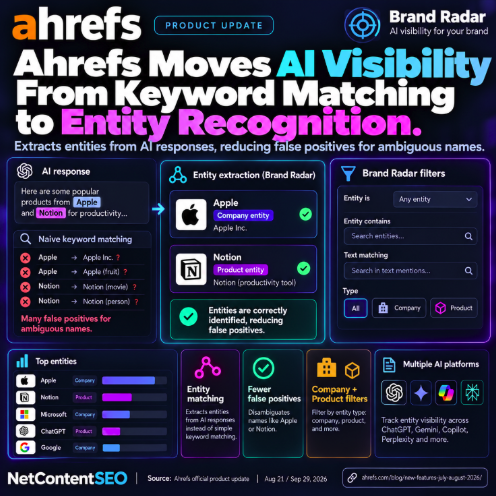
Ahrefs is moving AI visibility measurement beyond simple keyword matching. Brand Radar now extracts entities from AI responses, allowing brands, companies and products to be identified as specific entities rather than counted whenever their names happen to appear as plain text.
The update is designed to reduce false positives for ambiguous names such as Apple or Notion — a significant measurement problem when tracking brand visibility across generative search systems.
Entity matching replaces naive text matching
Traditional mention tracking can struggle when a brand name is also a common word, concept or name shared by unrelated entities. Searching for “Apple,” for example, can produce matches that have nothing to do with Apple Inc.
Brand Radar now extracts entities from the AI responses it tracks and uses those entities throughout report setup, filtering and overview analysis. Ahrefs says users can match a brand as an entity rather than relying only on plain-text occurrence.
Entity is, Entity contains or Text matching
Ahrefs provides several matching modes. Each tracked term can use Entity is, Entity contains or traditional Text matching. Optional category filters can further restrict matches to Company or Product entities.
This gives analysts control over whether they want semantic identity, broader entity matching or literal text occurrence.
Extracted entities become visible inside Brand Radar
The entity layer is not limited to filtering. Ahrefs marks extracted entities inside Prompt details, provides a Response entity filter and adds entity-level analysis to the Brand Radar overview. Its changelog describes a Top entities widget for examining the entities surfaced across tracked AI responses.
That turns entity recognition into an analytical dimension rather than simply a background disambiguation mechanism.
Why this matters for AI visibility measurement
Generative search creates a measurement problem that classic rank tracking rarely faced at the same scale: the same text string can refer to entirely different real-world objects.
If AI visibility platforms count every textual match equally, ambiguous brands can receive inflated mention counts and misleading Share of Voice measurements. Entity recognition provides a way to measure whether the AI system is actually discussing the intended company or product.
From keywords toward knowledge representation
The update also reflects a broader shift in AI-search optimization. Visibility is increasingly about whether systems can correctly identify an organization, product, person or concept — not merely whether a particular sequence of words appears in an answer.
This makes entity consistency across websites, profiles, structured data, citations and authoritative references increasingly relevant to how brands analyze their presence in AI-generated answers.
The NetContentSEO view
For GEO measurement, this is an important methodological upgrade. A mention should represent the intended entity, not simply a matching string.
As AI visibility tools mature, entity-aware measurement can reduce noise and make comparisons between brands more defensible. It also moves the industry closer to measuring how generative systems understand brands rather than simply counting words inside their outputs.