
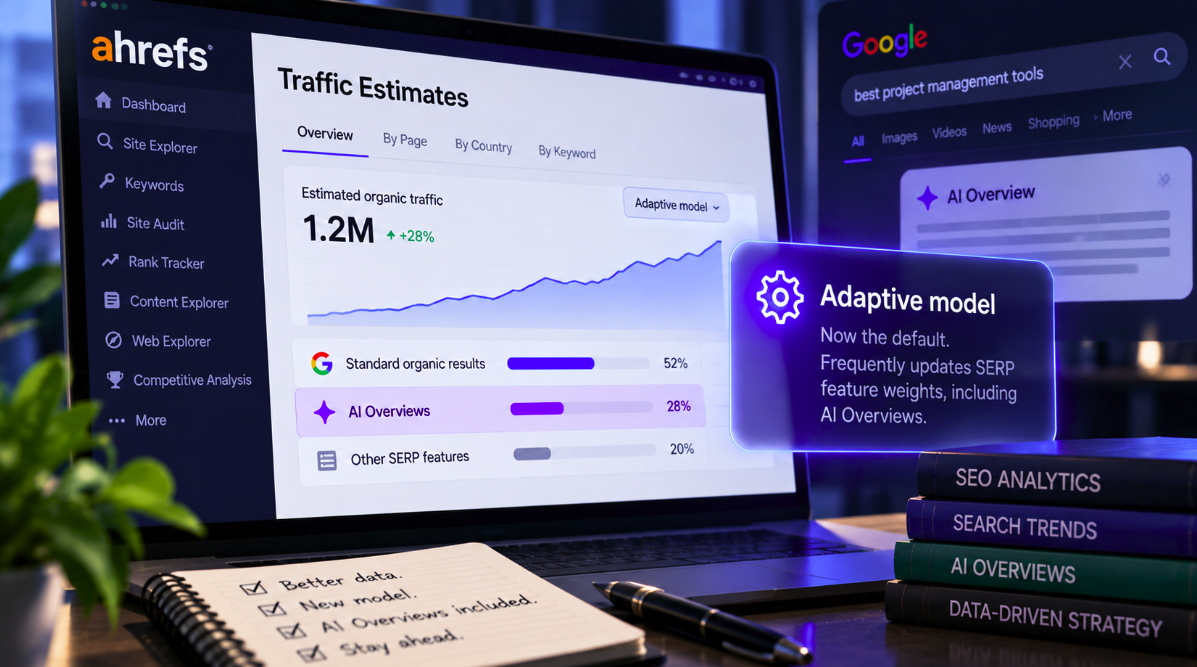
Ahrefs has made its adaptive organic traffic estimation model the default, a change that quietly alters one of the SEO industry’s most familiar metrics: the number a third-party tool assigns to a website’s estimated Google traffic.
The adaptive model is designed to account for the modern search results page rather than assuming that ranking position alone determines how many clicks a result receives. Its weights are refreshed for SERP features including Google’s AI Overviews, and Ahrefs says the calculations are updated more frequently than under its previous static model.
The change was highlighted on September 7 by SEO consultant Glenn Gabe, who noted that the model had previously been optional but was now the default. The shift is also reflected in Ahrefs’ current API documentation, where traffic_mode=adaptive is now listed as the default for core Site Explorer traffic endpoints.
The practical consequence is bigger than a settings toggle. Because the adaptive model also recalculates historical estimates, some Ahrefs charts can move even when a website’s actual historical Google traffic did not.
Ahrefs first launched the adaptive model as an opt-in experiment
Ahrefs introduced the model on August 4. Its official product changelog described a new approach to organic traffic estimation that refreshed the weights assigned to SERP features, specifically naming AI Overviews.
At launch, Ahrefs was cautious. The model was opt-in through Site Explorer settings, giving users the ability to compare it with the existing calculation before adopting it broadly.
The company said switching to adaptive would update statistics across Site Explorer, with exceptions including backlink reports and the Top organic competitors widget. Ahrefs also warned immediately that historical data would be affected. For dates earlier than February 2025, the model uses the state it had in that month.
That warning becomes more important now that adaptive calculation is the default experience rather than an optional comparison.
AI Overviews changed the assumptions behind traffic estimation
Traditional SEO traffic models generally start with a familiar formula: estimate how many searches a keyword receives, observe where a page ranks, then apply an expected click-through rate for that position.
That approach becomes less reliable when the SERP itself changes the probability of a click.
An organic result in position one beneath an AI Overview does not necessarily receive the same click opportunity as position one on a clean results page. Featured snippets, local packs, shopping modules, video results and other features have created similar problems for years, but AI-generated answers make the gap especially visible because they can satisfy substantial parts of a query directly on Google.
Ahrefs’ own research has found major click reductions associated with AI Overviews. In a 2026 analysis, the company reported that AI Overviews could reduce clicks to the top-ranking page by 58% in its measured sample. Whether that exact percentage applies to any individual site depends on query mix and context, but the direction explains why a static rank-to-click curve is increasingly difficult to defend.
The adaptive model accounts for 15 SERP features
In its product announcement for the model, Ahrefs said traffic estimates now account for 15 SERP features, including AI Overviews and featured snippets.
The logic works in both directions. SERP features can reduce clicks available to ordinary organic listings, but a site appearing inside a feature can itself receive traffic. A useful estimation system therefore needs to understand not merely that a feature exists, but how its presence changes expected click distribution.
Ahrefs says its adaptive estimates are also re-adjusted monthly against data from its Web Analytics product, taking into account factors such as SERP composition, search-volume changes and crawl frequency.
This does not turn estimated traffic into measured traffic. It remains a model. The difference is that the model is designed to adapt as the search interface changes.
Historical Ahrefs traffic can change without historical Google traffic changing
This is the part SEO teams need to understand before opening a client report and assuming a revised chart represents a real-world event.
Ahrefs explicitly says the adaptive model affects historical data. If the model changes the expected click contribution of a SERP feature, it can recalculate what Ahrefs believes a domain would have received during previous periods.
That means a historical line can move because Ahrefs changed its estimation methodology, not because Google retroactively changed the traffic a website actually received.
Measured first-party analytics do not work that way. Search Console clicks recorded in March remain the clicks Google recorded for March. Server logs and analytics sessions remain observations from the period in which they occurred. Third-party estimated traffic is different: it is reconstructed from rankings, keyword demand and modeling assumptions, so changing those assumptions can change the historical estimate.
For analysts, methodology changes therefore need to be treated like data annotations.
The current API confirms adaptive is now the default
Ahrefs’ developer documentation provides a useful independent check on the rollout state. The current Site Explorer Metrics endpoint lists traffic_mode with two possible values—static and adaptive—and shows adaptive as the default.
The same is true for the Metrics History endpoint and Pages by Traffic documentation.
This differs from the original August API changelog, which documented static as the default when the parameter first launched. The contrast confirms the operational change: adaptive moved from an available mode to the baseline calculation.
Ahrefs’ public feature changelog accessible at the time of writing still shows the original August 4 language describing adaptive as opt-in, so teams relying only on that entry could miss the newer default behavior.
SEO reporting now has a model-version problem
The shift creates a reporting challenge familiar to analysts in other data-heavy industries: when the measurement model changes, comparisons across time can become harder to interpret.
Suppose an agency exported Ahrefs traffic estimates for a competitor in July and exports the same historical period again in September. If the two numbers differ, the competitor did not necessarily gain or lose historical visibility. The model may simply assign different expected clicks to the SERP features present during that period.
This is especially important for automated dashboards that repeatedly request historical Ahrefs data through the API. If a reporting pipeline does not preserve snapshots, revised model output can overwrite the analyst’s mental baseline.
Teams that use Ahrefs estimates for competitive intelligence should therefore document the traffic mode used and, where historical consistency matters, preserve periodic exports rather than assuming a modeled metric is immutable.
AI Overviews are becoming part of ordinary SEO measurement
The broader significance is that AI Overviews are no longer merely an additional visibility metric sitting beside traditional SEO data. Their effect is being incorporated into the estimation of conventional organic traffic itself.
That reflects how search behavior has changed. If an AI Overview absorbs attention and clicks, an SEO platform that ignores it can overestimate the value of a ranking. If a publisher is cited prominently inside that feature, a model that treats the page as an ordinary organic result may miss part of the opportunity.
Ahrefs is effectively saying that the shape of the SERP has become important enough that traffic estimation must adapt continuously rather than rely on a fixed click curve.
Estimated traffic should never be confused with analytics
The adaptive model may produce a more realistic estimate, but it does not eliminate uncertainty. Ahrefs does not have access to every website’s Google Search Console account, and Google does not expose AI Overview clicks as a clean standalone category in Search Console.
Ahrefs itself has documented that AI Overview clicks can appear as ordinary Google organic traffic or without a useful referrer, making precise attribution difficult.
The model should therefore be used for what third-party traffic estimates are best at: competitive comparison, opportunity sizing and directional analysis when first-party data is unavailable.
For a site you own, Search Console, analytics and server-side data remain the stronger evidence of what actually happened.
Rankings alone no longer explain traffic potential
The adaptive model also reinforces a conceptual shift in SEO reporting. Two pages can hold the same ranking position for keywords with similar search volume yet have very different traffic potential because their SERPs look different.
One query may show a large AI Overview, shopping results and video modules before the organic listing. Another may present a relatively traditional set of links. Treating both position-one rankings as equivalent can produce misleading forecasts.
This is why modern traffic estimation increasingly needs query-level SERP context rather than just rank and volume.
Historical charts need more careful interpretation from September onward
For Ahrefs users, the immediate recommendation is simple: do not treat every change visible after the default switch as evidence of an SEO event.
When a traffic estimate shifts, compare rankings, keyword counts, SERP features and first-party data before concluding that the site itself changed. For important reports, annotate the transition to the adaptive model so clients and stakeholders understand that part of the movement may be methodological.
The same caution applies to competitor analysis. A sudden revision in a competitor’s estimated historical traffic may tell you something about Ahrefs’ improved model rather than something the competitor did.
SEO tools are being forced to model the post-blue-link SERP
Ahrefs making adaptive traffic estimation the default is ultimately a response to a search results page that no longer behaves like the one traditional traffic curves were built for.
AI Overviews are one part of that change, alongside featured snippets, local results, video, shopping and other interactive surfaces. As those features expand, the relationship between ranking position and clicks becomes conditional on what else Google places around the result.
A traffic estimate that ignores that environment can look precise while being based on increasingly outdated assumptions.
Ahrefs’ solution is to let the model change with the SERP—even if that means yesterday’s estimated traffic can be recalculated tomorrow. For SEO teams, the tradeoff is clear: potentially more realistic modeling, but less certainty that a historical third-party metric will remain frozen forever.