
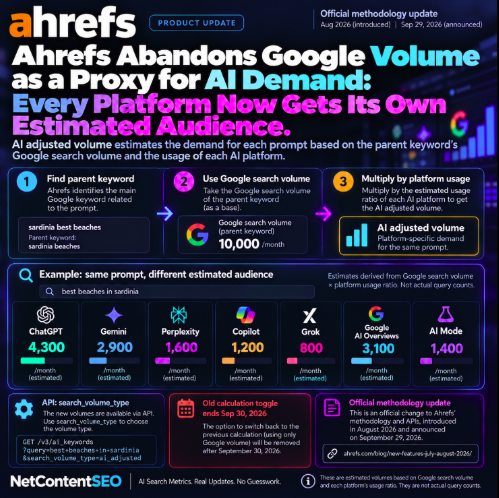
Ahrefs has changed one of the core assumptions behind AI visibility measurement. Brand Radar no longer assigns the same Google-derived volume to a prompt across every AI platform. Instead, its new AI Adjusted Volume estimates demand separately for ChatGPT, Gemini, Perplexity, Copilot, Grok and Google's AI surfaces.
The result is simple but important: the same prompt can now carry a different estimated audience on every platform.
Google volume is now the starting point, not the final AI volume
For each prompt, Ahrefs identifies a parent keyword, takes that keyword's estimated Google search volume and multiplies it by an estimated usage ratio for the relevant AI platform.
Ahrefs derives those ratios from aggregated website traffic attributed to different AI platforms relative to organic Google traffic. The resulting number is therefore a platform-specific estimate rather than an observed count of real prompts.
The same prompt gets different volumes on ChatGPT and Gemini
Under the previous methodology, the same prompt could effectively inherit the same volume regardless of which AI system was being analyzed. AI Adjusted Volume changes that by applying a separate usage ratio to each platform.
Ahrefs currently documents ratios including 0.115 for ChatGPT, 0.011 for Gemini, 0.01 for Perplexity, 0.0033 for Copilot and 0.000054 for Grok. Google AI surfaces use separate ratios depending on whether the dataset represents search queries or prompts.
This is an estimate of relative demand — not real prompt counts
Ahrefs explicitly warns that AI platforms generally do not publish comprehensive query-volume datasets. AI Adjusted Volume therefore should not be interpreted as the number of people who actually entered a particular prompt.
The metric is designed to provide directional demand estimates for comparing topics, platforms, brand visibility, impressions and AI Share of Voice.
The methodology also changes Brand Radar metrics
AI Adjusted Volume is not only displayed as an isolated prompt metric. Ahrefs uses it when calculating Brand Radar metrics including estimated impressions and AI Share of Voice, meaning the platform-specific adjustment can affect broader competitive visibility analysis.
The old calculation disappears after September 30
Ahrefs temporarily retained a toggle allowing users to compare the new methodology with the previous Google-volume calculation. Its September 29 product update states that this option disappears after September 30, 2026.
The API is changing as well. Ahrefs exposes the volume choice through search_volume_type, but its API documentation says the parameter itself will be deprecated on September 30 and requests will use AI Adjusted Volume.
The NetContentSEO view
This is a meaningful step toward treating AI search as a collection of distinct demand environments rather than one market represented by Google search volume.
Ahrefs still anchors the calculation to Google because reliable platform-level prompt counts largely do not exist. But applying different usage ratios acknowledges an obvious reality: a topic's potential audience on ChatGPT is not necessarily the same as its audience on Gemini, Perplexity or Copilot.
For GEO teams, the practical implication is that platform selection can now influence estimated opportunity as well as visibility. The metric remains modeled rather than directly measured, but it is substantially more platform-aware than assigning every AI system the same search-volume proxy.