

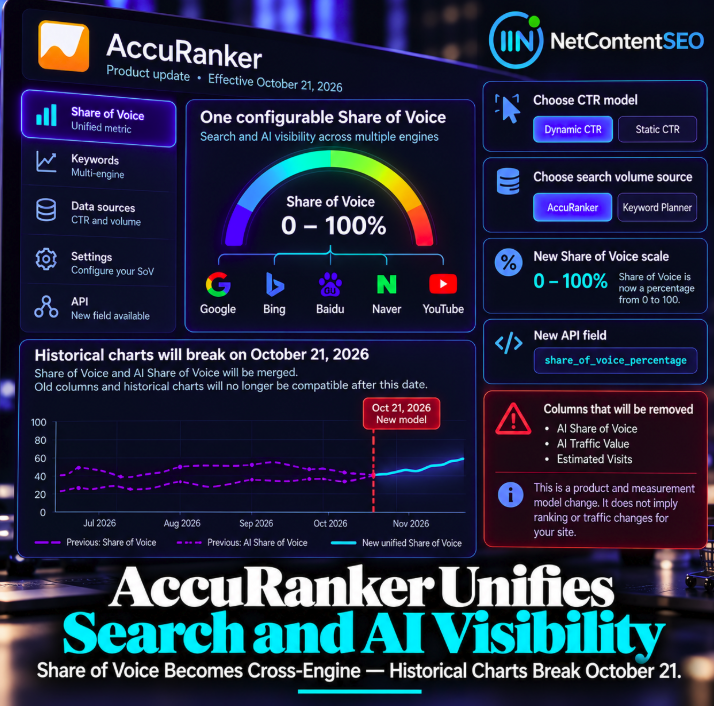
AccuRanker is removing the boundary between its traditional Share of Voice and AI Share of Voice metrics.
From October 21, 2026, the platform will expose one configurable Share of Voice metric. For Google keywords, users will choose both the CTR model and the search-volume source that power the calculation. At the same time, keywords tracked on Bing, Baidu, Naver and YouTube will begin contributing to total Share of Voice.
AI Share of Voice becomes part of Share of Voice
Today AccuRanker separates its fixed-rank CTR metric from AI Share of Voice, which uses a dynamic machine-learning CTR estimate that responds to the actual SERP environment.
After the October 21 cutover, that split disappears. Users who choose Dynamic CTR effectively retain the dynamic calculation inside the unified Share of Voice metric, while those who prefer the legacy-style approach can select Static CTR.
Google Share of Voice becomes configurable
For Google keywords, the new system exposes two independent choices.
The CTR model can be Dynamic CTR or Static CTR. Search volume can come from AccuRanker's own AR Search Volume estimate or Google Keyword Planner, using the applicable local or national data.
If users make no selection before the cutover, AccuRanker says the recommended default will be Dynamic CTR plus AR Search Volume.
Traffic Value follows the same settings
The configuration is not limited to Share of Voice. AccuRanker says Traffic Value will use the same selected CTR and search-volume settings.
This makes the October change a measurement-model update rather than a cosmetic renaming of one column.
Bing, Baidu, Naver and YouTube join total Share of Voice
Another significant change is cross-engine aggregation.
Keywords tracked on Bing, Baidu, Naver and YouTube will count toward total Share of Voice from October 21.
Those engines will continue using Static CTR and their existing search-volume source. Dynamic CTR and AR Search Volume remain Google-specific in this implementation.
Share of Voice becomes explicitly cross-engine
This changes what the top-level metric can represent.
A portfolio that monitors Google alongside Bing, Naver, Baidu or YouTube can now see those tracked keyword opportunities reflected in the same total Share of Voice rather than treating Google as the only contributor.
That is useful, but it also means teams must understand the composition of the metric before comparing domains or reporting changes.
A new Share of Voice % runs from 0 to 100
AccuRanker is also introducing Share of Voice %.
The percentage is calculated by dividing actual Share of Voice by the maximum Share of Voice the tracked keywords could achieve, usually based on the value available at rank one.
The result is expressed on a 0–100% scale and will appear in columns, charts, KPIs, reports and the API.
The API gets share_of_voice_percentage
For teams consuming AccuRanker programmatically, a new API field named share_of_voice_percentage will expose the new percentage metric.
Existing Share of Voice, Traffic Value and CTR API fields retain their names and formats, but their returned values will reflect the user's selected settings.
That means downstream dashboards should document which calculation configuration generated the data rather than assuming a universal definition.
Three existing columns disappear
When the change goes live, AccuRanker will remove the separate AI Share of Voice, AI Traffic Value and Estimated Visits columns.
Share of Voice and Traffic Value become the settings-driven replacements.
AccuRanker says saved table columns, segments, report templates and report filters will be updated automatically. Saved links containing a filter that no longer exists will open without that filter.
The historical charts need a warning label
The most important reporting issue arrives on the same day.
The new Dynamic CTR model applies only from October 21 onward. Values before that date keep the previous CTR model.
As a result, charts using Dynamic CTR will show a visible step on October 21.
That discontinuity is methodological. It should not be interpreted as a sudden SEO loss.
AccuRanker expects Share of Voice to drop sharply
AccuRanker's new CTR model estimates substantially lower click-through rates for many modern SERPs, particularly those affected by AI Overviews and other SERP features.
The company says most domains can expect Share of Voice to fall by roughly 35% to 60% when using Dynamic CTR. Its deeper CTR-model analysis places the median decline at about 48%.
Rankings and actual Search Console or analytics traffic do not change because of the model update.
The settings apply to history, but the new CTR model does not
There is an important distinction in AccuRanker's documentation.
Your selected Share of Voice settings apply across your history. But the rebuilt Dynamic CTR model itself is not backfilled before October 21.
That is why a historical chart can use the same conceptual configuration while still containing two generations of CTR estimates separated by the launch date.
Cross-engine totals create a second comparability problem
The inclusion of Bing, Baidu, Naver and YouTube keywords can also move Share of Voice even when nothing changes on Google.
A domain with substantial non-Google tracking may see its total shift simply because more engines now contribute to the aggregate.
AccuRanker's own FAQ identifies this as one reason Share of Voice can change under the new system.
Agencies should annotate October 21 in client reporting
Any agency or in-house team using AccuRanker Share of Voice in dashboards should mark October 21 as a methodology-change date.
Otherwise stakeholders may interpret a model-driven discontinuity as lost visibility, a Google update or a failed SEO campaign.
The safest reporting approach is to explain the metric configuration alongside the number: CTR model, volume source and included search engines.
Static CTR remains available for continuity
Teams that need the previous style of calculation can select Static CTR with Google Keyword Planner search volume.
AccuRanker says this reproduces the previous Share of Voice calculation, while the new Dynamic CTR model remains optional.
That gives reporting teams a continuity path, although it sacrifices the SERP-aware click modeling that AccuRanker recommends.
The broader shift is from “AI metric” to search visibility metric
The product decision is strategically interesting because AccuRanker is no longer presenting AI-aware CTR as a parallel visibility universe.
Instead, AI features become part of the environment that determines the click potential of a normal search ranking.
An AI Overview is not a separate market from organic Search when it physically changes how likely users are to click the organic result underneath it.
Cross-engine visibility also needs engine-level drill-down
A unified number is convenient, but it should not eliminate engine-level analysis.
Google, Bing, Baidu, Naver and YouTube have different interfaces, user populations, search-volume sources and CTR assumptions.
A rising total Share of Voice can therefore hide a decline on one engine if another engine gains enough weight.
Teams should use the aggregate as an executive metric while retaining engine-level views for diagnosis.
NetContentSEO take
AccuRanker's October 21 update is more than the retirement of an “AI” column.
It reflects a broader measurement reality: AI features, classic organic rankings and multiple search engines increasingly belong in the same visibility framework.
But unification creates a new obligation. Every Share of Voice number now needs context about which CTR model, which volume source and which engines produced it.
And October 21 needs to be annotated everywhere. When the chart breaks, the site's visibility did not necessarily break with it.