
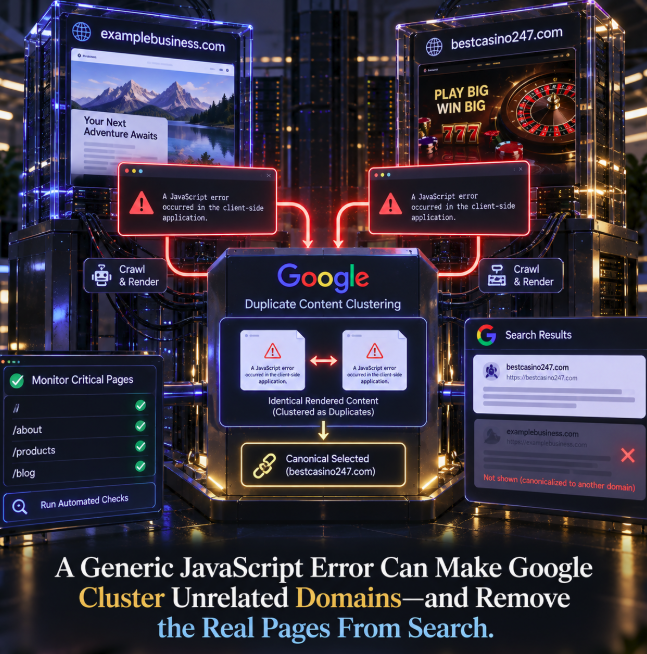
A temporary JavaScript failure can create a much stranger Google Search problem than a broken page. In a case discussed publicly this week, a site owner found Google selecting an apparently unrelated casino domain as the canonical for legitimate pages about companies and suppliers. The two sites appeared to have nothing meaningful in common, but a generic client-side error may have given Google's indexing systems something they did share: effectively identical rendered content.
John Mueller responded to the case and said that explanation was plausible, according to Search Engine Journal's September 18 report. The suspected common denominator was the generic JavaScript message “Application error: a client-side exception has occurred,” which both unrelated sites had apparently returned during failures. If Googlebot encountered those error shells instead of the real pages, Google's duplicate-detection systems could have had reason to cluster URLs that, under normal conditions, would never resemble one another.
This is not necessarily a rogue cross-domain canonical tag
The first instinct when Google chooses an unrelated external URL as canonical is to look for an accidental rel="canonical", redirect, hack or server configuration problem. Those are legitimate possibilities. Google's own canonicalization troubleshooting documentation specifically warns that server misconfigurations can lead to unexpected cross-domain URL selection and that malicious compromises can inject redirects or cross-domain canonical annotations.
But Google documents another scenario that is strikingly close to this case: two unrelated web servers can return identical soft-404 pages that Google fails to recognize as errors. Google's canonicalization system works by identifying pages whose primary content appears the same or very similar, clustering those URLs and selecting a representative canonical. An explicit canonical tag is therefore not required for Google to decide that two URLs belong to the same duplicate cluster.
That distinction matters. Calling the incident a “cross-domain canonical problem” can make it sound as though one site explicitly pointed its canonical tag at another. The more interesting hypothesis is that Google's systems independently inferred duplication because the rendered pages temporarily collapsed into the same generic error state.
To Googlebot, two broken applications can look surprisingly alike
Imagine two websites with completely unrelated normal content. One is a supplier directory; the other is a casino. When both applications work, their pages share almost nothing. But if both fail during rendering and expose the same framework-generated error shell, the content Google sees can suddenly become nearly identical.
That creates a technical SEO blind spot. Site owners usually think about duplicate content as something created by URLs, parameters, syndication, product variants or copied pages. Application failures can manufacture duplication dynamically. The underlying databases and intended page content remain different, but the crawler never reaches them. It receives the fallback state instead.
Google's canonicalization documentation explains that when pages appear to have the same or very similar primary content, Google clusters them and chooses a canonical based on the signals collected during indexing. If an error message temporarily becomes the primary rendered content, it can distort the evidence Google's systems use to make that decision.
The canonical selection may be a symptom, not the root problem
Mueller's response is particularly useful because he reframed the issue around outcomes. Whether Google keeps the affected URL as canonical while indexing the server error, classifies the page as a soft 404 or selects the other domain as canonical, the practical result can be similar: the intended page is no longer available in Search for its normal content.
That means obsessing over why a casino URL appeared as the selected canonical can distract from the more actionable failure. The site's real problem is that Googlebot was apparently able to receive an application-error page in place of useful content. Fixing the reliability problem is more important than attempting to manipulate canonical signals around a page that may still fail during rendering.
This is also why an incorrect external canonical should not automatically be interpreted as evidence of negative SEO or malicious duplication. Hacking and hostile technical signals should certainly be investigated, but identical fallback content is another credible explanation when unrelated sites appear mysteriously clustered.
Live URL Inspection becomes critical for JavaScript sites
Mueller recommended using Search Console's live URL testing to inspect what Google can currently render. Google's own JavaScript troubleshooting guide gives similar advice: site owners can use URL Inspection or the Rich Results Test to examine rendered HTML, loaded resources, JavaScript console output and exceptions.
The word “live” matters because the indexed state and the current state can diverge. A developer opening a page after an outage may see a perfectly functioning application and conclude that Google's canonical selection makes no sense. But Google may have crawled the URL hours or days earlier while the application was returning only the generic error shell.
A live rendering test cannot reconstruct every historical crawl, but it can reveal whether Googlebot can reproduce the failure now and whether critical resources behave differently for Google's rendering infrastructure. Server logs, application monitoring and error telemetry can then help reconstruct what happened around the original crawl window.
A 200 status code can make a broken page more dangerous
Modern JavaScript applications can fail visually while the server still returns HTTP 200. From an infrastructure perspective, the request succeeded; from the user's perspective, the page did not. This mismatch is especially risky for search because a crawler may receive what looks like a successful document containing little more than a generic application error.
Google has mechanisms for recognizing soft 404s, but Mueller's response makes clear that relying on the search engine to classify every broken application state correctly is not a robust strategy. If a fatal application failure means the intended content cannot be delivered, sites should consider how that state is communicated to crawlers and users rather than allowing a generic success response to persist indefinitely.
The exact implementation depends on the application architecture. The broader principle is stable: monitoring should test the content that matters, not merely whether the server returns a successful status code.
Mueller's practical recommendation is automated monitoring
The most actionable part of the exchange was not about canonical tags at all. Mueller recommended detecting these failures before search engines have enough time to treat them as stable page states. He described using automated tests before deploying changes and adding new tests whenever a failure mode appears.
For live sites, he suggested repeatedly fetching critical pages — potentially hourly, depending on the site's needs — and checking them for problems. That approach is more demanding than conventional uptime monitoring. A monitor that only verifies HTTP 200 could happily report that the site is healthy while users and Googlebot are staring at a JavaScript exception.
Useful checks can verify the presence of expected page elements, titles, headings or product data; detect known error strings; execute JavaScript when necessary; and alert when rendered content becomes suspiciously thin or generic. For commercially important templates, comparing content signatures over time can also reveal when many different URLs suddenly begin returning the same fallback shell.
Canonical monitoring should include the rendered page
Technical SEO teams routinely monitor redirects, canonical tags, robots directives and status codes. This case suggests adding another layer: the rendered identity of the page. If a JavaScript failure can temporarily make thousands of otherwise distinct URLs look identical, the canonicalization risk originates after the server has technically responded successfully.
Google also recommends keeping canonical information as clear as possible on JavaScript-powered sites. Its canonical guidance says the preferred approach is to specify the canonical in the source HTML and avoid having JavaScript change it to a different URL. But even perfect canonical markup cannot substitute for reliable primary content if the application fails before that content becomes usable.
Teams should therefore monitor both explicit signals and rendered output. A self-referencing canonical can tell Google what the site owner prefers, while the rendered page tells Google what the URL actually appears to contain. When those two layers tell radically different stories, Google still has to interpret the evidence.
Recovery may not be instantaneous
Once the underlying error is fixed, Google may need to crawl and re-evaluate the affected URLs before separating them from an incorrect duplicate cluster. Google's canonicalization troubleshooting documentation notes that re-evaluation takes time and that pages can remain grouped for a period after content problems have been corrected. Site owners can request re-indexing for important URLs after fixing the issue, but that does not make recovery immediate.
This is another reason prevention matters. A transient error caught by monitoring in minutes may never become a persistent search problem. The same error left online long enough for repeated crawls can influence indexing, soft-404 classification or canonical clustering and then require additional crawling before Search reflects the repaired state.
The bigger lesson is that error pages are content too
SEO teams often treat application errors as an availability problem owned by engineering. Google's indexing systems do not have that organizational boundary. Whatever Googlebot successfully retrieves and renders becomes evidence about the URL, even when the page shown was never intended to be indexable content.
The case does not prove that every bizarre cross-domain canonical is caused by identical JavaScript errors, and Mueller presented the explanation as a plausible option rather than a definitive forensic finding. Unexpected canonicals can still come from redirects, incorrect tags, server misconfiguration, hacking, copied content and other signals. Those possibilities should be checked rather than discarded.
But the incident exposes an important failure mode: two completely unrelated domains can become algorithmically similar if their applications fail in exactly the same generic way. For JavaScript-heavy sites, the defensive response is not another canonical trick. It is to test what Google actually renders, monitor critical pages continuously and treat generic application errors as an indexing risk before they have time to become one.