
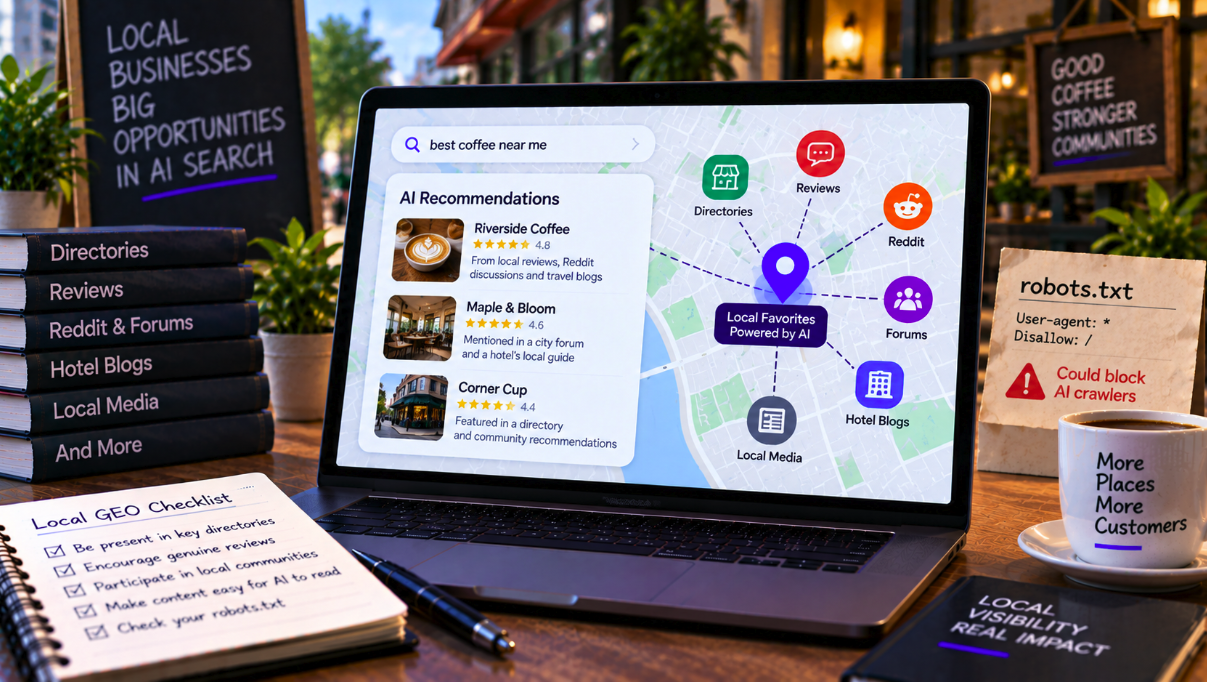
Local businesses have spent years learning where their digital identity needs to be accurate: their own website, Google Business Profile, major directories and review platforms. AI recommendations are making that map less predictable. A customer can ask an assistant for a specialist in a particular neighborhood or a business suited to a very specific need, and the evidence supporting the answer may come from a source the business never considered part of its search strategy.
That was one of the clearest themes in a September 10 Search Engine Journal recap of an SEJ Live session sponsored by Moz. Moz executives Kevin Chen and Jonathan Berthold described local assistants drawing information from listings, review sites, Reddit threads, city forums and curated local lists. Berthold’s most memorable example involved a tattoo artist whose recommendation was supported by a citation from a hotel website that had published a list of local artists.
The example is useful precisely because it breaks the old directory checklist. A hotel blog is not a canonical business database, yet it can contain highly relevant local knowledge: what is nearby, which businesses fit a visitor’s needs and how residents or travelers describe them. Generative systems can search across that wider evidence layer when composing recommendations. The session does not quantify how often hotel blogs, Reddit or city forums become citations, so it should not be read as a new source-ranking formula. It shows instead how broad the potential citation surface has become.
Local GEO extends beyond the properties a business controls
Traditional local SEO already depended on third parties, but marketers could focus heavily on a relatively stable group of structured platforms. AI assistants can make unstructured mentions more visible because a recommendation may be assembled from several documents rather than copied from a single business listing. A neighborhood guide, a discussion thread, a local publication or a hotel’s “things to do nearby” page can contain exactly the descriptive language needed to answer a nuanced prompt.
That changes competitor research. Berthold’s recommendation was to run relevant prompts across multiple engines, identify which businesses appear and inspect the URLs supporting those answers. The useful question is no longer only where a competitor ranks, but where the web is supplying evidence about that competitor. If the same independent local guide repeatedly supports recommendations, that page reveals a citation opportunity or an ecosystem the business has not yet entered.
The same mechanism can preserve bad information. Search Engine Journal’s Loren Baker described a school chain encountering prospective students who had been given outdated tuition information by Google’s AI, traced to an old Reddit post. Old threads can remain discoverable and continue accumulating comments long after the original facts have changed. For local brands, monitoring AI answers therefore has a defensive function as well as a visibility function: it can expose stale third-party descriptions before they become the information a prospective customer trusts.
An old robots.txt can quietly turn a content problem into an access problem
The session also highlighted a more technical failure mode. When a business ranks strongly in Google but fails to appear in AI answers, Berthold said he would first compare prompts and citations across engines and then verify whether relevant AI crawlers can access the site. He has encountered cases where robots.txt directives left behind by previous webmasters were still blocking AI crawlers unintentionally.
That does not mean every AI visibility problem is a robots.txt problem, or that every AI crawler should automatically be allowed. Providers use different user agents for different purposes, including model training, search retrieval and user-triggered browsing, and their handling of robots directives is not identical. A company may reasonably choose to block one form of crawling while allowing another. The audit requirement is intentionality: teams should know which agents are blocked, why they are blocked and whether those choices conflict with the visibility they expect from a particular service.
This is especially important after redesigns, migrations and agency changes. A rule created years ago to control an unfamiliar bot can survive long after the person who wrote it has left, while the business assumes that having an indexable Google page means every AI system has equivalent access. Search Engine Journal’s related guide to local AI recommendations similarly recommends keeping crawling permissions intentional and making important business information available as readable text. The safest technical foundation is not indiscriminate access; it is a configuration that matches the company’s actual distribution policy.
Consistency still matters because AI has more places to find contradictions
For all the novelty around generative search, Chen emphasized familiar fundamentals: business name, address, phone number and hours should remain consistent, and the website should be organized so systems can identify important information. The difference is that inconsistencies now have more routes into the customer experience. An outdated directory, old community thread or abandoned local page can conflict with the current website, forcing an answer engine to reconcile competing claims.
Reviews add another layer because they describe the business in customer language rather than the company’s own vocabulary. The Moz speakers discussed review recency, response behavior and the value of making legitimate review submission easy, while also warning against manipulative prompting. Google itself says reviews and positive ratings can help local ranking and recommends responding to reviews. For GEO, the additional value is descriptive: recent reviews can supply current evidence about services, quality and customer experience that an assistant may encounter while researching a recommendation.
None of this establishes a fixed weighting system for local AI. The SEJ article is a recap of a sponsored expert session, not a controlled experiment measuring citation probability by source type. ChatGPT, Gemini, Google’s AI experiences and other assistants have different retrieval architectures that also change over time. A Reddit thread appearing in one answer does not make Reddit a universal ranking factor, just as a hotel blog citation does not mean businesses should begin mass-pitching hotel websites.
The stronger strategy is to think in terms of local corroboration. Keep first-party facts current and machine-accessible, maintain accurate listings, earn genuine reviews, participate naturally in the communities where customers discuss the category and understand which independent local sources assistants already trust for the prompts that matter. Then audit the technical path so those systems are not accidentally denied access to the evidence the business deliberately publishes.
Local GEO therefore looks less like a new directory-submission exercise and more like management of an information ecosystem. A recommendation can be strengthened by a review, a city forum, a neighborhood guide or a surprisingly specific hotel article, while a forgotten robots.txt directive can prevent a crawler from seeing the business’s own version of the facts. The opportunity and the risk come from the same change: AI search can look far beyond the homepage, which means local visibility now depends on understanding what the wider web says—and whether the machines assembling the answer can reach the right evidence at all.