

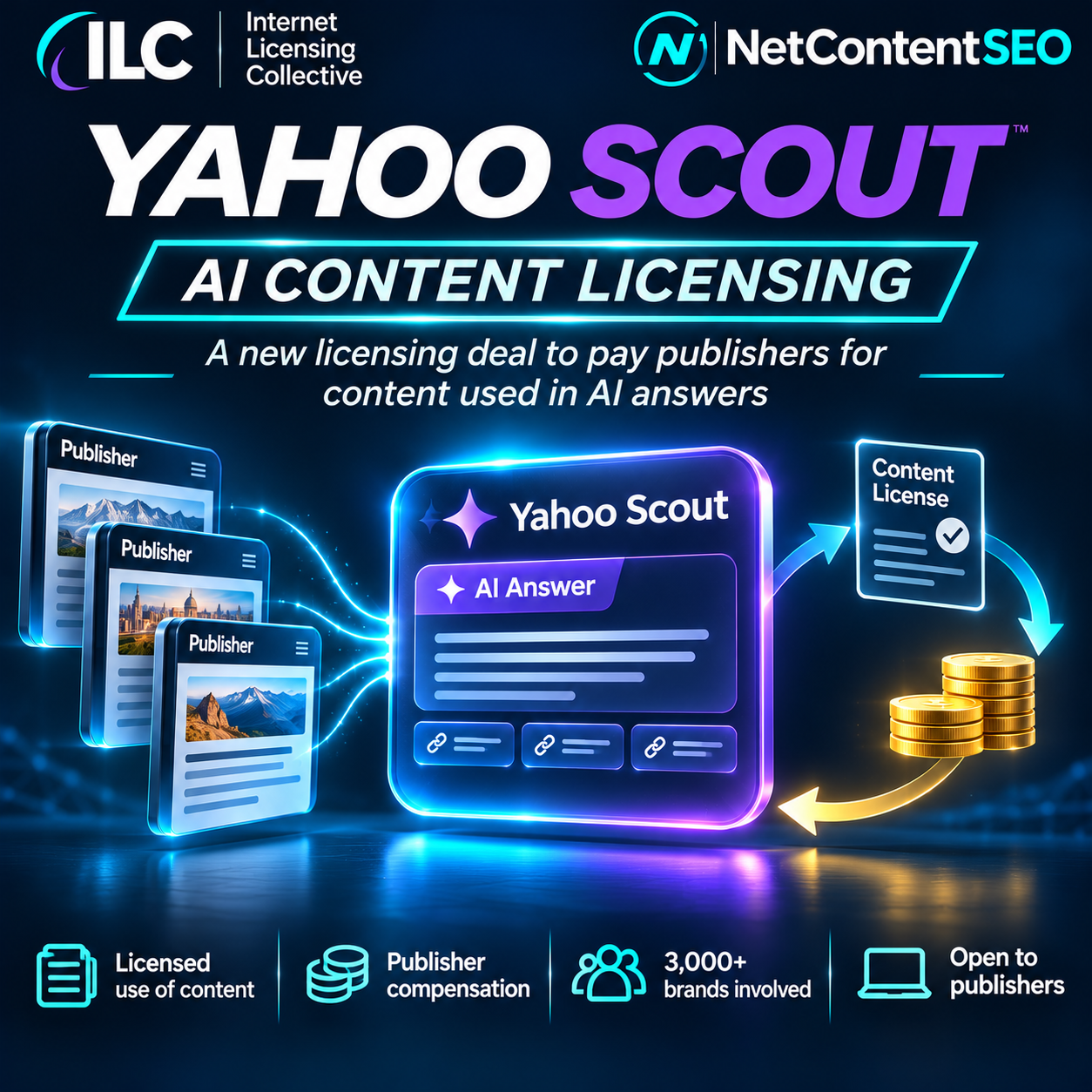

Yahoo Scout has become the first commercial licensee of the Internet Licensing Collective (ILC), a nonprofit, publisher-led organization designed to compensate publishers when AI products use their content. Announced on November 12, 2026, the agreement marks a notable shift in the economics of AI Search: publishers may be paid for licensed content use, rather than relying exclusively on search referrals, advertising impressions or a visible citation in an AI-generated answer.
The announcement is real, but the financial outcome is not yet measurable. The amount Yahoo is paying has not been disclosed, individual publisher royalty statements have not been published, and no public dataset establishes that the agreement increases traffic or revenue for a typical website. The distinction between an agreed licensing framework and verified publisher earnings is central to understanding the news.
What Yahoo Scout and the Internet Licensing Collective announced
In its November 12 launch announcement, ILC confirmed Yahoo Scout as its first commercial customer. Yahoo Scout is Yahoo's AI-powered answers product. The agreement is intended to give Scout ongoing access to permissioned content from participating publishers to inform and enrich AI answers.
ILC says its network encompasses more than 3,000 media brands, content owners and publishing platforms. The organization was previously called the RSL Collective, and it has developed a collective licensing framework based on the Really Simple Licensing (RSL) standard. The number of supporting brands should not be mistaken for a count of publishers already receiving royalties from Yahoo.
In independent coverage, Digiday reported that ILC co-founder Doug Leeds declined to disclose the amount of Yahoo's payment. Search Engine Roundtable also covered the agreement, underscoring its significance for publishers.
How collective AI content licensing works
Traditional AI licensing agreements often involve a technology company negotiating separately with a large media organization. ILC proposes a different mechanism: an AI company signs a single blanket license that provides authorized access to the participating content repertoire for selected uses. Publishers opt into the licenses they want to offer, and the collective administers reporting and revenue distribution.
ILC describes distinct licensing use cases including AI training, retrieval-augmented generation (RAG), grounding, agentic applications and AI-generated overviews. These uses should not be conflated. Training concerns model development, while grounding and RAG can involve consulting source material at answer time. Agentic uses may involve software acting on retrieved information to complete a task.
Participation is non-exclusive. Publishers can retain direct deals with AI companies, choose which content and uses to authorize and decline particular licenses. ILC says joining is free and does not transfer ownership of the publisher's content.
How will publishers be paid?
ILC says its royalty allocation rules consider how content is used, the economic value of the AI product and how frequently the publisher's work contributes to that product. The organization says the system is designed to reward value contributed, not simply the number of pages a publisher owns. That is an important distinction for smaller specialist publishers whose reporting or reference material may be disproportionately useful to a particular AI answer.
However, the exact calculation and the resulting per-publisher amounts have not been independently validated in published payment data. There is no confirmed public rate per article, citation, retrieval or token. Publishers should not interpret the announcement as a promise that every indexed page will generate royalties.
ILC expects its operating costs to be at or below 10% of licensing receipts, with the balance distributed to rights holders under its rules. This is an organizational projection, not an audited payout percentage for completed Yahoo Scout transactions.
Why citation visibility, click visibility and licensing revenue are different
For years, publishers have primarily evaluated search exposure through rankings, impressions, clicks and conversions. AI-generated answers complicate that framework because a source may inform an answer without generating a website visit. A citation can provide brand visibility, but the user may find enough information in the AI interface and never click through.
Collective licensing introduces a third dimension: licensed-use revenue. A publisher might receive compensation when its content contributes to an authorized AI product even if the final answer does not generate a referral. Whether and how that happens depends on the actual licensing and allocation rules, not simply the presence of a hyperlink.
| Metric | What it measures | What it does not prove |
|---|---|---|
| AI citation visibility | Whether an AI answer references a publisher or URL | That a user clicked or that a royalty was earned |
| Click visibility | Whether a source link is prominent and receives traffic | That content was licensed or remunerated |
| Licensed content use | Authorized use within a participating AI product | A particular payout without verified allocation data |
| Publisher revenue | Actual payments received and attributable business income | Improved search rankings or organic referral growth |
These metrics can overlap, but they are not interchangeable. A serious GEO measurement program should track them separately.
What is the Really Simple Licensing standard?
The Really Simple Licensing (RSL) initiative provides a machine-readable way for websites to communicate licensing permissions and payment terms to AI companies. ILC says the standard addresses different uses of online content, including training, grounding and AI-generated answers, and can complement blocking and access-control mechanisms.
RSL should not be confused with an ordinary SEO ranking signal or a guarantee that an AI crawler will obey every publisher preference. A technical declaration of licensing terms, a legally effective agreement and an AI company's actual compliance are distinct layers. Publishers need to verify which companies participate, what rights they have granted and how usage is reported.
Can small publishers join ILC?
According to ILC's membership description, participation is open to publications that can assert rights to their content. Joining is free, non-exclusive and does not transfer copyright. That suggests a route for smaller independent publishers, including specialist news and information sites, to explore licensing without negotiating individually with every AI platform.
Eligibility and revenue are still separate questions. A publisher must establish the rights it controls, review available licenses and decide which uses to permit. Membership alone does not guarantee that Yahoo Scout will use its material or that any payment will be due.
How a publisher can evaluate participation
- Review the official terms: start at internetcollective.org and read the publisher enrollment and licensing information.
- Audit content rights: identify which articles, images, datasets and other works the publisher actually owns or is authorized to license.
- Separate use cases: decide independently whether to permit training, RAG, grounding, agentic use or AI overviews where the offered licenses distinguish them.
- Check existing contracts: verify whether syndication agreements, contributor contracts or direct AI licensing deals impose restrictions.
- Understand the allocation rules: request details about how usage is identified, how royalties are calculated, payment thresholds, reporting cadence and dispute processes.
- Review technical controls: understand how RSL declarations interact with crawler access, robots directives and existing content-delivery systems.
- Establish a baseline: record current search traffic, AI citations, referral conversions and publishing costs before enrollment.
- Track actual receipts: treat statements and banked royalties—not modeled market size—as evidence of economic return.
Publishers should seek legal advice before licensing content they do not wholly own or altering rights already committed under other agreements.
What the economic projections do and do not show
The launch coincided with a report by Mather Economics, The Price of Intelligence, which models the potential value of collective licensing. The study estimates that AI companies could have an economic willingness to pay between 15% and 35% of revenue for access to licensed content under its assumptions, creating a market potentially worth tens of billions of dollars.
These are model-based projections, not current payments. They should not be presented as an established royalty share, a binding term in Yahoo's contract or a forecast of what a particular publisher will earn. The assumptions and scope of the analysis matter, and real negotiations may produce very different outcomes.
ILC argues that collective licensing could eventually support a market comparable in scale to digital advertising. That remains a scenario rather than an observed industry result.
What the Yahoo Scout deal means for AI Search and GEO
The agreement suggests a potential evolution from an AI Search economy focused on visibility to one that also values licensed source contributions. Publishers may eventually optimize not just for citations and clicks but for the quality, reliability and economic usefulness of content supplied to AI products.
However, there is no evidence that joining ILC improves Yahoo Scout's organic source rankings, increases citation frequency or changes Google's or Bing's ranking systems. Nor has Yahoo disclosed whether licensed content will receive preferential placement. Any claim that membership directly improves GEO performance would be speculative.
For independent publishers, the strategic opportunity is diversification: advertising, subscriptions, referral conversions, syndication and AI content licensing may become separate revenue streams. The relative value of each will depend on actual contract terms, distribution, measurement and demand for the publisher's work.
What remains unknown about the Yahoo agreement
| Question | Status as of November 15, 2026 |
|---|---|
| Is Yahoo Scout the first commercial ILC licensee? | Yes, officially confirmed. |
| Are more than 3,000 brands and platforms involved? | Yes, according to ILC. |
| Can eligible publishers join for free? | Yes, according to ILC's published terms. |
| Can publishers choose licenses? | Yes; participation is non-exclusive. |
| How much is Yahoo paying? | Not publicly disclosed. |
| How much will an individual publisher earn? | Not established by published payment data. |
| Have royalty distributions begun? | Not independently confirmed in the sources reviewed. |
| Does ILC membership increase AI citations? | No supporting evidence published. |
| Does the deal change Google rankings? | No such change was announced. |
Frequently asked questions
Will Yahoo Scout pay publishers for AI answers?
Yahoo Scout has signed a commercial licensing agreement with ILC, which is designed to distribute revenue to participating rights holders according to licensed use and contribution. Individual payment amounts are not yet publicly documented.
What is the Internet Licensing Collective?
A nonprofit, publisher-led organization that offers collective licenses for AI companies and administers rights and compensation for participating content owners.
Is ILC the same as RSL Collective?
ILC is the new name of the organization previously known as RSL Collective. It continues to support the Really Simple Licensing standard.
How much does it cost to join?
ILC says publisher membership is free.
Can a publisher keep an existing AI licensing deal?
Yes. ILC says its participation model is non-exclusive and does not automatically replace existing agreements.
Does every AI citation generate a payment?
No universal per-citation rate has been published. Royalty allocation depends on licensed uses, contribution and the collective's rules.
Is Yahoo's payment amount public?
No. Digiday reported that ILC declined to disclose the amount.
Will this replace search traffic revenue?
There is no evidence it will. Licensing could become a complementary income source, but its actual contribution remains unmeasured for most publishers.
Does the agreement cover AI training?
ILC offers licenses for several use cases, including training, RAG, grounding, agentic applications and AI-generated overviews. The precise rights authorized by any particular licensee depend on the agreement.
Should small websites join immediately?
They can evaluate free enrollment, but should first verify content rights, available licenses, reporting rules and how the arrangement interacts with existing contracts.
The bottom line
Yahoo Scout's agreement with the Internet Licensing Collective is a concrete step toward paying publishers for the use of their content in AI products. It is not yet proof that a particular citation earns a royalty, that participating sites receive more traffic or that the collective will deliver the market size forecast by its supporters. The most important development is structural: AI content use is beginning to be treated as a licensable economic activity distinct from search rankings and referral clicks.
Sources
- Internet Licensing Collective — Official November 12 launch announcement.
- Internet Licensing Collective — Membership and rights information.
- Internet Licensing Collective — Licensing framework and RSL standard.
- Digiday — Yahoo becomes first licensee of collective AI content licensing model, November 12, 2026.
- Search Engine Roundtable — Internet Licensing Collective Pays Publishers for AI Usage, November 13, 2026.