

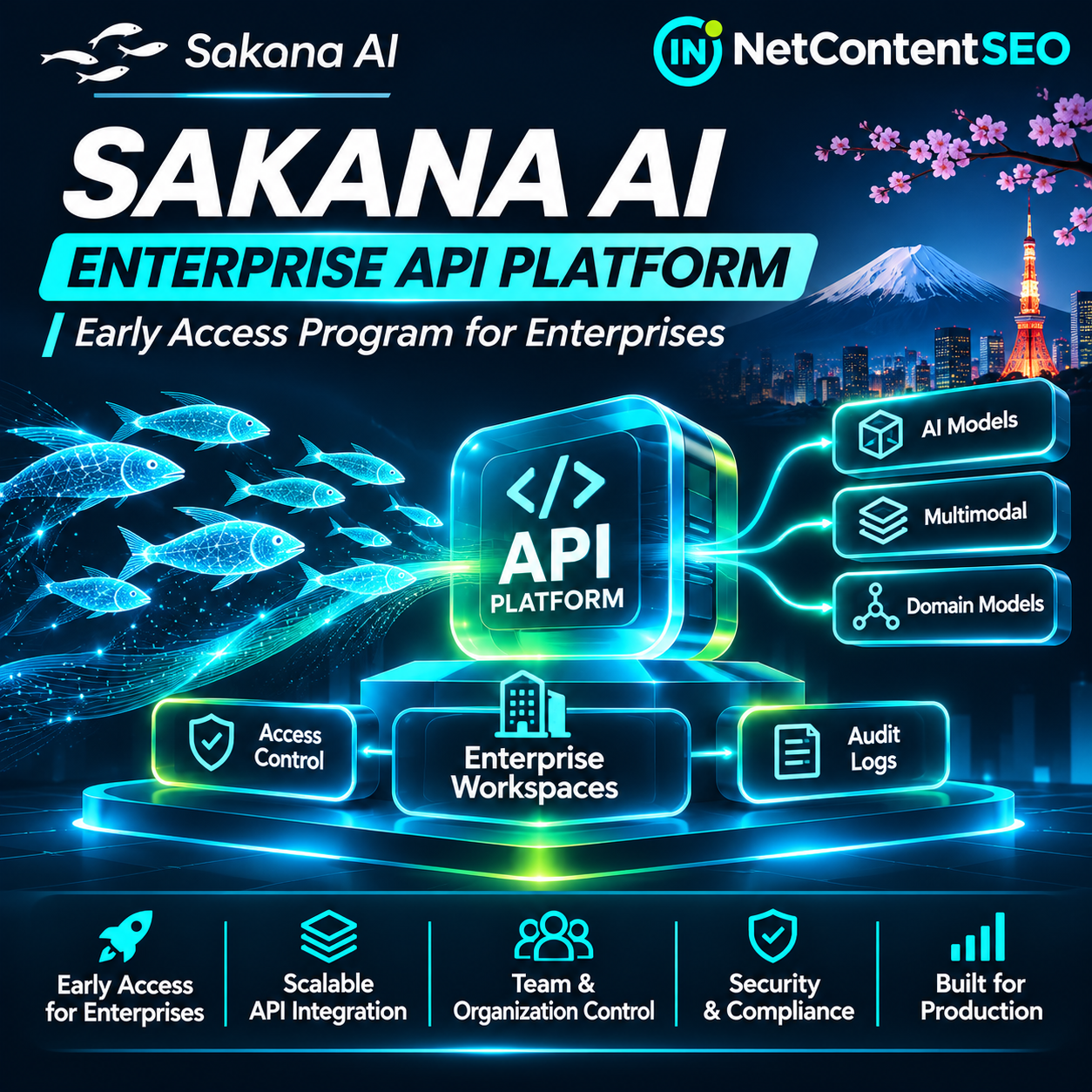

November 9, 2026. Japan's Sakana AI has opened an early access program for its new enterprise API platform, adding organization-level management, access controls and billing features to the company's model portfolio. The announcement, published on October 28, marks a shift from offering individual model APIs toward infrastructure designed for teams and businesses running AI systems in production.
The official Sakana API Platform announcement is available in both Japanese and English. Sakana says its APIs are OpenAI-compatible, allowing developers already using compatible SDKs to change their endpoint rather than redesign an entire application. The first models named for the enterprise platform are Sakana Fugu and Fugu Ultra. Sakana Namazu and Fugu Max are scheduled to follow, with no firm dates disclosed in the launch notice.
For SEO and AI search professionals, the significance is not that Sakana has launched a new public search engine. It has not. The development is that more organizations can build their own retrieval, analysis and decision-support applications around Japanese and multi-model AI infrastructure. Where those applications obtain their information—and which sources they select—could become an important part of digital discovery.
What Sakana API Platform offers
The platform combines model access with administrative capabilities intended for enterprise use. Sakana lists organization and workspace management, centralized control of members and API keys, role-based access control, usage visibility, budget limits, CSV-downloadable audit logs, invoice payment, and support for master service agreements and data processing agreements.
Sakana also states in its data-handling terms that customer inputs are not used for model training. That is an important commercial assurance, but it is not a substitute for reviewing the actual contract, retention rules, security architecture and data-processing arrangements for a particular deployment.
The company's screenshot of the administration console is explicitly illustrative: it uses fictional data and may change without notice. Buyers should therefore confirm which controls are enabled in their own early access environment rather than assuming every interface detail shown is final.
Fugu and Fugu Ultra arrive first
Sakana Fugu is not simply another standalone chatbot. The company describes it as an orchestration foundation model that selects and coordinates multiple frontier models according to the workload. Its approach builds on Sakana's research called Trinity and Conductor, accepted at ICLR 2026.
This architecture matters because enterprise applications often need to balance quality, latency, cost and task complexity. A workflow may benefit from a relatively inexpensive model for routine classification and a more capable model for difficult reasoning. Sakana's orchestration strategy is designed to manage combinations of models rather than require the customer to choose a single model for every request.
Fugu and Fugu Ultra are the initial enterprise offerings announced for the new platform. Fugu Max is planned for a later phase. Sakana's separate developer documentation currently describes additional models and endpoints, but availability through existing APIs should not be confused with enrollment or entitlement under the new enterprise early access program.
Where Sakana Namazu fits into the Japanese AI ecosystem
Sakana Namazu is a Japanese-focused language model designed around the language and cultural context of Japan. That specialization is relevant for domestic enterprise knowledge systems, customer service, document analysis and applications that must understand Japanese terminology and local business practices.
The October 28 enterprise announcement says Namazu will join the platform later. Sakana's existing developer documentation separately describes Namazu API access and capabilities such as web search, code execution and file inputs. These are documented capabilities of the model's broader API offering, not proof that every feature is already available inside the new enterprise platform.
The distinction between a model optimized for Japanese and an application that searches Japanese websites is equally important. Language specialization may improve an application's ability to interpret local queries and documents, but it does not by itself create a public index or guarantee that Japanese publishers will be cited.
OpenAI-compatible APIs lower the migration barrier
Compatibility is a practical part of Sakana's positioning. Its developer documentation shows the API base URL as https://api.sakana.ai/v1, with examples using the OpenAI SDK interface. Existing applications can potentially test Sakana models by updating their API configuration and model selection.
That does not mean all features behave identically across providers. Tool calls, response formats, context limits, reasoning settings, streaming behavior, error handling and rate limits should be validated against the relevant model and account. Enterprise authentication, workspace controls and commercial terms also need to be confirmed during onboarding.
For teams considering a pilot, a sensible first step is to test a small, representative workload against their current provider. Compare answer accuracy, Japanese-language performance, latency, cost, reliability and the correctness of any tool calls before attempting a larger migration.
Why this matters for agentic search and enterprise discovery
Public search engines are only one way users and organizations discover information. Companies are increasingly building assistants that retrieve internal documents, search approved external sources, compare vendors or answer questions using curated knowledge bases.
Sakana's enterprise platform could support such applications by providing managed access to its models. A Japanese retailer, for example, might build an assistant that retrieves product documentation and recommends the appropriate category. A professional services firm could build a research assistant that combines internal reports with authorized external information. In each case, the retrieval and selection rules are defined by the application, not by an automatic Sakana-wide search ranking.
This creates a concrete GEO question: is a company's information accessible, accurate and usable by the systems that matter to its customers? In some cases the answer will depend on public websites. In others it may depend on a business directory, a licensed dataset, a partner integration or a private knowledge base.
It would be premature to claim that Sakana API Platform introduces a new source of measurable organic traffic. No public publisher dashboard, citation ranking system or general web search referral channel was announced with this enterprise launch.
Practical implications for SEO and GEO teams
Organizations preparing for agent-driven discovery should focus on information quality and integration readiness rather than trying to optimize for an unannounced ranking algorithm.
- Maintain consistent entity information: ensure organization names, product descriptions, service categories, locations and contact information are accurate across relevant sources.
- Publish useful, verifiable content: explain capabilities, eligibility, pricing conditions, limitations and procedures clearly enough for retrieval systems to answer real questions.
- Support Japanese-language intent: for Japan-facing brands, evaluate whether content answers local queries naturally rather than relying only on literal translations of English pages.
- Review authorized data access: understand whether the target assistant uses public search, private documents, third-party feeds or APIs. Each requires a different visibility strategy.
- Measure actual inclusion: run representative queries through the deployed application, record the retrieved sources and compare results over time.
- Separate mentions from conversions: a model naming a brand is not the same as a qualified lead, a transaction or a measurable website visit.
Enterprise governance is part of the story
The administrative features may be as important as the models themselves. Centralized API-key management and role-based access can help teams separate development from production. Budget limits can reduce the risk of unexpected usage costs. Audit logs can help operators investigate which systems made requests and when, subject to the actual logging fields and retention arrangements provided.
Invoice billing and enterprise agreements can also make adoption easier for organizations that cannot rely on individual developer credit cards. Still, the launch does not publish the price of the enterprise platform, minimum commitments, service-level agreements, geographic availability or a date for general availability. Sakana says these details will be provided individually to applicants.
That uncertainty should be reflected in procurement comparisons. Pricing for existing standalone Sakana APIs is not necessarily the pricing for the new enterprise platform.
How to apply for Sakana API Platform early access
Interested organizations can visit the official announcement and early access application. Sakana says it will review applications, contact companies individually and enable access as it becomes ready. Acceptance is not guaranteed, and the company has not published a universal enrollment date.
Before applying, teams should identify their intended workloads, expected request volume, required models, security and compliance requirements, and the applications that would use the API. Ask Sakana to clarify platform pricing, regional availability, data retention, model availability, support terms, audit-log scope and any contractual commitments before a production rollout.
What is confirmed—and what remains unknown?
| Question | Status |
|---|---|
| Was Sakana API Platform announced? | Yes, October 28, 2026. |
| Is early access open for applications? | Yes; access is granted individually as capacity and readiness permit. |
| Which models were named for the initial enterprise offering? | Fugu and Fugu Ultra. |
| Are Namazu and Fugu Max planned? | Yes, with no specific enterprise rollout dates announced. |
| Is the API OpenAI-compatible? | Yes, according to Sakana. |
| Are enterprise prices public? | No; pricing and conditions are shared with applicants. |
| Is this a public search engine? | No; it is an enterprise model-access and management platform. |
| Does the announcement prove new AI search traffic or citation opportunities? | No; no public search ranking or publisher analytics product was announced. |
Frequently asked questions
What is Sakana API Platform?
It is Sakana AI's enterprise-oriented platform for accessing its language models through APIs while managing users, workspaces, keys, usage, budgets and related administrative controls.
When did Sakana announce the enterprise early access program?
The official announcement is dated October 28, 2026.
Which models are included first?
Sakana identifies Fugu and Fugu Ultra as the initial models. Namazu and Fugu Max are planned for later availability within the enterprise platform.
How much does Sakana API Platform cost?
Enterprise pricing has not been published. Sakana says it will provide prices and terms individually when contacting applicants.
Can developers use the OpenAI SDK?
Sakana documents OpenAI-compatible APIs and SDK examples. Developers should still test model-specific behavior, supported features and account entitlements.
Does Sakana API Platform replace Google or ChatGPT Search?
No. The announcement concerns enterprise API access and administration. Search or retrieval capabilities in a customer application depend on how that application is designed and connected.
Does the platform guarantee GDPR or other regulatory compliance?
No. Sakana lists contractual and data-handling features, but customers must evaluate the applicable agreement, processing arrangements, security requirements and legal obligations for their own deployment.
Conclusion: a Japanese AI ecosystem moves closer to enterprise infrastructure
Sakana API Platform is a meaningful step in the company's evolution from research and individual model APIs toward managed enterprise adoption. The OpenAI-compatible interface reduces integration friction, while workspaces, access controls, audit logs and billing features address practical obstacles that can slow deployment.
For the search industry, the long-term implication is not a new public ranking factor. It is the expansion of AI systems that can retrieve, interpret and act on information within organization-specific workflows. As more regional AI providers build their own infrastructure, digital visibility will increasingly depend on which information sources those systems are allowed to access—and whether the information they find is trustworthy and useful.