

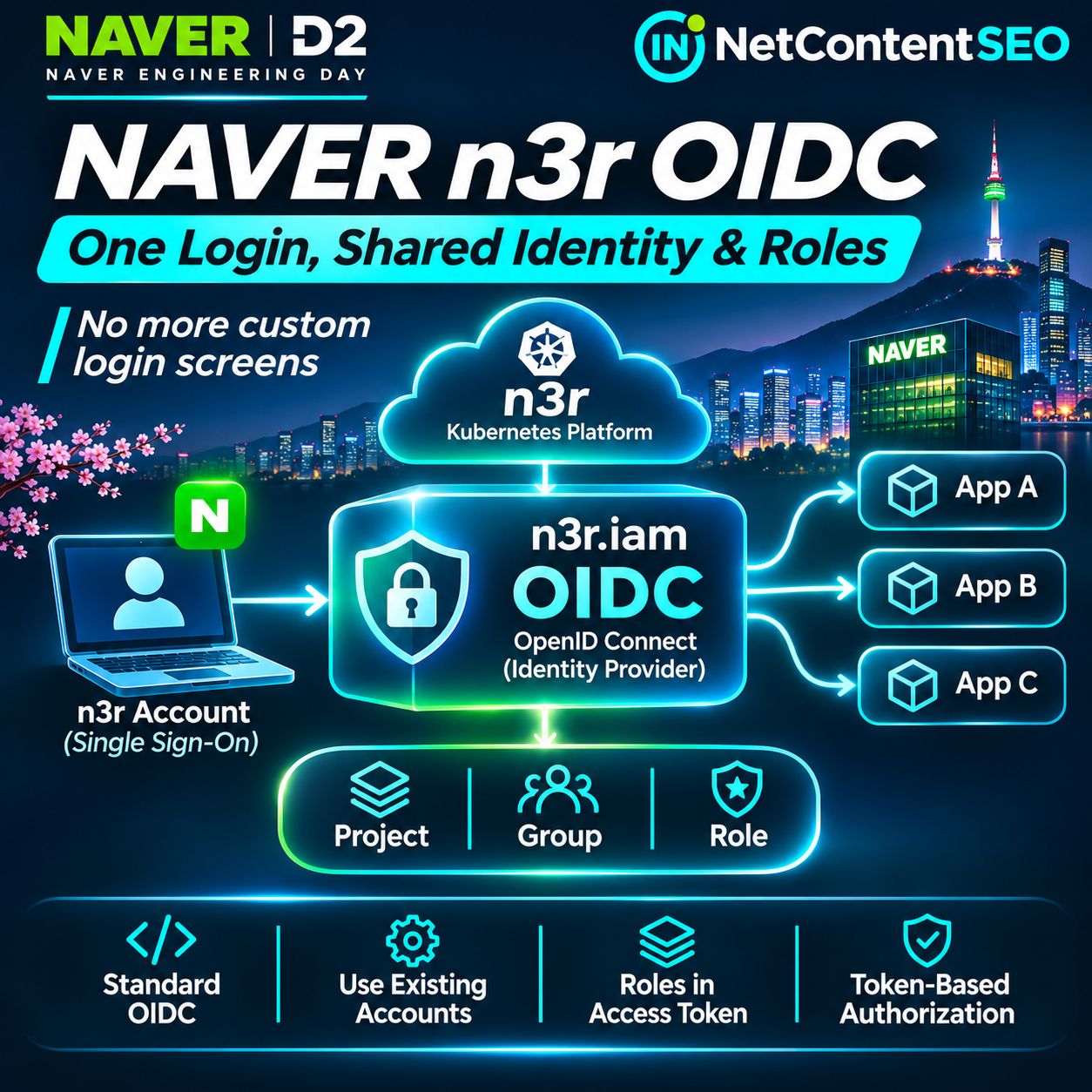

NAVER has shared a technical presentation explaining how its internal Kubernetes-based container platform, n3r, uses OpenID Connect (OIDC) to simplify login and authorization across applications. The session, titled “Stop Building Login Screens — n3r OIDC”, was presented at NAVER Engineering Day 10th and made available through NAVER D2.
The engineering story is straightforward: instead of asking every application team to build and maintain its own login screen and permission integration, NAVER extended its existing identity service, n3r.iam, to act as an OIDC provider. Applications can reuse an n3r account and receive identity information together with the project's roles and groups in tokens. The result is a more consistent foundation for authentication and authorization across internal services.
Although this is not a new AI model or public search product, it is relevant to the infrastructure behind enterprise applications. The same identity and access-control challenges arise when organizations deploy internal AI assistants, retrieval systems and agents that interact with protected services. That connection is an architectural implication, not a claim that NAVER announced a new AI agent feature in this presentation.
What NAVER announced in its engineering session
The presentation describes how n3r.iam was expanded into an OpenID Connect provider and how developers can attach “Sign in with n3r” to applications running on NAVER's internal platform. NAVER explains how its existing project, role and group information is represented in tokens, how an application registers as an OIDC client and how access tokens are used to call n3r APIs.
The source is a technical knowledge-sharing session, not an announcement of a consumer-facing login product. The term n3r refers to NAVER's internal Kubernetes-based container platform, not to NAVER's public account system or a third-party identity service that any website can immediately adopt.
Why teams should not keep rebuilding login screens
Every independently built login implementation creates recurring work: handling sign-in flows, session management, access permissions, changes to user roles and security updates. When an organization already has an identity service, duplicating those responsibilities in every application can increase maintenance overhead and create inconsistent access behavior.
OIDC offers a standardized way for applications to delegate authentication to an identity provider. A developer registers an application as a client, configures the required endpoints and redirect behavior, and uses the resulting identity information rather than maintaining a separate password-based login experience.
This does not eliminate the need for security engineering. Applications still have to validate tokens, protect sessions, implement authorization and handle errors correctly. The benefit is that teams can reuse a common identity foundation instead of rebuilding the same authentication mechanism for each service.
How the n3r OIDC integration works
NAVER organizes the implementation section of its presentation around three steps: registering a client, configuring the integration and understanding the n3r information carried in the token. Its session outline also includes the full login flow and an integration checklist.
- Register the application: create an OIDC client in the n3r identity environment and establish the application-specific configuration.
- Configure OIDC integration: connect the application to the identity provider using the appropriate OIDC settings and login flow.
- Read the identity and authorization context: use the resulting token information to identify the user and their n3r project, role and group context.
- Authorize API requests: present the appropriate access token to n3r APIs, which use role information to determine whether an action is permitted.
- Handle changes in access: NAVER's design requires a new access token for changed role information to take effect.
The source summary does not provide production endpoint URLs, claim names, token lifetimes or a copy-paste client configuration. Developers should obtain those values from the actual internal documentation rather than infer them from the presentation's outline.
Authentication and authorization are not the same thing
A central point of the presentation is that knowing who a user is is different from knowing what that user may do. OIDC provides a standardized identity layer. NAVER then connects that identity to the platform's own projects, roles and groups.
For example, a user might successfully authenticate to an internal application but lack permission to administer a particular project. The application and API must enforce that distinction. NAVER's session explains that n3r APIs use role information in the access token when authorizing requests.
In general OIDC implementations, an ID token communicates authentication information to the client, while an access token is intended for accessing protected resources. Developers should not treat the two as interchangeable. Any platform-specific claims or role conventions must be validated according to the identity provider's documented contract.
Why putting roles in tokens creates a trade-off
NAVER's design includes user project, role and group information in standard token-based flows. This can make authorization more straightforward for downstream services because relevant access context travels with the request.
But role-bearing tokens introduce a familiar problem: permissions can change while an already-issued token remains valid. NAVER's presentation explicitly states that role changes are reflected by issuing a new access token. That makes token refresh and expiration behavior important parts of the authorization design.
For teams building similar systems, the security question is how quickly a revoked or reduced permission must stop working. Short-lived access tokens, appropriate refresh policies, audience validation and resource-server checks may help, but the right approach depends on the threat model. The presentation does not disclose the exact token lifetime or revocation mechanism used in n3r, so those details should not be assumed.
What this means for enterprise AI agents
Internal AI agents often need to retrieve documents, inspect project resources or invoke business APIs on behalf of a user. That creates the same identity challenge described by NAVER: an agent must know which user it represents and what that user is authorized to access.
An OIDC-based identity foundation can be one component of that architecture. A retrieval assistant could authenticate the employee, use a properly scoped credential to access an approved document service and prevent retrieval from projects the employee is not permitted to see. An operational agent might be allowed to inspect deployment status but not modify production infrastructure without additional authorization.
These are illustrative enterprise patterns, not features claimed for n3r OIDC in NAVER's session. In particular, a token containing a user's role does not automatically make every tool call safe. Agents still need explicit permission boundaries, action confirmation where appropriate, logging and defenses against instructions embedded in untrusted retrieved content.
Does n3r OIDC change SEO or AI Search rankings?
No direct ranking or citation change is described. The presentation concerns internal authentication and authorization, not NAVER Search's public ranking systems, HyperCLOVA X, consumer search results or publisher visibility.
Its relevance to SEO and GEO is indirect. As businesses deploy more internal and customer-facing AI applications, the information an assistant can retrieve may depend on identity, access policies and authorized integrations. Publicly indexable content and private enterprise knowledge are not interchangeable. An assistant that cannot access a protected document should not be expected to cite it simply because the document is well written or uses structured data.
For organizations measuring AI visibility, this suggests a useful distinction: test public search discovery separately from authorized enterprise retrieval. A missing result may reflect access permissions, not a relevance or ranking problem.
Implementation checklist for engineers
- Identify which applications should rely on the shared identity provider and which user groups need access.
- Register each client with correctly scoped redirect URIs and suitable authentication flow settings.
- Validate issuer, audience, signatures, token expiration and other relevant claims using the provider's actual documentation.
- Distinguish ID tokens from access tokens and never use an unvalidated client-side claim as the sole basis for privileged actions.
- Define project, role and group mappings explicitly, including default-deny behavior when required information is missing.
- Test role changes, token renewal, expired sessions, revoked access and cross-project isolation.
- Protect tokens and secrets in logs, browsers and backend systems; avoid exposing access tokens in URLs.
- For AI agents, separately authorize each connected tool and sensitive action rather than assuming login alone grants permission.
This checklist combines the integration themes in NAVER's session with general security engineering practices. It is not a verbatim reproduction of NAVER's internal checklist.
What is confirmed and what remains unspecified?
| Topic | Evidence |
|---|---|
| n3r is an internal Kubernetes-based container platform. | Explicitly stated in the NAVER D2 session summary. |
| n3r.iam was extended to function as an OIDC provider. | Explicitly described in the presentation. |
| Project, role and group information is carried in tokens. | Explicitly described in the presentation outline. |
| n3r APIs use access-token role information for authorization. | Explicitly described in the presentation outline. |
| Role changes require a newly issued access token to be reflected. | Explicitly described in the presentation outline. |
| Public availability, pricing or third-party signup. | Not announced in the supplied source. |
| Specific token claims, lifetimes or endpoints. | Not available in the supplied summary. |
| New AI search or SEO ranking functionality. | Not claimed by NAVER. |
Frequently asked questions
What is NAVER n3r OIDC?
It is an internal identity integration that extends NAVER's n3r.iam service into an OpenID Connect provider, allowing n3r applications to reuse existing accounts and authorization context.
What is n3r?
According to NAVER D2, n3r is NAVER's internal Kubernetes-based container platform.
Does OIDC remove the need to build a login screen?
It allows applications to delegate authentication to a shared identity provider rather than implement separate login mechanisms. Developers still need secure client integration, session handling and authorization.
What information does NAVER include in the tokens?
The presentation describes user project, role and group information. The supplied summary does not specify exact claim names or token schemas.
How do role changes take effect?
NAVER says changed role information is reflected when a new access token is issued.
Can external developers use n3r OIDC?
The source describes an internal NAVER platform integration. It does not announce a publicly available OIDC service or external enrollment process.
Is n3r OIDC a new AI product?
No. It is identity and access-control infrastructure. Its relevance to AI agents is a potential architectural application, not a feature announced in the session.
Does this affect NAVER Search rankings?
No ranking or public search changes are described in the source.
The bigger lesson: shared identity is infrastructure, not a shortcut
NAVER's n3r OIDC session illustrates an engineering choice with broad relevance: centralize authentication where possible, carry authorization context through well-defined token flows and make permission changes an explicit part of the design.
For enterprise software teams, the immediate benefit is less repeated login engineering and a more consistent security model. For teams building AI assistants and agents, the lesson is that trustworthy automation depends on knowing who is requesting an action and whether the connected systems should permit it. Neither problem is solved by the model alone.
Sources
- NAVER D2 — 로그인 화면, 이제 만들지 마세요 - n3r OIDC (Stop Building Login Screens — n3r OIDC). Source presentation outline supplied by the publisher; full page could not be independently retrieved during preparation.
- NAVER D2 — Engineering articles and technical presentations.
- NAVER D2 — OAuth and OpenID background.