

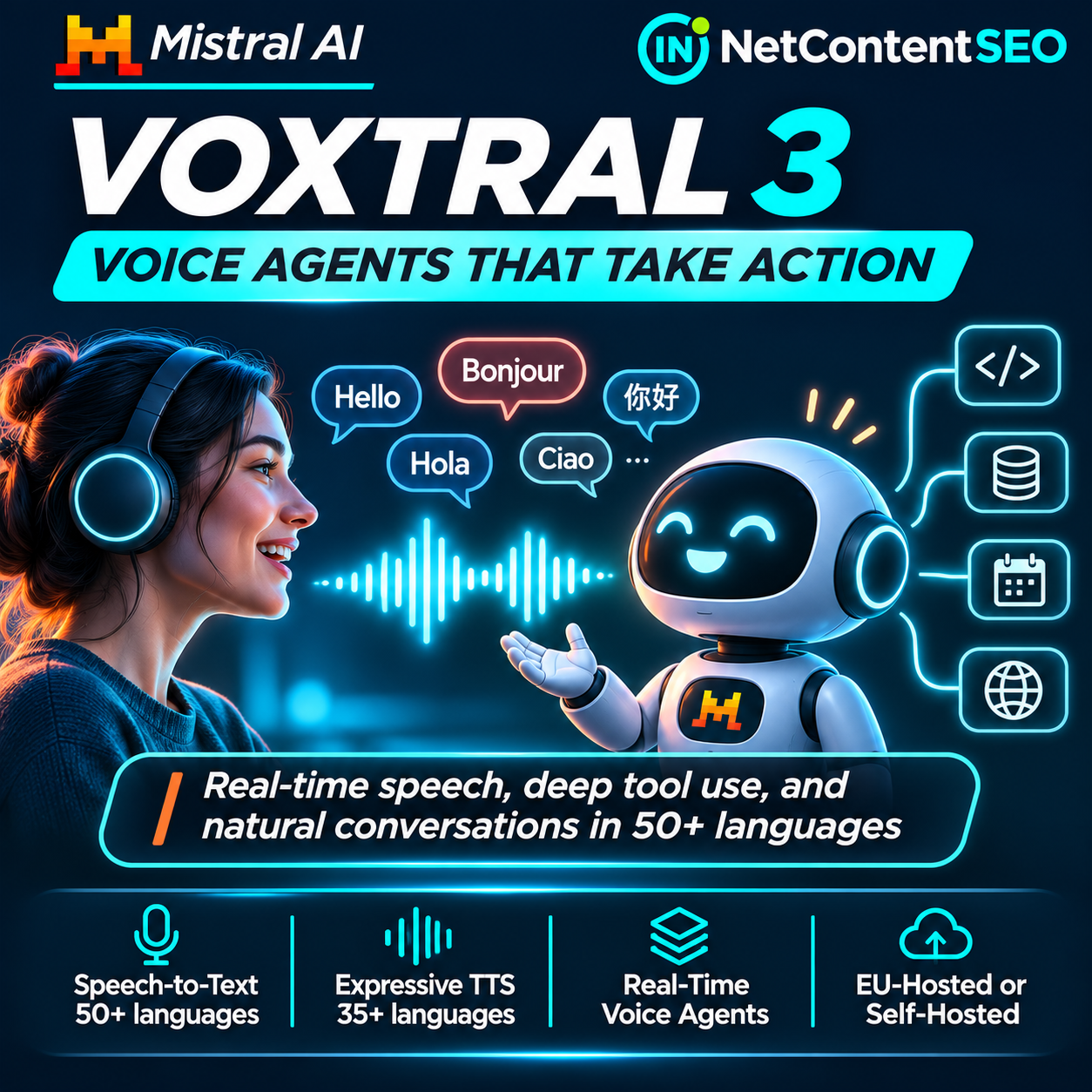

November 9, 2026. Mistral AI has introduced Voxtral 3, a family of speech models and a voice agent SDK designed to combine listening, reasoning, tool calls and spoken responses in a real-time workflow. For organizations building customer service, booking, support and hands-free assistants, the announcement is about more than generating a convincing voice: it is about turning a conversation into an authorized business action.
The French AI company says the family supports transcription in more than 50 languages, expressive text-to-speech in more than 35 languages and real-time speech recognition with sub-500-millisecond latency in over 35 languages. These numbers describe different components, not one model that performs every function identically. Mistral offers an EU-hosted API and self-deployment options, making infrastructure and data control part of its positioning.
What Mistral actually launched
Voxtral 3 combines several specialized capabilities. Voxtral Small Transcribe 3 targets multilingual speech-to-text, including speaker diarization, context biasing and end-of-turn detection. Voxtral Mini Transcribe 3 is a smaller 4-billion-parameter option; Mistral advertises a price of $0.0035 per minute. Voxtral Realtime Transcribe 3 focuses on low-latency recognition for live agent interactions, with claimed latency below 500 milliseconds across more than 35 languages. Voxtral Mini TTS 3 generates speech with contextual emotion, pacing and emphasis, covering over 35 languages and 50 dialects. Finally, the voice agent SDK orchestrates recognition, reasoning, tool use and synthesis into a streaming application.
The product announcement also describes Pro Voice adaptation, which Mistral says can reproduce a speaker's characteristic style and emotional range from approximately 30 minutes of recorded audio. That capability introduces additional operational questions about consent, authentication and permissible use of voice likenesses. A deployment should not assume that technical availability constitutes permission to clone a person's voice.
Why the voice agent SDK matters more than another transcription benchmark
Traditional speech applications often separate transcription, language-model processing, application logic and speech synthesis into distinct stages. Each stage can introduce delay, context loss or integration complexity. Mistral's SDK is intended to make these stages work together during a live exchange, including interruptions, multi-step reasoning and calls to connected tools.
Consider a customer asking a clinic for an appointment in one language while holding a referral letter in another. A voice agent could identify the request, retrieve the relevant appointment slots, ask for confirmation and submit a booking through an authorized system. Mistral demonstrates a similar scenario in its launch material. The demonstration illustrates a potential workflow; it does not establish that every healthcare integration or booking service is supported out of the box.
The distinction is important: a voice model that can answer questions is not necessarily an agent that can complete a task. Tool connections, permissions, reliable data and error handling determine whether a deployment can safely move from speech to action.
Multilingual speech recognition and contextual vocabulary
Mistral says Voxtral Small Transcribe 3 covers more than 50 languages, including all 24 official EU languages and additional Asian and Indian languages. It supports diarization—identifying which speaker said what—and context biasing, which lets developers provide key terms or other context to improve recognition of domain-specific vocabulary.
For a travel company, context might include local place names, hotel names or unfamiliar pronunciations. For a service business, it could include product identifiers, technical terminology or employee names. Context biasing is useful because many customer-service failures involve the recognition of a specific name or number rather than a general misunderstanding of the sentence.
Mistral presents multilingual benchmark comparisons against competing transcription systems, including Whisper, Scribe and Gemini variants. These are vendor-published evaluations, and performance can vary with background noise, accents, audio quality, the evaluation dataset and whether the spoken language is specified or automatically detected. Enterprises should validate accuracy on recordings representative of their own customers before drawing procurement conclusions.
Real-time transcription: latency is only one measure of quality
The realtime model is positioned for agentic applications and supports diarization, context biasing and end-of-turn prediction. Mistral says it can deliver high-quality transcriptions with latency below 500 milliseconds in more than 35 languages.
Low latency matters because long pauses make voice conversations feel awkward. But a fast agent that interrupts users or acts on incomplete requests is not necessarily a better one. Production evaluation should include interruption handling, turn-taking, recognition of corrections, end-to-end response time and the success rate of completed actions.
For multilingual contact centers, those tests should be repeated across relevant accents and noisy environments, not only on clean demonstration audio.
Expressive text-to-speech and the role of brand voice
Voxtral Mini TTS 3 introduces context-sensitive speech generation that can adjust emotion, pacing and emphasis. Mistral says the model supports more than 35 languages and 50 dialects and lists a price of $13 per million characters. These are published launch prices, not a guarantee of total application cost; reasoning, transcription, hosting, telephony and tool usage may add expenses.
Expressive speech may make support interactions more understandable, but it also raises expectations. Users need clear signals that they are speaking to an AI system, particularly when the agent handles financial, medical or other sensitive requests. Voice adaptation should require consent and strong controls against impersonation.
EU hosting and self-deployment: what sovereignty means in practice
Mistral says Voxtral 3 is available through its EU-hosted API or for self-deployment on customer infrastructure. This provides organizations with different ways to control processing location and retention policies.
However, hosting in Europe or running a model on private servers does not automatically establish GDPR compliance or meet every sector-specific obligation. Buyers still need to review contractual terms, processor roles, data retention, security, access logging, transfers, recording consent and the systems reached through tool integrations.
Self-deployment can provide greater operational control but also shifts infrastructure, patching, monitoring and reliability responsibilities to the organization.
What Voxtral 3 changes for SEO, GEO and AI discovery
For SEO professionals, the most interesting implication is the potential migration of some discovery journeys from visual search results to spoken conversations with connected agents. A user might ask an assistant to find a local service, compare providers, check availability and book an appointment without opening a conventional search-results page.
That does not mean Voxtral 3 is itself a new search engine or that Mistral has announced a public ranking system for businesses. Voxtral supplies voice and agent-building components. Whether a specific application retrieves websites, searches an internal knowledge base, consults a booking API or selects among providers depends on how its developer designs the system.
Visibility therefore becomes partly an integration question. A business may be discoverable because its information appears in a connected search index, a trustworthy third-party source, an authorized business directory or a structured service API. A model's speech quality alone does not determine which provider is recommended.
From search rankings to action eligibility
Imagine a traveler asking a voice assistant: “Find a restaurant near my hotel with vegetarian options and book a table for four tomorrow evening.” The agent needs reliable information about the restaurant's location, menu, opening hours and reservation availability, along with permission to complete the booking. A conventional ranking position is only one possible input, and may not be used at all if the assistant relies on connected business systems.
This suggests a practical GEO priority: maintain accurate, consistent and accessible business facts, and make legitimate transactional integrations available where appropriate. It does not establish that adding Schema.org markup guarantees inclusion in Voxtral-powered assistants. Structured data can help participating systems interpret content, but an agent must actually retrieve and use that data for it to affect a result.
A practical checklist for businesses preparing for voice agents
- Audit business facts: keep names, addresses, contact details, service areas, hours, prices and booking policies accurate across owned properties and relevant directories.
- Make answers actionable: publish clear requirements, exceptions, availability rules, cancellation policies and next steps instead of vague marketing copy.
- Document authorized integrations: provide secure APIs or booking workflows where they are commercially and technically appropriate; do not expose sensitive operations without authentication.
- Test spoken queries: evaluate how the agent handles accents, corrections, multilingual requests, ambiguous place names and background noise.
- Measure completion: distinguish successful appointments, qualified leads and resolved service requests from transcript accuracy or conversational engagement alone.
- Protect users: require confirmation for consequential actions, disclose AI involvement, protect voice data and provide human escalation.
- Check data provenance: identify which source supplied each recommendation and whether the information was current when the action was taken.
How developers can evaluate Voxtral 3
Start with the official Mistral documentation and developer console. Choose the component that matches the use case: batch transcription, realtime transcription, speech generation or a full conversational agent. Then test the end-to-end application with representative audio and real authorization constraints.
Track word error rate, diarization quality, domain-specific term recall, end-of-turn accuracy, total response latency, tool-call accuracy, failed actions, escalation rates and cost per completed workflow. For customer-facing deployments, include privacy and safety reviews before production release.
At published list prices, 1,000 minutes of Mini transcription at $0.0035 per minute would represent approximately $3.50 in transcription charges alone, before any other service or infrastructure costs. Similarly, one million characters of TTS is advertised at $13. These examples are arithmetic illustrations, not quotes for a full voice agent.
Frequently asked questions
What is Voxtral 3?
Voxtral 3 is Mistral AI's family of speech-to-text and text-to-speech models, accompanied by a voice agent SDK for real-time conversations that can interact with connected tools and business systems.
Does Voxtral 3 support more than 50 languages?
Mistral says its multilingual transcription offering supports more than 50 languages. The realtime transcription and text-to-speech components have different stated coverage, so developers should check the supported language list for the specific model.
Can Voxtral 3 make bookings or use business tools?
Agents built with the SDK can call connected tools and execute multi-step workflows. Actual booking or transaction capabilities depend on the application's integrations, permissions and confirmation logic.
Is Voxtral 3 a search engine?
No. It is a speech-model family and agent-development toolkit. A developer can connect an agent to search or retrieval systems, but Mistral has not presented Voxtral 3 as a public web search engine with its own universal ranking index.
How much does Voxtral 3 cost?
Mistral advertises Mini transcription at $0.0035 per minute and Voxtral Mini TTS 3 at $13 per million characters. Full agent costs depend on the selected components, infrastructure and other connected services; current pricing should be checked before deployment.
Can organizations self-host Voxtral 3?
Mistral says the family supports self-deployment as well as access through an EU-hosted API. Deployment options and hardware requirements should be confirmed in the documentation for each component.
Does Voxtral 3 automatically improve a company's AI search visibility?
No. It does not create an automatic citation or ranking advantage. Visibility in a Voxtral-powered application depends on the data sources, retrieval methods and business integrations selected by its developer.
The bigger shift: voice is becoming an interface for action
Voxtral 3 illustrates a shift from speech recognition as a standalone feature toward voice as an interface for software workflows. Its significance lies in connecting language understanding, natural speech and authorized tool use while giving enterprises options for infrastructure control.
For SEO and GEO teams, the practical lesson is not to chase a hypothetical Voxtral ranking factor. It is to prepare reliable information and service integrations for a future in which users increasingly discover, evaluate and act through conversational agents. The quality of the underlying information—and the ability to complete the requested task—will matter at least as much as how naturally an assistant speaks.