

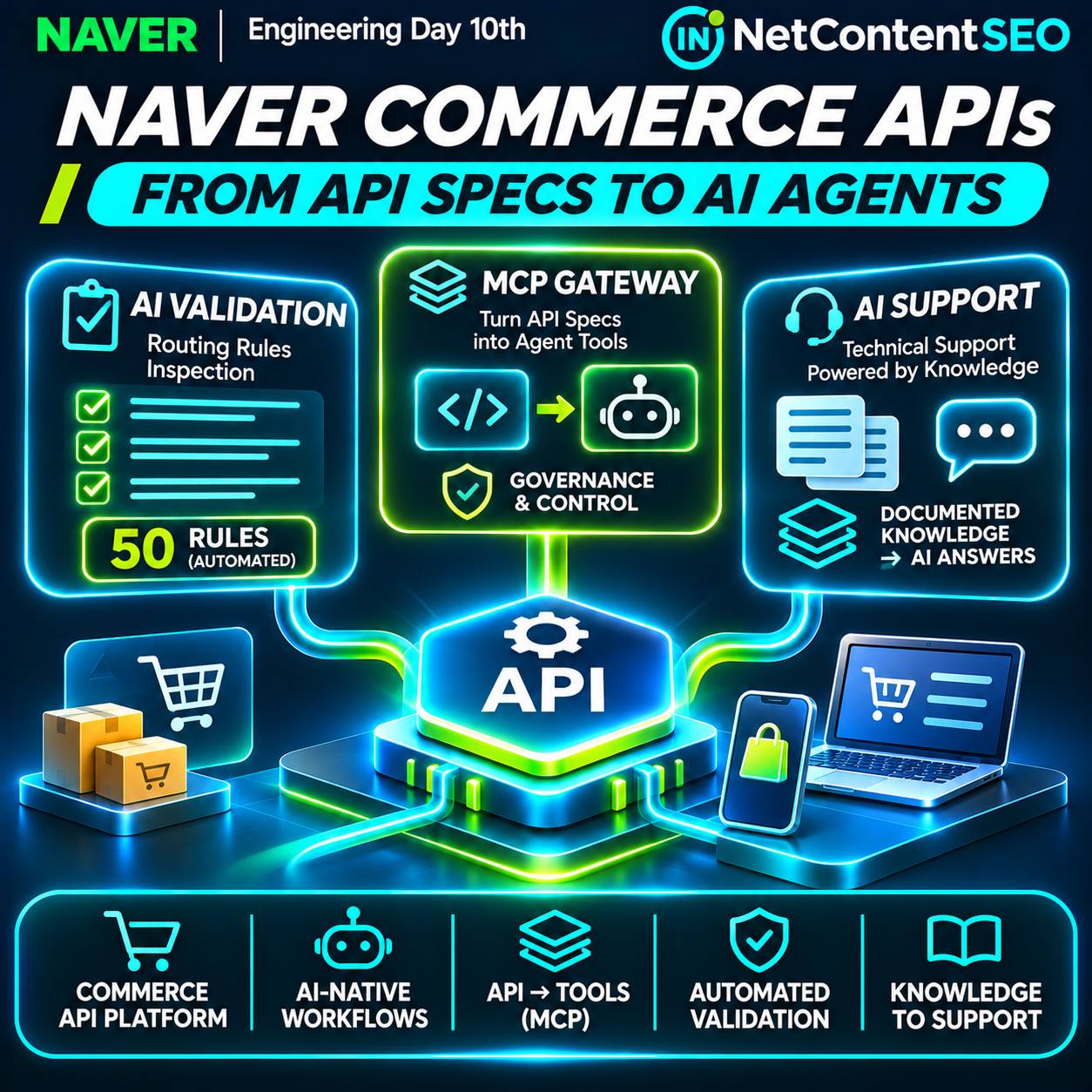

What happens when an API specification becomes more than documentation for developers? At NAVER, the same commerce API specification is being used in three AI-native workflows: checking routing rules, providing evidence for technical support answers, and exposing approved operations as tools an AI agent can invoke.
That is the premise of a NAVER Engineering Day 10th presentation titled “검수도 답변도 호출도 AI가? 커머스API의 2026” (“AI for Validation, Answers and Calls? Commerce API in 2026”). Its published session description outlines three projects undertaken by NAVER's Commerce API platform team during 2026. Together, they suggest an important shift: API specifications can serve as shared operational assets across governance, support and agent execution.
For SEO and AI Search, the most interesting implication is not a new chatbot. It is the prospect of agent-accessible commerce services, where an assistant could move from finding information about a product or merchant to invoking an authorized service operation. NAVER's session does not establish that every Commerce API is publicly available to external agents or that such tools have produced measurable search referrals or sales.
Three AI-native projects inside NAVER's Commerce API platform
The Korean session outline describes three chapters, each addressing a different operational problem:
- AI validation of routing rules: turning 50 existing automated rules into data and building an engine capable of inspecting rules that require judgment, not just simple deterministic checks.
- MCP gateway: converting API specifications into tools callable by AI agents, while placing tool calls behind the same inspection and control processes.
- AI-assisted technical support: consolidating scattered operational knowledge into reusable knowledge assets, AI-readable documentation and an assistant for responding to inquiries.
The presentation is aimed at backend developers, API and gateway operators, and engineers connecting LLMs or the Model Context Protocol (MCP) to services. The source outline says the team discusses design decisions and operational results, but it does not supply quantitative accuracy, cost, latency or productivity figures. Such outcomes should not be inferred.
1. Turning 50 routing rules into data for AI validation
Routing rules determine where requests go and how a platform applies operational constraints. Traditional automated validation is well suited to requirements that can be expressed as deterministic checks: required fields, valid paths, allowed methods, conflicting identifiers or schema compatibility. Other cases involve context or judgment that cannot easily be reduced to a single static rule.
NAVER's first chapter describes representing 50 automated routing rules as data and extending validation to rules that require judgment. The noteworthy architectural idea is to treat the rule inventory as an explicit, inspectable asset rather than leaving it scattered across application code and team knowledge.
This does not mean an LLM should be trusted as the final authority on whether a route is safe. A robust design would keep deterministic checks for hard constraints, use AI only where it provides value, preserve evidence for each assessment, and require review for high-impact changes. These are recommended controls, not a claim about NAVER's undisclosed implementation.
What should teams measure?
A team evaluating AI-assisted API inspection should measure false approvals, false rejections, reproducibility, reviewer workload, time per change and the rate of problems detected before deployment. The most important measure is not how many rules the model can read; it is whether the process reduces real operational risk without introducing new failure modes.
2. The MCP gateway: converting API specifications into agent tools
The second chapter introduces an MCP gateway that turns API definitions into tools AI agents can call and routes those calls through established validation and control. This is a meaningful architectural change. Instead of every agent team manually writing and maintaining a custom integration for each service, an organization can create a governed interface between existing APIs and agent-facing tools.
The Model Context Protocol specification defines tools as operations a server exposes for invocation by an AI application. Tool descriptions and input schemas help the application discover what a tool does and how to call it. MCP itself does not guarantee that a tool call is authorized, safe or appropriate for a specific user; those requirements depend on implementation and surrounding security controls.
For commerce, possible tool categories include checking product details, retrieving order status, requesting shipping estimates or initiating permitted account operations. These are illustrative examples of what commerce APIs might expose, not a confirmed inventory of NAVER's MCP tools.
Why a gateway matters more than simply exposing an endpoint
Agent-facing tools can trigger real effects. A model may generate a valid-looking request that is inappropriate for the user, outside the user's permissions or based on misunderstood context. A gateway can provide a central place to enforce authentication, authorization, input validation, rate limits, logging and approval requirements.
Tool descriptions also need to be precise. An agent should be able to distinguish a read-only product lookup from an action that changes an order or submits a refund. For sensitive operations, the application should require explicit confirmation and maintain auditable records. An AI model's decision to call a tool is not a substitute for permission checks performed by the service.
3. From scattered knowledge to AI-assisted technical support
The third chapter addresses a common operational bottleneck: technical answers are often buried in documents, support conversations, team notes and undocumented assumptions. NAVER describes consolidating that material into knowledge assets, preparing documentation readable by AI systems and using it to support inquiry responses.
The practical challenge is knowledge quality. If documentation is stale, contradictory or missing important exceptions, an assistant can produce fluent but incorrect guidance. Teams need clear ownership of API documentation, version information, examples, deprecation notices and links back to authoritative specifications.
For a technical support assistant, a defensible answer should identify the relevant API version, quote or link to the supporting documentation, distinguish verified behavior from interpretation, and escalate cases where the available knowledge is insufficient. These are best-practice recommendations; the presentation summary does not specify NAVER's retrieval architecture or answer-quality scores.
Why these three projects belong together
At first glance, routing validation, MCP tools and technical support look like separate AI use cases. They share a dependency: a trustworthy description of what the API is, how it behaves and which rules govern it.
When the same specification informs validation, support and tool invocation, inconsistencies become easier to detect. A documented parameter change can affect what the validator checks, what the support assistant explains and what the agent is permitted to send. That does not happen automatically; it requires version control, governance and synchronization between systems.
The architecture also introduces new risks. A misleading specification could propagate across all three workflows. Teams should therefore treat source-of-truth quality, change management and auditability as central requirements rather than assuming that AI automatically makes documentation reliable.
What is the difference between an API, an MCP tool and an AI agent?
An API exposes defined functionality through a technical interface. An MCP tool presents an operation in a format that an AI application can discover and invoke through the Model Context Protocol. An AI agent uses a model and application logic to decide when to request information or execute a permitted operation.
The layers are related but not interchangeable. Publishing an API does not automatically make it available as an MCP tool. Exposing a tool does not mean every AI assistant can access it. And making an operation available does not mean an agent should be authorized to execute it without human approval.
NAVER has also published a separate technical discussion of agents, workflows, context, memory, MCP and A2A, illustrating the importance of distinguishing these concepts when designing real systems.
What could agent-accessible commerce mean for product discovery?
Today, many shopping journeys involve separate steps: search for a product, compare merchants, open a product page, verify availability, and complete an order. Agent-facing commerce tools could allow some of those steps to be coordinated within an assistant, provided the relevant services expose authorized operations and the user consents.
For example, a future assistant could retrieve a product's specifications, check whether a merchant can deliver to a particular region and ask the user whether to proceed. The model would handle the conversation; the tool would provide a structured connection to the underlying commerce service. This is a hypothetical workflow, not a claim that NAVER's described MCP gateway currently offers public consumer checkout functionality.
The implication for digital discovery is that the point of interaction may shift from a web page to a tool-enabled assistant. Brands would then need to think about both how their information is represented in answers and whether their services can be accessed through supported, governed integrations.
Why this is relevant to SEO and GEO—but not a new ranking factor
Search engine optimization concerns discoverability in search systems. Generative Engine Optimization, or GEO, often focuses on how brands and information appear in AI-generated answers. Agent-accessible APIs introduce a related but distinct layer: actionability.
A business might be mentioned accurately in an AI answer but offer no direct way for the assistant to check inventory or complete a task. Another business might expose well-documented, authorized tools that allow an integrated assistant to perform those steps. Whether either business is recommended depends on the particular assistant, retrieval sources, tool access, user intent and commercial rules.
NAVER's presentation does not establish that MCP availability improves Naver Search rankings, increases citations in ChatGPT, or creates a universal new distribution channel. It describes platform engineering work. The GEO implications are an editorial analysis of what similar infrastructure could enable.
A related but separate NAVER API change in 2026
NAVER has independently announced a migration of certain developer APIs to NAVER Cloud Platform's NAVER API HUB. Its June 29, 2026 notice covers Search API, Search Trend API and Shopping Insight API, with new applications through the old developer center closing in July 2026 and legacy support scheduled to end in June 2027.
The same notice says that specific shopping, book and academic-information search API offerings were discontinued without a replacement through that migration path. This is a separate documented API policy development; it should not be conflated with the Commerce API MCP gateway discussed in the Engineering Day session. A public API migration is not evidence that NAVER's internal MCP gateway is generally available.
Practical checklist for businesses preparing agent-ready APIs
- Inventory existing operations. Separate read-only endpoints from actions that change user or business state.
- Make specifications authoritative. Keep schemas, parameter descriptions, errors, examples and version information accurate.
- Classify sensitive operations. Identify payments, refunds, account changes and other actions requiring stronger safeguards.
- Introduce an explicit tool boundary. Expose only approved operations and document what each tool may do.
- Enforce permissions at execution time. Do not rely on an LLM's interpretation of authorization.
- Require confirmation where appropriate. Give users a clear opportunity to approve consequential actions.
- Test tool-call failures. Validate malformed inputs, timeouts, retries, duplicate requests and partial completion.
- Log decisions and outcomes. Maintain audit trails without collecting unnecessary sensitive information.
- Evaluate AI-assisted support. Measure answer accuracy, citation quality, escalation rates and unresolved questions.
- Measure completed tasks. Track successful, authorized outcomes rather than counting tool calls alone.
What publishers and SEO teams should do now
Not every publisher needs an MCP server. For an editorial website, accessible pages, clear authorship, accurate entities and trustworthy citations may remain more important than tool integration. But a service provider, marketplace or booking platform should examine whether important actions are locked inside interfaces that future agent integrations cannot access.
Start with a concrete user task: checking availability, requesting a quote, comparing service options or retrieving order status. Identify which information is already public, which requires authentication and which actions need human approval. Only then decide whether a documented API, MCP integration or another supported mechanism is appropriate.
For measurement, keep separate dashboards for search impressions, AI referrals, assistant mentions, authorized tool calls and completed business transactions. An increase in MCP requests is not automatically an increase in organic search visibility or qualified customers.
Frequently asked questions
What did NAVER announce in its Commerce API Engineering Day session?
The session describes three AI-native platform projects: AI-assisted routing-rule validation, an MCP gateway converting API specifications into agent tools, and AI-assisted technical support based on consolidated documentation.
How many routing rules were involved?
The supplied NAVER presentation summary states that 50 automated routing rules were represented as data for the validation initiative. It does not provide a measured validation-accuracy rate.
What is an MCP gateway?
It is an architectural layer that can expose approved service operations as tools through MCP and apply controls around their use. The specific capabilities depend on its implementation.
Can external AI agents already use NAVER's Commerce API gateway?
The available presentation summary does not establish general public availability, supported clients or a public onboarding process. Developers should not assume access without official documentation.
Does MCP replace REST APIs?
No. MCP can present operations to AI applications while underlying services continue to use existing APIs and protocols.
Can AI safely approve API routing changes by itself?
That should not be assumed. Teams should preserve deterministic checks, risk-based review, access controls and audit trails, particularly for changes affecting production traffic.
Does this improve Naver Search rankings or ChatGPT citations?
No direct ranking or citation improvement has been demonstrated by this presentation. The relevant development concerns infrastructure for agent-accessible operations.
Is the Commerce API MCP gateway the same as NAVER API HUB?
No equivalence has been established. NAVER API HUB is part of a separately documented public developer API migration; the Engineering Day session discusses Commerce API platform projects.
The bottom line
NAVER's 2026 Commerce API work illustrates how an API specification can become a shared foundation for AI-assisted validation, support and agent tool execution. The significant change is not simply adding a chatbot to a developer portal. It is designing governance and operational knowledge into the interfaces that AI systems may use to act.
For SEO and AI Search professionals, the strategic question is expanding from “Can an assistant find and describe our business?” to “Can an authorized assistant reliably use our services when the user wants to take action?” The two questions are related, but they demand different infrastructure and different measurements.
Sources
- NAVER D2 — 검수도 답변도 호출도 AI가? 커머스API의 2026 (Engineering Day 10th).
- NAVER D2 — Agents, workflows, context, memory, MCP and A2A.
- Model Context Protocol — Tools specification.
- NAVER Developers — Search, Search Trend and Shopping Insight API migration notice (June 29, 2026).
- NAVER Developers — API terms and transition dates (July 20, 2026).