

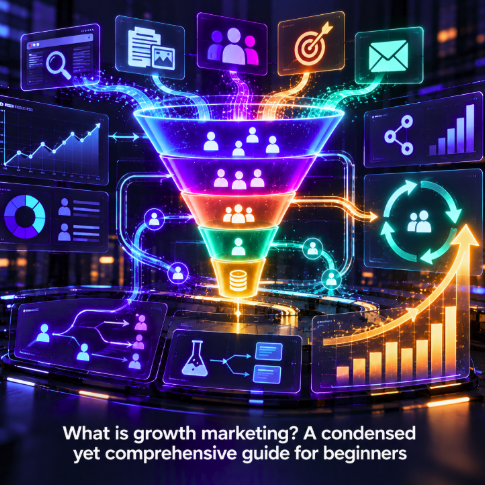

Growth marketing is often described as marketing with more data, faster experiments and a bigger appetite for optimization. That definition is directionally correct but incomplete. The important difference is scope: growth marketers are not responsible only for getting attention at the top of a funnel. They look across the customer journey to find the constraints that prevent a product from acquiring, activating, retaining, monetizing and generating new users efficiently.
Sandy Diao’s beginner’s guide to growth marketing, originally published in June 2023, provides a useful starting point. Diao frames growth as a measurable, data-driven discipline built around experimentation, funnel analysis, channel selection, retention and cross-functional execution. Her later teaching materials at UC Berkeley continue that model, covering AARRR growth accounting, acquisition channels, retention, viral loops, lifecycle marketing and experimentation. citeturn0search0turn0search6
The easiest way to understand growth marketing is to stop thinking of it as a collection of promotional channels. It is an operating system for finding where growth is constrained, forming a hypothesis about how to remove that constraint, testing the hypothesis and investing more heavily when the result is repeatable.
Growth marketing starts with a business outcome, not a channel
A traditional marketing plan can begin with a channel: launch paid search, build a social calendar, start an email newsletter or publish SEO content. A growth program should begin one level higher. What behavior needs to change for the business to grow?
A company with strong traffic but weak signup conversion does not primarily have an acquisition problem. Buying more traffic may simply pour more prospects into the same leak. A product with high signup volume and poor retention may need better onboarding or stronger recurring value before it needs another advertising campaign.
This is why growth teams look across the funnel. The highest-leverage intervention may sit in marketing, product, pricing, lifecycle communication or referral mechanics rather than the channel that initially attracted the user.
The AARRR funnel gives beginners a useful map
A common growth framework divides the customer journey into Acquisition, Activation, Retention, Referral and Revenue. The categories are not laws of nature, and companies can define them differently, but they force teams to distinguish stages that are frequently collapsed into one generic metric called “growth.”
Acquisition asks where users come from. Activation asks whether they experience enough initial value to continue. Retention asks whether they return or keep using the product. Referral asks whether existing users create additional users. Revenue asks how usage becomes economic value.
The framework becomes useful when each stage is tied to observable behavior. “Activation” should not mean that somebody created an account merely because signup is easy to measure. For a collaboration product it might mean inviting a teammate and completing a shared task. For a marketplace it could mean completing the first transaction. The metric should represent meaningful progress toward recurring value.
Acquisition is about channel fit, not being everywhere
Growth marketers have a large menu of acquisition channels: paid advertising, SEO, content, partnerships, communities, influencers, affiliates, referrals, outbound sales and increasingly AI-mediated discovery. The temptation is to operate all of them at once.
A stronger approach is to identify where the target audience already has intent or attention and test a small number of channels deeply enough to learn whether they can become repeatable. Diao’s more recent growth curriculum explicitly emphasizes identifying where the best users come from and prioritizing acquisition channels rather than spreading resources indiscriminately. citeturn0search6
Channel fit also depends on economics. A channel that produces many users can be unattractive if those users rarely activate, retain poorly or cost more to acquire than the value they create. Growth analysis therefore follows users beyond the initial click.
Activation is the bridge between marketing and product
Acquisition can create a misleading sense of progress. A campaign produces thousands of registrations, dashboards turn green and the business appears to be growing. If new users never reach the product’s core value, the acquisition engine is feeding a temporary metric rather than durable growth.
Activation work can involve onboarding, templates, defaults, product education, removing unnecessary steps or helping users reach a useful outcome faster. These interventions often require marketers to work with product managers, designers, engineers and analysts.
That cross-functional boundary is one reason growth marketing differs from a conventional promotional function. The team is optimizing customer behavior, not merely communications.
Retention determines whether acquisition compounds or leaks away
A business can acquire new users aggressively and still fail to build durable growth if users leave at roughly the same rate. Retention measures whether the product continues to create enough value for people to stay engaged, renew or purchase again.
The correct retention interval depends on the product. Daily retention may matter for a communication app; monthly or annual behavior may be more meaningful for software used periodically. Ecommerce companies may focus on repeat purchase windows, while subscription businesses often examine renewal and churn cohorts.
Growth teams frequently use cohort analysis because aggregate numbers can conceal deterioration. Total active users can rise while newer cohorts retain worse than older ones, particularly when acquisition spending is increasing. Cohorts expose whether the underlying product behavior is improving.
Referral turns customer value into an acquisition mechanism
Referral is more than adding a “share” button. A strong referral mechanism connects a user’s motivation to a reason for another person to join. Collaboration products can generate invitations naturally because the product becomes more useful with other participants. Consumer services may use incentives, affiliates or creator programs.
Diao’s later work describes referrals and affiliates as structured growth mechanisms rather than incidental word of mouth. Her broader point is that trust can become a distribution channel when companies deliberately design the loop around it. citeturn0search0
A referral loop is especially powerful when it shortens the distance between product use and new acquisition. The customer does not merely consume the product; normal use helps expose or distribute it to the next potential customer.
Revenue belongs inside the growth model
Traffic, registrations and active users are easier to celebrate than unit economics, but growth that cannot support the business eventually reaches a limit. Revenue analysis connects customer behavior with pricing, conversion, average order value, subscription upgrades, lifetime value and acquisition cost.
This does not mean every growth experiment should maximize immediate revenue. A company can rationally sacrifice short-term monetization to improve activation or retention. The important requirement is that the tradeoff is explicit.
Growth marketers therefore need to understand how funnel improvements translate into business outcomes. A small retention improvement can sometimes create more long-term value than a large increase in low-quality traffic.
Experiments turn opinions into testable hypotheses
Experimentation is one of the defining practices of growth marketing. Instead of debating indefinitely whether a new onboarding flow, landing page, price presentation or acquisition message will work, the team states a hypothesis, defines a success metric and tests the intervention where feasible.
A useful hypothesis is specific. “Improve onboarding” is a project description. “Reducing the number of required setup steps will increase the percentage of new users who complete the first meaningful task” is something a team can evaluate.
The experiment should also have a primary metric and guardrails. A new signup flow might increase registrations while decreasing the quality of users entering the product. Looking only at the metric closest to the intervention can reward a local improvement that damages the broader system.
Not every result is an experiment
The language of experimentation can create false confidence. If a team changes a landing page and conversions increase the next week, that does not necessarily prove the page caused the increase. Traffic mix, seasonality, promotions and random variation may have changed simultaneously.
Where controlled testing is possible, randomized experiments provide stronger evidence. Where it is not, teams should be precise about the limitation and treat before-and-after observations as weaker evidence.
The goal is not statistical sophistication for its own sake. It is avoiding expensive decisions based on patterns that disappear when repeated.
Growth metrics need a hierarchy
Modern analytics tools make it possible to track almost everything, which can leave teams with dozens of dashboards and no clear definition of success. Growth programs need a hierarchy connecting local metrics to the business objective.
A paid campaign may optimize click-through rate, but the company ultimately cares whether acquired customers activate, retain and create enough value relative to acquisition cost. An onboarding experiment may track completion rate while also monitoring downstream retention as a counter-metric.
Beginners should become comfortable asking three questions about every metric: what behavior does it represent, what decision changes when it moves and how could optimizing it create an unintended consequence?
Growth loops complement the funnel
Funnels are useful because they show conversion and loss between stages. Their limitation is that they can make growth look like a one-way journey from impression to purchase.
Many scalable systems behave more like loops. A user creates content that attracts another user. A buyer refers a friend who becomes another referrer. A marketplace gains suppliers, improving selection, which attracts buyers and makes the marketplace more attractive to additional suppliers.
The distinction changes strategy. A funnel asks how to improve conversion at each stage. A loop asks whether an output of one cycle can become an input to the next.
Automation should accelerate a working system, not hide a broken one
Marketing automation can coordinate lifecycle emails, audience segmentation, lead routing, campaign management and reporting at a scale that would be impractical manually. Generative AI can now accelerate research, creative production and analysis as well.
But automation magnifies the logic it is given. Automating a weak lifecycle campaign sends irrelevant messages more efficiently. Scaling paid acquisition before retention is understood can accelerate spending without creating durable users.
The order matters: understand the behavior, test the intervention, then automate the repeatable parts.
Growth teams are cross-functional by design
Diao describes effective growth teams as combining capabilities such as marketing, analytics, development and design. That mix reflects the range of levers growth work can touch. citeturn0search1
An acquisition problem may require a marketer. An onboarding problem may require product and design changes. Measurement needs analytics. A referral mechanism may require engineering. Treating every growth constraint as a marketing-communications problem prevents the team from using the highest-leverage intervention.
Small companies do not need a dedicated person for every discipline. They do need access to the relevant capabilities and a shared metric that prevents functions from optimizing against one another.
A beginner’s growth plan can be simple
A useful first growth plan does not need dozens of channels or an elaborate experimentation platform. Start by defining the business outcome and mapping the customer journey. Measure the major conversion points well enough to identify the largest credible constraint.
Then generate a small set of hypotheses about that constraint. Prioritize them using expected impact, confidence and implementation effort. Define the metric that would indicate success and any counter-metrics that could reveal damage elsewhere. Run the test, document the result and decide whether to scale, iterate or stop.
The documentation matters. Without an experiment history, teams repeatedly test forgotten ideas and lose the institutional knowledge that makes a growth program improve over time.
Growth marketing has changed since the original 2023 guide
Diao’s original guide predates the current wave of AI-mediated discovery and AI-native marketing workflows. Her later work reflects that change: her 2025 Berkeley course added AI-powered growth strategies alongside performance advertising, SEO, lifecycle marketing, referrals and experimentation. citeturn0search6
AI changes the speed and economics of execution. Teams can create more variants, analyze more customer feedback and automate more workflow steps. It also creates new discovery surfaces beyond conventional search and social feeds.
The underlying growth discipline remains recognizable. More output does not remove the need to identify the bottleneck, choose a metric, test a hypothesis and determine whether the result is repeatable.
Growth marketing is a system for learning what scales
The most useful definition of growth marketing is not “marketing that grows a company.” Every competent marketing function intends to contribute to growth. The distinctive feature is the systematic search for repeatable levers across the customer journey.
Acquisition brings potential users into the system. Activation gets them to meaningful value. Retention determines whether that value persists. Referral can turn users into distribution. Revenue connects the behavior to sustainable economics. Experimentation helps the team distinguish promising ideas from repeatable mechanisms.
For a beginner, that is enough of a map to start. Pick a real business outcome, find the most important constraint between the current state and that outcome, and run the smallest credible test that can teach you whether the constraint can be moved. Growth marketing becomes much less mysterious once it is treated not as a bag of tactics, but as a disciplined process for learning what actually scales.