

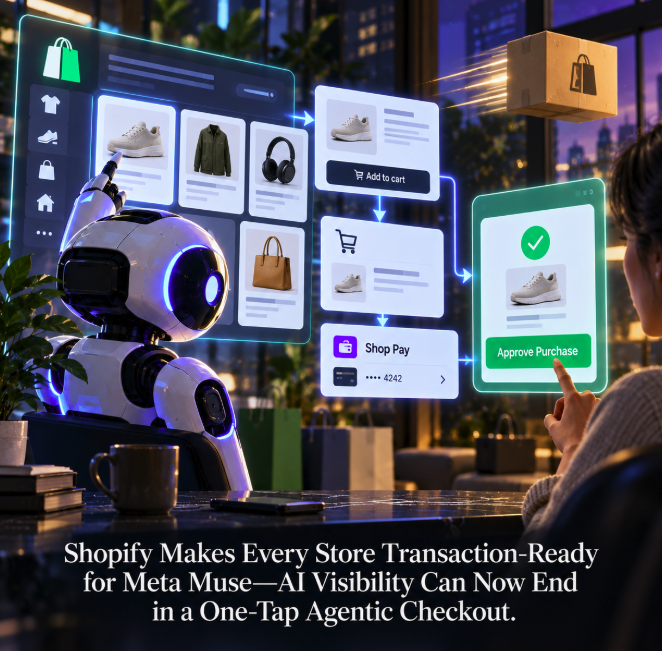

Meta's Muse agent launched with the ability to search the web, compare products and prepare purchases, but its original payment story still depended on which checkout infrastructure it encountered. Shopify is now moving to close that gap. The commerce platform and Meta have confirmed a partnership that will bring Shop Pay checkout into Muse, connecting the agent's product-discovery workflow with Shopify's catalog and payment infrastructure.
The partnership was reported by The Wall Street Journal on September 21, with public comments from Shopify CEO Tobias Lütke and Meta Chief AI Officer Alexandr Wang. The companies have not yet published a detailed Muse-specific technical specification or rollout calendar, so claims about the exact transaction flow should remain narrower than the strategic direction. What is confirmed is that Muse will be able to facilitate purchases at Shopify-powered stores using Shop Pay, turning a product recommendation into a much shorter agentic path to checkout.
Shopify is supplying the commerce layer Muse did not have to build
Meta designed Muse as a general-purpose personal agent rather than a merchant platform. In its September 8 launch announcement, Meta said Muse can open a browser, fill forms, negotiate and continue working in the background, stopping for approval before sensitive actions such as sending an email or making a purchase. At launch, Stripe's Link provided a payment option, while Meta explicitly said Shop Pay was coming soon.
The Shopify partnership makes that promise concrete. Instead of Muse having to improvise through every merchant's bespoke checkout, Shopify can expose a normalized commerce layer across participating stores. Product discovery can draw from Shopify Catalog, while Shop Pay can provide a familiar accelerated payment path using information the shopper has already saved.
This is one of the central attractions of agentic commerce infrastructure. Autonomous agents are capable of operating ordinary websites, but reliability becomes much higher when product data, checkout state and payment credentials are available through predictable platform-level systems. Shopify effectively sits between millions of merchant catalogs and the AI interface, translating heterogeneous stores into a commerce environment an agent can use more consistently.
Shopify Catalog becomes part of the discovery surface
Shopify has already been building the distribution layer needed for AI shopping. Its current Meta Agentic Storefront documentation says products can be made available to Meta through Shopify Catalog and that eligible merchants can manage Meta from the Agentic sales channels section of Shopify Admin. Shopify Catalog standardizes product information so external AI and commerce surfaces do not need to reconstruct every merchant's inventory independently from raw webpages.
That changes the meaning of AI visibility for Shopify merchants. A product can still be discovered through the open web, advertising or other channels, but structured catalog distribution gives agentic systems another route to obtain authoritative product details. The merchant's title, price, availability, policies and other commerce attributes become inputs to an environment where the next action may be a transaction rather than another click.
Shopify's documentation also makes clear that discovery and checkout are separable. A merchant can allow products to be discovered through Shopify Catalog while disabling direct checkout on Meta surfaces. That distinction is useful because it shows the emerging agentic funnel as two different optimization problems: getting the product into the agent's consideration set and enabling the agent to complete the purchase without sending the shopper through a conventional storefront journey.
Shop Pay collapses the distance between recommendation and purchase
The strategic value of Shop Pay is not simply that it is another payment button. Its stored shopper credentials can remove repeated form filling at the moment the agent is ready to transact. In an ordinary ecommerce journey, a user may move from search to product page, cart, account or guest checkout, shipping details and payment. An agent can potentially perform much of that work before returning to the person for a final approval.
That is the significance of the Muse model. Meta says the agent asks for approval before it makes a purchase. If product discovery, cart creation and checkout preparation have already happened in the background, the human interaction can become closer to confirming a prepared transaction than manually navigating the store.
The result is a new endpoint for AI visibility. Historically, ecommerce SEO aimed to turn search visibility into a click and then rely on the merchant site to convert the visitor. Agentic commerce can compress those stages. A product that is correctly represented in an AI shopping surface may move from recommendation to a Shop Pay-backed checkout without the shopper browsing the merchant's storefront in the conventional way.
“Every store” still comes with eligibility conditions
The platform-level reach of Shopify is what makes the Meta partnership important, but it should not be interpreted as meaning every Shopify merchant and every product is immediately eligible for every Meta checkout flow. Shopify's current Meta documentation lists requirements and exclusions for direct checkout, including U.S. customer eligibility, Shopify Catalog eligibility and acceptance of the Agentic Storefronts terms.
Shopify also says some product types are not supported in Meta direct checkout, including subscriptions, bundles, customizable products and B2B-only products. Local delivery, store pickup and pickup points are also excluded from the documented direct-checkout experience, while accelerated checkout support is limited to a subset of the options enabled on a merchant's store.
The Muse-specific partnership may evolve these rules, and the companies have not yet published enough technical detail to map every existing Meta Agentic Storefront requirement directly onto Muse. For now, the safest interpretation is that Shopify is making its commerce infrastructure available at platform scale while actual merchant and product participation remains subject to eligibility, settings and rollout details.
The storefront may no longer be where conversion happens
One of the most consequential details in Shopify's existing Meta direct-checkout documentation concerns analytics. Google Analytics and custom client-side pixels do not fire inside Meta's direct checkout; Shopify says the flow instead sends server-to-server events for checkout initiation and completion. That illustrates a measurement problem likely to become more important as agentic transactions expand.
If an AI agent discovers a product through a catalog, prepares the transaction in its own interface and completes checkout on an external surface, the merchant may receive an order without receiving the familiar sequence of pageviews, add-to-cart events and browser-side checkout signals that traditional ecommerce analytics expect. The sale is real, but part of the customer journey has moved outside the website.
This means merchants will increasingly need to reconcile storefront analytics with platform, catalog and server-side commerce data. A drop in conventional sessions or client-side funnel events does not necessarily imply a drop in commercial demand if more transactions originate through agents that do not reproduce a human browsing session.
Structured product data becomes transactional infrastructure
SEO teams have traditionally treated structured product information as a discovery and presentation asset: accurate data helps search engines understand a product and can support richer appearances. Agentic commerce raises the stakes because the same class of information can now participate in a transaction workflow.
An agent deciding between products needs dependable titles, variants, prices, inventory and policies. If those facts are inconsistent, the problem is no longer only that a search result may be less attractive. The agent may choose the wrong variant, discover an unexpected price at checkout or be unable to determine whether the merchant satisfies the user's constraints.
Shopify's advantage is that it can standardize these facts at the platform level. Merchants already manage much of the relevant commercial state inside Shopify, and Shopify Catalog can distribute that information to participating AI channels. The cleaner that data is, the less an agent has to infer from visual storefront pages before deciding whether a product belongs in the user's consideration set.
Agentic commerce creates a new optimization funnel
For Shopify merchants, the emerging funnel can be thought of as three connected layers. First comes agent discovery: can Muse or another AI system find and correctly understand the product? Second comes agent selection: does the product satisfy the shopper's stated constraints strongly enough to be recommended or chosen? Third comes agent transaction: can the commerce infrastructure complete the order with minimal friction once the user approves?
Traditional SEO primarily concentrated on the first stage and handed the rest to the website. The Meta-Shopify partnership connects all three more tightly. Shopify Catalog can support discovery, the agent can perform comparison and selection, and Shop Pay can carry the transaction toward completion.
This does not eliminate the merchant's website. Stores still need compelling product information, trustworthy policies, branding, support and a direct customer experience. Muse itself can browse the open web, meaning crawlable pages remain another source of information. But the website is no longer guaranteed to be the place where every shopper evaluates the product or enters payment details.
Shopify is positioning itself as infrastructure for AI shoppers
The Meta agreement also fits Shopify's broader agentic-commerce strategy. The company has been building Shopify Catalog and cross-platform checkout capabilities so merchants can sell where AI-driven discovery happens rather than requiring every shopping journey to begin and end on the online store. Its Spring 2026 Editions materials describe structured product data for agents and cross-platform checkout as core parts of that direction.
That strategy gives Shopify a different role in the AI search transition. Rather than competing to own the conversational interface, it can provide the commerce substrate underneath multiple interfaces. If an AI agent knows what a product is, whether it is available and how to transact through a trusted checkout, Shopify can remain central to the order even when the shopper never begins with a Shopify storefront.
The Muse partnership is therefore more than another payment integration. It connects a consumer agent capable of autonomous web research with a commerce platform that already holds normalized product data and accelerated checkout credentials. The technical details and rollout schedule still need to be published, and current eligibility rules mean the transition will not be instantaneous for every merchant. But the direction is clear: AI visibility is moving closer to transaction infrastructure, and for Shopify stores a product discovered by an agent may increasingly be only one approval away from becoming an order.