
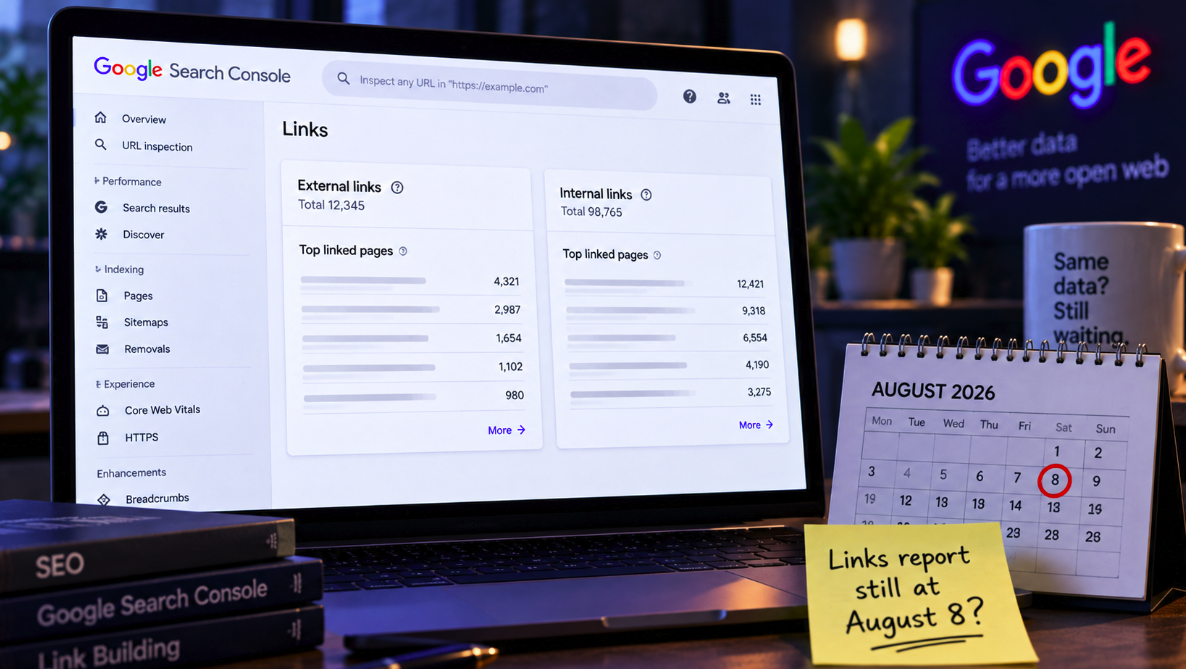
Google Search Console’s Links report may be showing SEOs a view of the web that is roughly one month out of date.
The report appears not to have received fresh link data since around August 8, according to Search Engine Roundtable. Barry Schwartz says the most recent links visible in the reporting appear to stop around that date, leaving the tool potentially frozen while the rest of September’s Search Console data continues moving forward.
There is an important uncertainty: Google has not confirmed that the Links report is broken. Search Console also does not display a clear “last updated” timestamp for this particular report, making it unusually difficult for site owners to distinguish a delayed refresh from normal reporting lag.
That makes the safest conclusion narrower than “Google has a backlink bug.” The Links report appears stale. There is currently no evidence that Google itself has stopped discovering, crawling or processing links.
The visible link data appears to stop around August 8
Schwartz has tracked Search Console’s link data through several updates this year and reports that the last obvious refresh occurred around August 8. By September 8, that would put the visible dataset approximately one month behind.
The problem is easier to notice in exports of recently discovered links than in the report’s headline totals. Google allows site owners to export up to 100,000 “Latest links,” ordered according to when Google discovered them.
If that list repeatedly ends around the same date despite a site continuing to earn new links, it provides a practical indication that the reporting layer has not refreshed.
But because Google does not expose a formal freshness timestamp alongside the Links report, users cannot simply look at the interface and confirm when the underlying batch was last processed.
Google has not confirmed an outage
This distinction matters because Search Console reporting delays and Google Search processing problems are not the same thing.
Schwartz says he has contacted Google for more information, but the report did not include a confirmation from Google that the Links report is experiencing a bug.
Google’s official Search Console data-anomalies page also does not currently list a product-wide Links report incident. The page records known reporting problems affecting areas such as Search performance, Discover, indexing and other Search Console datasets, but no recent Links report issue is listed at the time of writing.
Absence from the anomaly page does not prove the report is healthy. It does mean publishers should avoid presenting the apparent August 8 cutoff as a confirmed Google incident until the company says so.
The Links report was never a real-time backlink database
Even when functioning normally, Search Console’s Links report should not be treated as a continuously updated inventory of every backlink Google knows about.
Google’s official Links report documentation explicitly says the report is not a comprehensive list of all links to a site. Instead, it provides samples designed to help site owners understand their overall internal and external link profile.
The interface also applies normalization and aggregation. Duplicate links can be combined, URLs are grouped according to canonicalization rules, tables can be truncated and some URLs can be omitted for reasons such as non-indexing or deduplication.
That means a link missing from Search Console does not automatically mean Google has not discovered it.
The current freshness concern is different: observers are seeing signs that the sample itself may not have been regenerated recently.
Crawling and reporting run through different pipelines
A common mistake would be to infer that if Search Console has not displayed a new backlink since August, Googlebot must not have found new links since August.
There is no evidence for that conclusion.
A recent Google Search Central Community discussion about Links report refresh frequency included guidance from a Gold Product Expert explaining that the report is processed separately from individual URL crawling and indexing. A page can be recrawled and its changes reflected in Google Search while the Links report remains unchanged for some time.
That explanation comes from a Google community expert rather than an official engineering announcement, but it matches the broader way Search Console works: many reports are produced through background reporting processes rather than updating instantly whenever Googlebot sees something new.
A stale report is therefore a reporting problem until evidence shows otherwise.
The report’s missing last-update date makes troubleshooting harder
Most data problems become easier to diagnose when a tool tells users how fresh its dataset is.
Search Console does this in several places, but the Links report does not provide an obvious last-refresh date. Users can inspect the data and exports, yet the interface does not simply say, “Data updated through August 8.”
That creates ambiguity during periods like the current one.
If a company launches a major internal-linking project in late August and sees no change in Search Console, the team has to determine whether Google failed to crawl the new links, whether the links are technically inaccessible or whether the Links report simply has not refreshed.
Without a visible freshness marker, three very different situations can look similar.
Do not use the apparent delay to diagnose a link-building failure
For SEO teams, the most immediate practical lesson is to avoid evaluating recent link work from the Links report alone.
If a digital PR campaign earned coverage in late August or early September, the apparent reporting freeze means those backlinks may not yet appear even if Google has already crawled the referring pages.
The same applies to internal links. A site that redesigned navigation or added contextual links may see no corresponding change in the Search Console report while Google’s index has already processed the pages.
Site owners should verify the underlying implementation independently. Check whether the linking pages are accessible, whether the links use crawlable HTML anchors, whether the destination pages can be indexed and whether Google has recently crawled the relevant URLs.
Those checks answer a technical question. The Links report answers a reporting question.
Third-party backlink tools will not exactly match Search Console either
A stale Search Console report can make Ahrefs, Semrush or other backlink indexes appear dramatically more current, but direct numerical comparisons still require caution.
Each platform crawls the web independently, maintains its own index and applies different normalization rules. Google’s Links report is also explicitly a sample rather than a full export of every known link.
If a third-party tool shows 500 links and Search Console shows 200, the difference does not establish that Google knows about only 200.
During a suspected reporting delay, third-party tools can be useful for confirming that new backlinks exist and are crawlable. They should not be used to reverse-engineer the exact number of links in Google’s systems.
Historical links can remain even after they disappear from the web
Google’s documentation includes another reason the Links report should not be read as a live snapshot.
The company says the report includes links it has found over time and that some of those links may have since been removed or may point from pages that no longer exist.
This makes the report fundamentally different from a real-time crawler.
A user can therefore encounter both kinds of staleness at once: old links that remain in the sample and new links that have not yet appeared.
That is useful for understanding the broad historical profile of a site, but less useful for measuring what changed during the last few days.
Search Console has had Links report problems before
The apparent August freeze is also not occurring in a vacuum.
Search Engine Roundtable documented problems with the Links report earlier in 2026, including a May incident where users reported missing data or zero links. Schwartz later reported that Google had fixed and refreshed the report on June 12, followed by further observed updates on August 1 and August 8.
That history makes another delayed batch plausible, but it still does not constitute confirmation from Google that the current situation has the same cause.
Search Console contains multiple reporting systems, and one report can lag while others continue updating normally.
A month-old Links report matters more for diagnostics than rankings
Search Console’s link data is primarily valuable because it gives site owners a view into the links Google chooses to surface for their property.
If that view is a month behind, the biggest immediate cost is diagnostic.
Teams cannot confidently use the report to validate recent internal-link changes, inspect newly earned backlinks or monitor short-term link acquisition. It also becomes harder to investigate sudden differences between Google’s sample and third-party link indexes.
That does not mean rankings should suddenly change because the report is stale.
Search Console is an observation layer. The report displaying a link is not what makes the link exist or what causes Google’s ranking systems to process it.
Confusing the dashboard with the underlying search system can lead to unnecessary interventions.
Use the Latest links export carefully
Until Google clarifies the situation, the “Latest links” export is one of the most useful places to inspect the apparent delay.
Google says this export contains the most recently discovered backlinks to a property, up to 100,000 rows, ordered by discovery date.
If a site that routinely earns links sees that export consistently stop around early August, that supports the hypothesis that the reporting dataset is behind.
However, the date should not be interpreted as an exact global timestamp proving every Search Console property froze simultaneously. Different properties can expose different samples, and Google has not formally stated the scope of the issue.
The August 8 date is therefore best described as the observed freshness boundary reported by Search Engine Roundtable, not an official Google cutoff.
Google should expose freshness directly
Regardless of whether the current situation proves to be a bug, it exposes a straightforward product weakness.
A report used for monitoring changing web data should tell users when its dataset was last refreshed.
That information would immediately distinguish normal reporting lag from a technical implementation problem on the publisher’s site. It would also reduce the temptation to interpret missing recent links as evidence that Google has not crawled them.
Search Console already teaches site owners to make decisions from Google’s own data. Data freshness is part of the context required to make those decisions responsibly.
For now, treat the Links report as potentially stale—not Google’s link systems
The evidence available on September 8 supports a cautious conclusion.
Search Console’s Links report appears to be showing link data that has not materially refreshed since around August 8. The report does not expose an obvious last-update timestamp, and Google has not yet confirmed a bug or explained whether the delay is expected.
What the evidence does not show is equally important. There is no indication that Google stopped crawling new backlinks, stopped processing internal links or froze its link-related ranking systems one month ago.
SEOs should therefore avoid using the report as a real-time audit of work completed since early August. Validate crawlability and indexing separately, use other link sources for recent discovery and wait for either a fresh Search Console batch or clarification from Google.
A dashboard can be a month behind without the search engine behind it being a month behind. Until Google says more, that is the distinction that matters.