
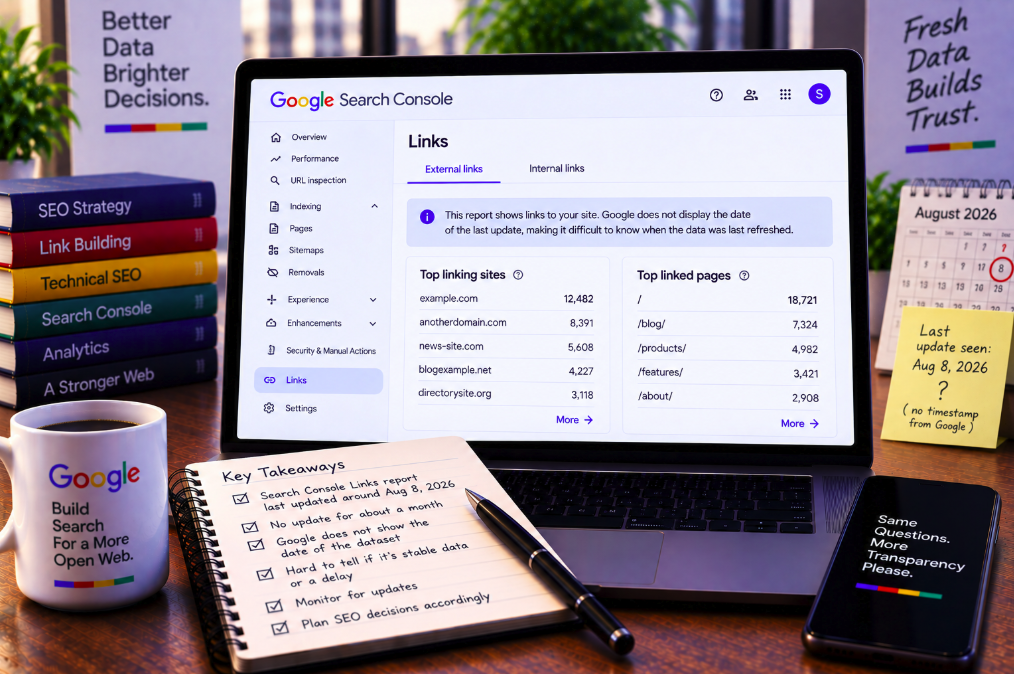
Google Search Console's Links report appeared to go roughly a month without fresh data by September 8, 2026, creating a familiar SEO problem with an unusually frustrating twist: the report itself does not show when its underlying dataset was last refreshed.
Barry Schwartz of Search Engine Roundtable had begun monitoring the report's changes precisely because Google provides no visible data timestamp. In his September 8 report, Schwartz said the last fresh link data he had observed arrived around August 8.
That left practitioners with two possibilities that the interface could not distinguish. A link profile might genuinely have remained stable, or Google's reporting pipeline might simply have stopped surfacing newer information.
There was no confirmed Google outage notice in the sources reviewed, and a stale Links report does not mean Google stopped discovering links, crawling pages or using links in Search. The incident is better understood as a reporting-transparency problem: without a timestamp, users cannot reliably tell how old the snapshot they are looking at actually is.
The last observed refresh was around August 8
Schwartz says he started tracking the Links report because Search Console does not disclose the date on which its data was updated.
His observations showed the most recent fresh data around August 8, leaving the report approximately one month old by September 8.
He noted that the report had generally seemed to refresh every couple of weeks in his monitoring, making the month-long gap look unusually long.
That “every couple of weeks” observation should not be turned into an official service-level expectation. Google does not document a fixed Links report refresh cadence in the help material reviewed for this article.
Google does not show a dataset timestamp
The missing timestamp is more than a cosmetic interface complaint.
Many Search Console reports expose date ranges or otherwise make data recency easier to understand. In the Links report, users can see counts, linking domains, target pages and exports, but there is no obvious report-level label saying that the underlying snapshot is current through a particular date.
That means the user must infer freshness by watching counts change or exporting data and comparing it with previous snapshots.
For a platform used to make technical and editorial decisions, that uncertainty can be more problematic than a known delay. A report labeled “data through August 8” is stale but interpretable. A report with no timestamp can look current when it is not.
The Links report is not designed as a live backlink index
Google's official Search Console Links documentation makes clear that the report should not be treated as a comprehensive inventory of every link Google knows about.
Google describes it as a sample of internal and external links intended to help site owners understand their overall link profile. Some URLs can be omitted for reasons including non-indexed pages and deduplication.
The interface tables are also capped at 1,000 rows, which means large sites can see a truncated view even when the dataset itself contains much more information.
This design already makes the report unsuitable for exact, real-time link auditing. A month-long apparent refresh gap amplifies that limitation.
A stale report does not mean Google stopped crawling links
One of the easiest mistakes is to assume that if Search Console has not updated its Links report, Google's search systems must also be unaware of recently added links.
There is no evidence supporting that conclusion.
Search Console reporting is a separate product layer. Google can crawl and index a page containing a new internal or external link while the aggregate Links report remains unchanged.
A recommended answer in the Google Search Central Community made the same distinction in August, explaining that the Links report is not real time and is not directly tied to URL Inspection or the last crawl date of individual pages.
The community guidance also highlights the missing update date
In that August 10 discussion, a Google Product Expert said the report appears to update through a separate background reporting process and does not display an exact refresh date.
The answer suggested that the data seems to update roughly monthly, although that statement is community guidance rather than a formal Google engineering commitment.
This matters because observations about historical refresh behavior can help users set expectations, but they cannot establish that a particular delay violates a documented Google schedule.
As of the September 8 report, the strongest claim is therefore observational: no fresh data had been seen for about a month.
“No change” and “no update” look identical
This is the central measurement flaw.
Imagine a site that has spent August earning editorial backlinks from several high-authority publications. If the Links report shows exactly the same top linking sites and counts it showed in early August, the SEO team cannot tell from the interface whether Google has not yet surfaced those links or whether the report has refreshed and simply omitted them from its sample.
The same ambiguity affects internal linking work. A site can add hundreds of contextual links during a content restructuring project and still see old counts in Search Console.
Without a freshness indicator, stability in the dashboard is not evidence that nothing changed on the web.
Google's report is sampled by design
Even a freshly updated Links report would not necessarily show every newly acquired backlink.
Google explicitly says the report is not a comprehensive list. Duplicate links are combined, URLs are grouped by canonical URL and some data is normalized before display.
External linking sites are grouped at the root-domain level, stripping protocol, subdomains and subdirectories. This can make multiple distinct sources appear under one domain-level entry.
These rules are useful for summarization but make the report a directional diagnostic tool rather than a forensic link database.
Historical links can remain after they disappear from the web
Another important caveat in Google's documentation is that the Links report includes links Google has found over time.
A reported link may have since been removed, or the source page may no longer exist. Google does not present the report as a guaranteed current-state crawl of every linking page.
This creates asymmetry in how SEOs should interpret changes. A new link missing from the report does not prove Google has not found it, while an old link remaining in the report does not prove it still exists.
Freshness information would not eliminate those limitations, but it would at least tell users when Google's reporting snapshot was last processed.
Exports provide more data, but not a cure for unknown freshness
Search Console allows users to export link data as CSV or Google Sheets.
For external links, the export can include up to 100,000 “Latest links,” sorted by discovery date, as well as a separate sample of other known links.
Those exports are valuable for historical comparisons because teams can preserve their own snapshots and observe when rows or discovery dates change.
But exporting an undated underlying dataset does not magically make the source current. The best workaround is to timestamp the export yourself and compare it with previous downloads.
Teams can build their own freshness monitor
Schwartz's monitoring approach points to a practical solution for organizations that depend on the Links report.
Schedule periodic exports, store each snapshot with a collection timestamp and compare a small set of indicators: latest discovered link date, total exported rows, top linking domains and top target pages.
If those values remain identical for an unusually long period despite known link activity, the dataset can be flagged as potentially stale.
This does not reveal Google's internal refresh date with certainty, but it makes reporting latency visible instead of allowing it to masquerade as stability.
Do not use the Links report to validate a newly earned backlink immediately
PR and link-building teams often want confirmation that a newly published editorial link has been “seen by Google.”
The Search Console Links report is a poor tool for immediate validation because it is sampled, asynchronous and currently lacks an explicit freshness timestamp.
The most direct confirmation that the backlink exists is the source page itself. Crawlability, indexability and discovery can be investigated separately where necessary.
Waiting for the link to appear in Search Console can produce false negatives even when everything is functioning normally.
Internal-link audits should rely on crawling the site itself
The same principle applies to internal links.
If a technical SEO team changes navigation, breadcrumbs or contextual links, its own crawler can verify the live internal graph immediately. Search Console's internal Links table can later provide a useful Google-side perspective, but it should not be the deployment acceptance test.
This is especially important during migrations and architecture projects where teams need to know whether important pages are reachable through the intended internal paths.
A delayed aggregate report cannot replace direct crawling of the current site.
Third-party backlink indexes answer a different question
Commercial SEO platforms maintain their own web crawlers and backlink databases, often exposing discovery dates and historical link changes more explicitly than Search Console.
Those tools can help fill the monitoring gap, but their data should not be treated as a mirror of Google's link graph.
Each crawler discovers a different portion of the web, uses different canonicalization and deduplication rules and refreshes pages on its own schedule.
A link appearing in a third-party index but not Search Console does not prove Google missed it, just as a Search Console link absent from a commercial tool does not prove the third party's crawler is defective.
Link-report staleness is not evidence of ranking impact
Nothing in the September 8 report indicates that Google stopped processing links for ranking purposes.
The observation concerns the Search Console reporting interface and its apparent lack of fresh displayed data.
There is no confirmed connection between the month-long reporting gap and a site's rankings, crawling, indexing or PageRank calculations.
Teams should resist explaining organic traffic changes through the Links report delay unless independent evidence supports that connection.
It is also not evidence that backlinks were lost
If the top linking sites or counts remain unchanged for weeks, the most cautious interpretation is simply that the report has not demonstrated a change.
That is not the same as proving a backlink campaign failed, proving new links were ignored or proving older links disappeared.
Because the report is sampled and historical, link acquisition and loss need to be validated using source pages and additional monitoring data.
A stale report should reduce confidence in the measurement, not confidence in the links themselves.
A timestamp would solve much of the ambiguity
The most obvious product improvement is also the simplest: show the date through which the Links dataset has been processed.
Search Console does not need to make the report real time for it to become much more useful. A visible “data last updated” label would let users distinguish a quiet link profile from a delayed pipeline.
It would also reduce unnecessary support questions and prevent teams from treating a stale snapshot as current evidence.
Schwartz explicitly called for Google to add such a date, and the month-long apparent delay demonstrates why that request is operational rather than cosmetic.
Freshness metadata should be standard in SEO dashboards
The issue extends beyond Google Search Console.
Any analytics dashboard that combines Search Console, crawlers, rankings, backlinks and web analytics should record the freshness of each source alongside the metric itself.
A number without a data date can be misleading even when the number is technically correct for the last available snapshot.
Enterprise reporting systems increasingly need to treat freshness as a first-class field: source, collection time, latest processed date and expected latency.
Do not compare stale link data with fresh traffic data
Another common reporting error is combining datasets with different update schedules as though they describe the same moment.
A September dashboard might show organic sessions through September 7, rankings through September 8 and a Links report effectively frozen around August 8.
Plotting those series together can tempt analysts to explain fresh traffic movements with old link information.
The correct response is to label the link series as stale or omit the most recent comparison period until its freshness can be verified.
The report remains useful when its limitations are respected
Google's Links report can still answer valuable questions.
It can show which pages Google associates with the most external links, which root domains appear prominently among linking sites, which anchor text is common and which pages receive the most internal links.
Those views are useful for sanity checks and for understanding Google's sampled representation of a site's link profile.
The mistake is expecting the report to function as a complete, continuously refreshed backlink-monitoring service when Google's own documentation says it is only a sample.
The missing timestamp is the bigger problem than the one-month delay
A slow report can be managed if users know it is slow.
The more serious usability problem is that Search Console does not tell users how old the Links data is. That forces SEOs to reverse-engineer freshness by watching exports and changes over time.
As of September 8, the last fresh data observed by Search Engine Roundtable was around August 8. That is useful evidence of an unusually long reporting gap, but it is not an official Google statement about the dataset's exact age or a documented outage.
Until Google adds a timestamp, the safest approach is to treat the Links report as a delayed, sampled perspective rather than a live source of truth. Preserve your own dated exports, validate important links independently and never interpret an unchanged dashboard as proof that the underlying web—or Google's search systems—has stopped changing.