
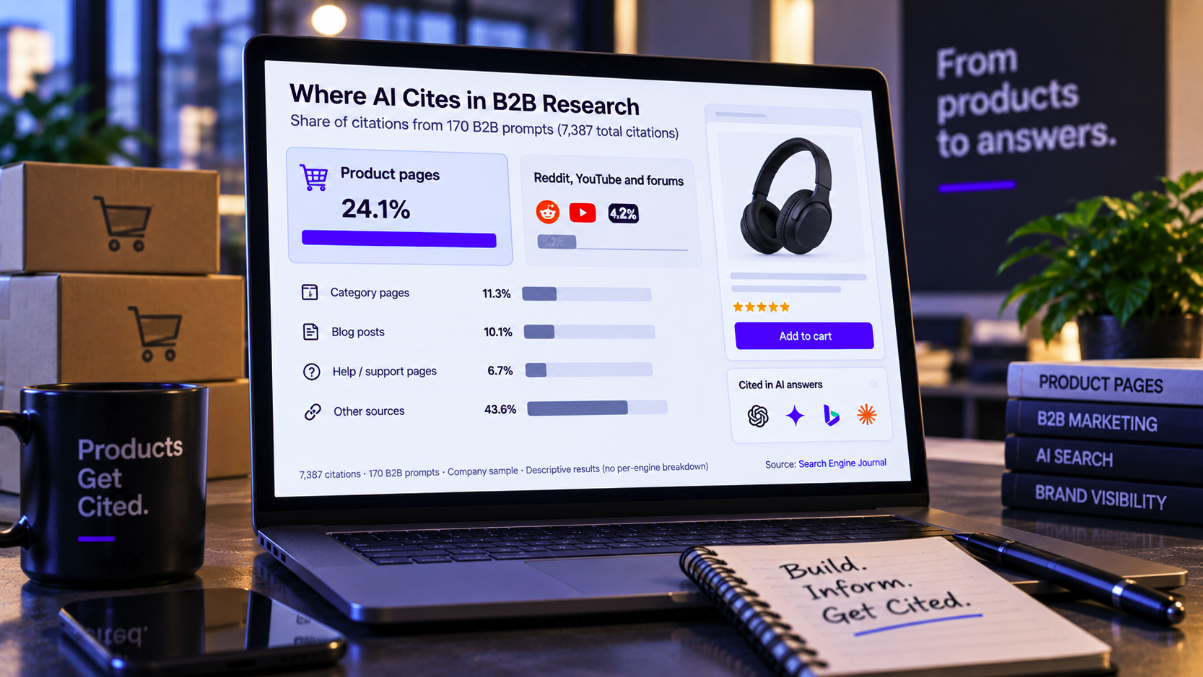
For B2B marketers chasing visibility in AI answers, product pages may deserve considerably more attention than the current obsession with Reddit and YouTube suggests. A new evaluation-stage study found that product pages accounted for 24.1% of 7,387 AI citation appearances, while Reddit, YouTube, forums and other discussion sources combined for just 4.2%.
That makes product pages roughly 5.7 times as prominent in this particular dataset—close enough to summarize as about six times the citation share. But the qualification matters. The research does not show that product pages universally outperform community content across AI search. It shows that they dominated a specific set of B2B buying questions drawn from one company’s client base.
The study was published by Ten Speed on September 3 and examined citation data collected through Peec AI. Search Engine Journal subsequently questioned Ten Speed about its methodology, correcting a prompt-count discrepancy and establishing several important limitations that make the results more useful when interpreted as directional evidence rather than a universal benchmark.
Product pages were the largest citation category
Ten Speed analyzed 7,387 citation appearances generated from 170 prompts designed around mid- to bottom-of-funnel B2B evaluation. These were not broad informational questions such as “what is a CRM?” The prompts reflected buyers comparing products, investigating alternatives, checking features and integrations, evaluating use cases and asking questions closer to a purchase decision.
Product pages captured 24.1% of all citation appearances, the largest individual page type. Articles—including blog posts, news and PR—accounted for 17.4%. Comparison pages reached 13.3%, listicles 13.2%, how-to guides 8.9%, homepages 7.8% and third-party profiles such as software directories 7.2%.
Community-driven sources were much smaller in aggregate. Ten Speed reports that Reddit, YouTube, forums and discussion threads together represented 4.2% of citation volume at this stage of the buyer journey. In its page-type table, discussion pages accounted for 3.7% and video for 0.5%.
The contrast is significant because much of the conversation around generative engine optimization has encouraged brands to build visibility on community platforms. The Ten Speed data does not invalidate that strategy, but it suggests the value of those platforms can change dramatically depending on what the buyer is asking.
The study was designed around buyers evaluating products
Intent is central to understanding the result. A buyer asking an AI assistant to explain a broad category may benefit from community experiences, educational articles and discussion threads. A buyer asking how a named product handles a specific integration has a different information need. The product’s own documentation or product page may be the most direct source available.
Ten Speed deliberately excluded informational and top-of-funnel queries. Its examples include direct product comparisons, questions about product use cases, best-tool requests and questions about cost or technical capabilities. The client base covered B2B SaaS and professional services across areas including fintech, physical security, hospitality and IT automation, with look-alike competitors included so citations were not restricted to the agency’s clients.
That framing helps explain why product pages performed so strongly. When an AI system needs to establish what a product does, who it serves or whether it supports a particular feature, the vendor’s own page can be a primary source. At a different stage of the funnel, the source mix may look very different.
Owned content accounted for most citation volume
Ten Speed grouped product pages, articles, comparison content, listicles, how-to guides and homepages as brand-controllable content. Together, those formats represented 88.3% of citation volume in the study. That is a striking result for B2B content teams because most of those surfaces are already under marketing’s direct control.
The implication is not that third-party reputation has stopped mattering. Directory profiles still captured 7.2% of citations, and third-party sources can provide independent validation that a vendor cannot create for itself. The finding instead suggests that AI visibility at the evaluation stage may depend heavily on whether a company has published clear, specific material answering the questions a buyer asks when comparing vendors.
A product page written entirely around brand slogans can be weak raw material for an answer engine. A page that clearly describes the product category, target customer, integrations, capabilities, limitations and use cases gives a retrieval system more explicit facts to work with. The same clarity that helps a human evaluator can also make the page easier for an AI system to interpret.
Comparison pages also performed disproportionately well
Another result reinforces the importance of buyer intent. Comparison-format questions represented 34 of the 170 prompts, or 20% of the prompt set, but generated 1,970 of the 7,387 citation appearances—26.7% of the total. Ten Speed describes that as a 1.33× citation return relative to the format’s share of prompts.
That makes comparison content a potentially important citation surface for B2B brands. Buyers frequently ask AI assistants questions in the form of “X versus Y,” especially when they already understand the category and are narrowing a shortlist. A company that has no useful comparison material leaves other sources to define the differences.
This does not mean vendors should publish biased pages declaring themselves superior in every scenario. Useful comparison content should explain meaningful differences, ideal use cases, integrations, pricing structures where available and the circumstances in which another option may be a better fit. Factual specificity is more useful to both buyers and retrieval systems than a disguised sales pitch.
The Reddit and YouTube headline needs a funnel-stage warning
The 24.1% versus 4.2% comparison is attention-grabbing, but applying it to all AI-search behavior would overstate the evidence. Ten Speed explicitly says community content may matter more earlier in the buyer journey, and the study was designed to avoid those broader informational questions.
Reddit can be valuable precisely because it contains first-person experiences, objections and discussions that vendors may not publish themselves. YouTube can be useful for demonstrations, reviews and complex visual workflows. Those formats can answer different questions from a product page. A dataset concentrated on active vendor evaluation should not be used to conclude that community platforms are generally unimportant to AI systems.
There is also an interesting nuance inside Ten Speed’s data: although discussion sources represented a small share of total citations, the Reddit threads that did appear were cited relatively aggressively on a per-URL basis. Low aggregate share and strong performance for individual qualifying pages can coexist.
The research has several important limitations
Search Engine Journal’s follow-up reporting is valuable because it establishes exactly what the headline number can and cannot support. The original Ten Speed article contained an inconsistent prompt total: one chart referred to 220 prompts while the citation breakdown used 170. Ten Speed confirmed to Search Engine Journal that 170 is the correct denominator and said the visual would be corrected.
The underlying company sample is also not disclosed. Ten Speed declined to provide even a range for the number of distinct client brands, citing the risk of identifying confidential clients when combined with the listed verticals. That means outside researchers cannot fully evaluate how broadly distributed the sample is across companies.
More importantly, there is no clean per-platform breakdown. Peec AI monitors citations from systems including ChatGPT, Perplexity, Claude and Gemini, but Ten Speed says this particular data pull did not preserve the platform-level split needed to show whether each engine favored product pages to the same degree. The 24.1% figure is therefore an aggregate across systems that may have substantially different retrieval behavior.
The headline comparison was also descriptive rather than a statistically tested difference. Search Engine Journal asked specifically whether the 24% versus 4% split had been subjected to significance testing, and Ten Speed confirmed that it had not. The study used nonparametric statistical methods for some other page-type comparisons, but not for this particular headline ratio.
Seven thousand citations do not mean seven thousand independent observations
The denominator deserves careful interpretation. The 7,387 figure counts citation appearances, not unique URLs or independent companies. A source cited repeatedly across responses contributes multiple appearances. Citation volume therefore measures how often page types surfaced within this prompt set, not how many distinct product pages were discovered across the web.
That is not a flaw by itself. Repeated citation is commercially interesting because a source that surfaces across many relevant buyer questions may have meaningful visibility. But it means the number should not be presented as though 7,387 independent pages were sampled.
The data is also a single point-in-time export. AI retrieval systems change quickly, and citation patterns can move as models, search integrations and product interfaces are updated. Ten Speed appropriately describes the findings as practitioner intelligence rather than a definitive industry benchmark.
Product pages should be treated as AI information assets
With those limitations in place, the strategic signal remains useful. B2B teams often treat product pages almost entirely as conversion assets: pages optimized around positioning, demo requests and sales messaging. The citation data suggests they may also function as machine-readable reference material at the moment an AI assistant is helping a buyer evaluate options.
That argues for auditing product pages with retrieval questions in mind. Can a reader quickly determine what the product is? Are important features and integrations stated explicitly? Are target users and use cases clear? Are technical claims specific enough to verify? Is the page current? Does it answer the kinds of questions prospects repeatedly send to sales?
The objective is not to write for a chatbot instead of a buyer. In many cases the same improvements benefit both. Precise product information reduces ambiguity for humans and gives AI systems stronger evidence when constructing an answer.
The six-times gap is a signal, not a universal rule
The most defensible reading of the September 3 study is narrower than the headline but still important. Within 170 B2B evaluation-stage prompts drawn from Ten Speed’s client environment, product pages captured 24.1% of 7,387 citation appearances, compared with 4.2% for Reddit, YouTube and other community discussion sources combined.
That is a powerful counterweight to the idea that brands must primarily win AI visibility through third-party communities. At least for these commercially oriented B2B questions, content a company can directly improve captured most of the citation volume.
But the study does not establish a universal six-times advantage for product pages, does not tell us whether every AI engine behaves the same way and does not connect citation volume to clicks, demos or revenue. The useful conclusion is more practical: when buyers are asking AI systems to compare vendors and evaluate products, the product page itself is not merely a conversion destination. It can be one of the sources from which the answer is built.