

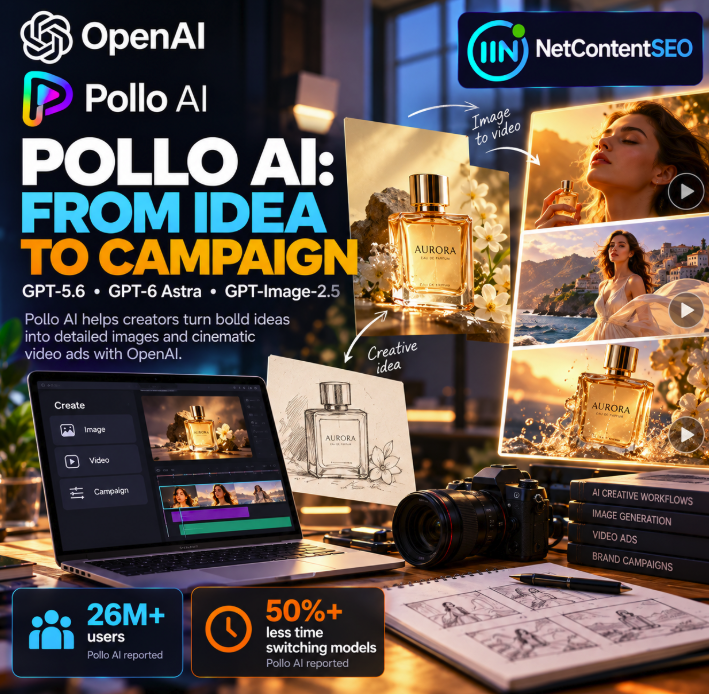

October 8, 2026 — OpenAI has published a customer case study describing how Pollo AI uses GPT-5.6, GPT-6 Astra and GPT-Image-2.5 to turn rough creative ideas into images, storyboards and cinematic advertising assets. The case is particularly relevant to marketers because it focuses not just on model output, but on making a multi-step creative workflow easier to use.
According to OpenAI, Pollo AI serves more than 26 million users. The company reports that 30% of creator sessions begin with templates or trending-format workflows, and that users spend more than 50% less time choosing or switching models thanks to its model orchestration. These are company-reported figures in a customer case study, not independently audited campaign performance metrics.
What Pollo Agent actually does
Pollo Agent takes a user's rough idea or visual reference and develops a creative direction, including storylines, scene sequences and scripts. The aim is to reduce the technical decisions that can prevent creators and smaller businesses from completing a visual project.
Three OpenAI models, different jobs
Pollo AI uses GPT-5.6 for routing and interpretation of ambiguous creative input, while GPT-6 Astra handles more challenging narrative development and planning revisions. For image generation, the team selected GPT-Image-2.5 to create posters, storyboards and campaign visuals. This division of labor lets the product choose capabilities according to the task rather than making users manually compare models.
From a product photograph to a video ad
OpenAI describes Pollo's Photo to Video Ads feature within Marketing Studio. In one example, a fragrance brand supplied a product photograph and used the tool to create an approximately 15-second luxury-style advertisement. The sequence incorporated warm spotlights, rich fabrics and product close-ups to communicate a premium mood. The case demonstrates a production workflow; it does not provide verified return-on-ad-spend or conversion-rate results.
Luxury jewelry and imaginative product campaigns
A jewelry customer used Pollo Agent and GPT-Image-2.5 to create a high-concept editorial image featuring statement jewelry, dramatic lighting and a model beside a cheetah. In another example, a peach soda product image was transformed into a miniature snowy world with a train and playful details. These examples show the platform's range from polished product photography to stylized campaign concepts.
Why templates matter
Pollo's early success with video templates helped simplify the starting point for creators. OpenAI says templates and trending-format workflows now account for 30% of creator-session starts. This matters because creative automation is often limited by the difficulty of choosing a format, planning scenes and coordinating tools—not only by the quality of a single generated image.
What the 50% improvement means
The reported improvement is more than 50% less time spent choosing or switching models. It is not a claim that every advertisement is produced 50% faster, that production costs fall by half or that generated ads perform better in market. Those outcomes would require separate measurement.
Implications for SEO, GEO and digital marketing
For SEO and AI visibility teams, Pollo AI illustrates a broader shift toward agent-orchestrated content production: an application can translate a business brief into a coordinated sequence of reasoning, image creation and video production steps. Marketers may be able to test more creative concepts, but brand accuracy, product fidelity, advertising disclosures and human review remain essential.
Importantly, this is a case study about creative production—not an announcement of new Google ranking factors, AI Search citation behavior or guaranteed advertising performance.
A practical checklist for marketing teams
- Start with a clear creative brief and approved brand assets.
- Separate idea development, scene planning and asset generation into reviewable stages.
- Check generated product details against the real item.
- Review commercial rights, likeness permissions and platform advertising policies.
- Test different concepts with measurable campaign objectives.
- Compare total production time and cost against existing workflows.
- Track real engagement and conversion outcomes instead of assuming AI-generated creative will outperform traditional work.
NetContentSEO analysis: the interface is becoming the differentiator
The strategic lesson is not that one model can create every part of a campaign. It is that model routing and workflow design can make advanced capabilities accessible to users who do not want to manage multiple AI systems. Pollo AI's reported reduction in model-switching time points to an increasingly important product metric: how much friction an agent removes between an idea and a usable asset.
Official source
OpenAI — Pollo AI turns creative ideas into campaigns with OpenAI (October 8, 2026).