
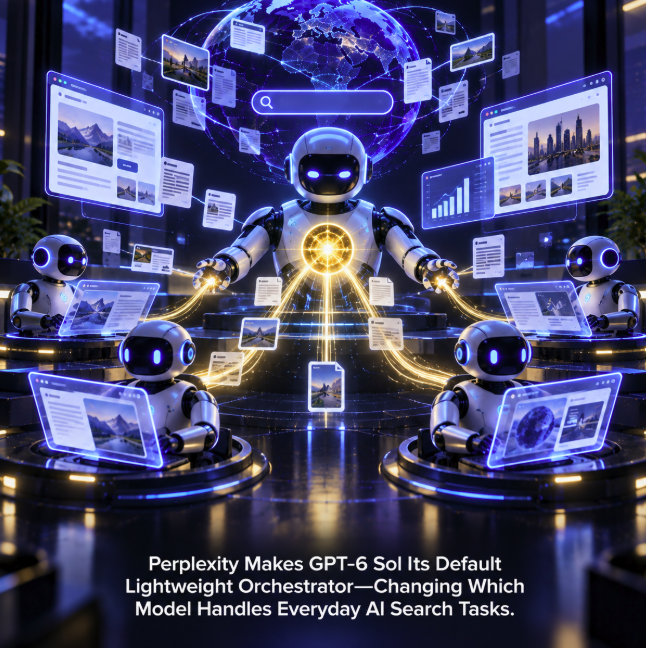
Perplexity has added OpenAI’s GPT-6 Sol to both its answer engine and Perplexity Computer, and the model is now the default choice behind Computer’s Light effort setting. The change means that when users choose the lowest-effort preset for routine agentic work, GPT-6 Sol becomes the model responsible for orchestrating the assignment by default rather than merely appearing as another optional model in a selector.
Perplexity confirmed the rollout in an official company update on LinkedIn, stating that GPT-6 Sol is now available in Perplexity and Computer and is the default Light option in Computer’s effort selector. The wording is concise, but the architectural implication becomes clearer when combined with Perplexity’s documentation for the effort system introduced days earlier.
Perplexity’s official explanation of Computer’s effort controls says an effort setting determines both the model responsible for coordinating an assignment and how deeply that model reasons. The orchestrator then decides how to approach the work and can delegate parts of it to supporting agents, including agents running models from other providers.
GPT-6 Sol is the default Light orchestrator, not the only model in the system
The distinction between orchestrator and supporting model matters. Perplexity Computer is designed as a multi-model system rather than a wrapper around one frontier model. The orchestrator interprets the assignment, plans the work and decides how tasks should be delegated, while supporting agents can use different models when the workflow benefits from them.
Making GPT-6 Sol the default Light option therefore does not mean every model call inside a Light assignment is necessarily handled by GPT-6 Sol. It means Sol becomes the default coordinating model for that effort level, with Perplexity’s harness retaining the ability to route supporting work elsewhere.
This also should not be interpreted as GPT-6 Sol becoming the universal default for every Perplexity answer. Perplexity’s announcement separately says Sol is available in Perplexity and Computer, while the explicit default designation applies to the Light option in Computer’s effort selector.
That qualification is important because model-routing decisions inside multi-model products are increasingly invisible to users. The model shown at the top of an interface may be the planner while several other models execute parts of the task behind it.
Light is designed for routine work where cost matters
Perplexity introduced four effort presets for Computer: Light, Standard, High and Ultra. The company describes Light as the option for straightforward everyday tasks, giving examples such as collecting vendor invoices into a spreadsheet.
Higher settings allocate more expensive models or deeper reasoning to more difficult assignments. Standard targets balanced everyday work, High is intended for complex analysis and Ultra is designed for open-ended tasks where users want maximum effort.
Perplexity explicitly says lower settings use less expensive models and that the purpose of the effort system is to let users balance intelligence and cost without manually choosing a model and reasoning level for every assignment.
GPT-6 Sol’s placement at Light therefore says something about how Perplexity views the model economically as well as technically. Sol is capable enough to coordinate everyday agentic tasks while fitting the lower-cost end of Computer’s orchestration strategy.
Perplexity is turning model selection into a routing problem
AI products initially exposed model selection directly to users: choose one model for speed, another for reasoning and perhaps a third for coding. Perplexity’s effort system abstracts that decision into the amount of work the user wants the system to perform.
A person can choose Light or High without needing to know which frontier model currently provides the best cost-quality tradeoff. Perplexity selects the orchestrator and reasoning level behind the preset, while advanced users can still open Custom controls and choose specific models themselves.
This gives Perplexity freedom to change the model behind an effort tier as the market evolves. GPT-6 Sol can become the Light default today without requiring Light itself to be redesigned as a product concept.
For AI search users, this means model changes can increasingly happen beneath a stable interface. The search or research workflow may look identical while the model interpreting the query, planning retrieval and coordinating supporting agents changes from one week to the next.
The orchestrator influences how search work is decomposed
In a conventional answer engine, users often focus on the model that writes the final response. In an agentic system, the coordinating model can matter just as much because it decides what work needs to happen before that answer exists.
Perplexity says Computer’s orchestrator determines how to approach an assignment and delegates portions to supporting agents. For a research task, those decisions can include whether more investigation is necessary, how to divide the problem, which supporting capabilities should be invoked and how much reasoning should be spent coordinating the result.
The default orchestrator therefore sits upstream of many visible outputs. Two models can receive the same user request and produce different research paths even when both ultimately use similar retrieval tools.
Making GPT-6 Sol the Light default changes which model makes those planning decisions for routine Computer assignments. The significance is less about a model badge and more about who controls the first layer of task decomposition.
Everyday AI search is becoming multi-agent execution
Perplexity began as an answer engine where the defining interaction was asking a question and receiving a sourced response. Computer expands that model into tasks that can involve browsing, files, connected applications, coding and long-running work.
The line between “search” and “agent” therefore becomes increasingly difficult to draw. A simple research request can begin with web retrieval, continue through document analysis and end with an artifact or action rather than a text answer.
Perplexity’s Light setting is important precisely because it applies this agentic architecture to routine work. Multi-agent orchestration is not reserved only for expensive deep-research modes. The company is building a lower-effort path for everyday assignments and automatically choosing the coordinating model behind it.
GPT-6 Sol now occupies that default role.
Perplexity says it optimizes for intelligence per unit of cost
Perplexity’s effort-mode announcement describes its objective as maximizing intelligence while minimizing cost through multi-model orchestration. The company says it tests models from different providers at different reasoning levels and compares the quality of their work with the cost required to produce it.
When a lower-cost combination produces comparable results, Perplexity says users can preserve more of their budget for assignments that benefit from deeper reasoning.
This explains why a model can be important to Perplexity even when it is not positioned at the highest effort tier. A lightweight orchestrator needs to make good planning decisions cheaply enough that routine work remains economical.
The company’s model-agnostic architecture also means that provider loyalty is secondary to routing economics. OpenAI, Anthropic and other models can occupy different roles depending on Perplexity’s evaluations and the workload.
Sol arrives one day after GPT-6 Astra entered Computer
The GPT-6 Sol update follows another major OpenAI model integration. Perplexity’s September 21 changelog announced GPT-6 Astra for eligible Computer users alongside the new effort controls.
Astra sits at the high-capability end of OpenAI’s GPT-6 family, while Sol is designed to provide much of the family’s strength at lower cost and higher speed. Perplexity can therefore use different GPT-6 models at different points on its effort curve rather than treating GPT-6 as a single fixed capability tier.
The sequencing illustrates how quickly model routing can change inside modern AI products. Within days, a newly released model can move from external API availability into a default orchestration role inside another company’s agent system.
For users, those changes can alter the behavior of familiar product settings without requiring them to manually migrate anything.
Model defaults can affect AI visibility research
The change also matters to marketers and researchers who measure brand visibility in answer engines. A Perplexity result is not generated by a timeless, fixed system. The models, effort levels and orchestration logic behind the interface can change.
If the orchestrator influences how queries are decomposed and which supporting agents are invoked, a default-model change can potentially alter retrieval behavior, source selection or the depth of investigation even when the user submits the same prompt.
That does not establish that GPT-6 Sol will systematically favor different domains or citations; Perplexity has not published evidence supporting such a conclusion. It does mean that longitudinal AI visibility studies should record product configuration and date rather than assume “Perplexity” represents one stable retrieval pipeline.
As answer engines become model routers, the platform name alone provides less information about the system that actually generated a result.
The Light preset could become one of the most consequential tiers
High-end reasoning modes receive more attention because they produce impressive demonstrations, but lower-effort defaults can handle a much larger volume of ordinary work. Users do not need maximum reasoning to summarize routine information, organize data, perform lightweight research or complete simple connected-app tasks.
If Light becomes the default choice for frequent everyday assignments, the model behind it can influence a substantial share of Computer interactions even without being Perplexity’s most powerful option.
This is similar to the economics of search engines, where the system handling the enormous volume of ordinary queries can matter more commercially than a specialized mode used occasionally for difficult research.
GPT-6 Sol’s role is therefore strategically interesting because it sits where capability, latency and cost need to balance at scale.
Users can still override Perplexity’s choice
Perplexity has not removed direct model control. Its effort presets are designed for users who want the platform to make the cost-quality decision automatically, but Custom controls remain available for people who prefer to select a specific model and reasoning level.
This creates two product philosophies in the same interface. One treats model choice as an implementation detail and asks users only how much effort they want. The other exposes the underlying model stack to advanced users who care about provider or reasoning configuration.
The first approach is likely to become increasingly common as the number of capable models grows. Most users do not want to benchmark a dozen frontier models before asking an everyday question.
Perplexity can perform that comparison centrally and update the default when it believes another model provides a better balance.
The model behind AI search is becoming a moving target
Perplexity’s adoption of GPT-6 Sol demonstrates how quickly the answer-engine layer is becoming decoupled from any single model provider. The interface remains Perplexity, but the orchestrator underneath can change as new models arrive and the company reoptimizes its effort tiers.
GPT-6 Sol is now available across Perplexity and Computer, and in Computer it has become the default model for the Light effort setting. For routine agentic work, that means OpenAI’s new Sol model is now making the initial orchestration decisions unless the user chooses another configuration.
The broader lesson is that everyday AI search increasingly depends on model routing rather than one permanent model. The answer engine owns the interface, retrieval systems and orchestration harness; frontier model providers compete for positions inside that architecture.
For users and visibility researchers alike, asking which platform produced an answer is no longer enough. The increasingly important question is which model the platform chose to orchestrate the task that day.