

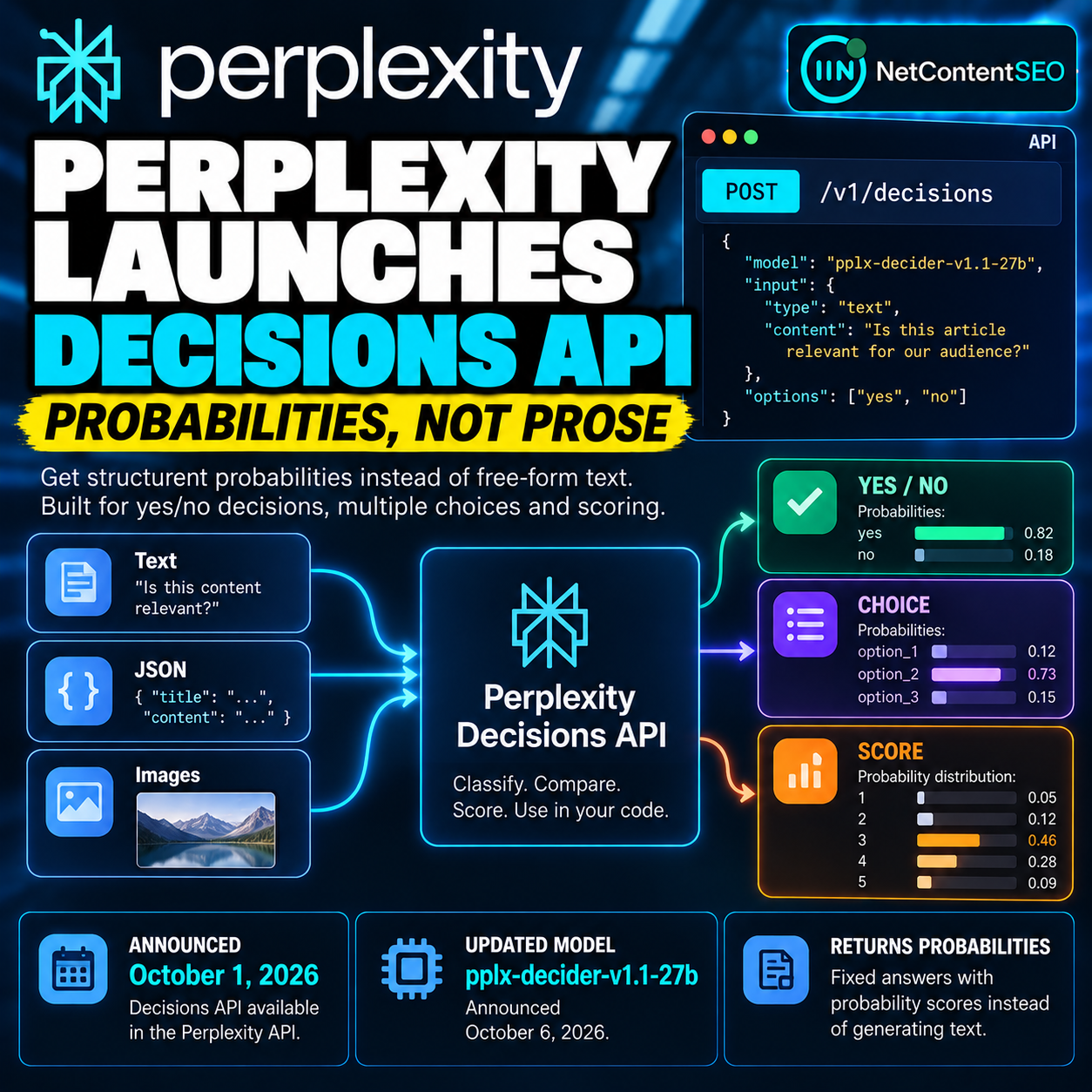

Perplexity has launched the Decisions API, an endpoint designed to return structured decisions and probabilities rather than a free-form text answer. Announced in the API changelog on October 1, 2026, the endpoint is POST /v1/decisions and initially uses the pplx-decider-v1-27b model. It is intended for tasks such as yes/no classification, choosing among options and assigning scores that application code can use directly.
Unlike a conventional answer-generation endpoint, the Decisions API is built around a fixed set of possible answers and a probability distribution over those answers. That makes it a potential fit for workflows that need a consistent, machine-readable decision rather than prose to parse.
What the Decisions API returns
Perplexity describes the API as turning inputs such as text, JSON and images into typed answers with probabilities. Developers define the decision they want to make and the possible answers or scoring scheme; the model returns a structured result that can be consumed by downstream code.
The initial launch used pplx-decider-v1-27b. Perplexity subsequently announced an updated open-weights model, pplx-decider-v1.1-27b, on October 6. Developers should check the current API documentation for the supported model identifier and request schema before integrating.
Three decision patterns
- Yes/no: classify whether an item meets a defined condition, such as whether a page matches a stated requirement.
- Choice: select among a fixed set of options, such as assigning a source to one of several editorial categories.
- Score: assign an item to a predefined score level or rubric, for example to support triage or prioritisation.
These are possible application patterns, not claims that the API is a specialised SEO product. Using it to classify content, evaluate sources or prioritise editorial signals would be an implementation choice made by the developer.
Why probabilities and structured output matter
When an application needs a category or a score, generating a paragraph and then extracting a label adds an extra interpretation step. A decision-focused endpoint instead returns a result in a defined format, making it easier to connect to filters, queues, dashboards or review workflows.
The probability distribution can help downstream systems decide whether to accept a result automatically or send uncertain cases for human review. Probabilities should not automatically be treated as calibrated real-world confidence, however; teams should validate them against labelled examples for their own task.
Potential applications for content and search workflows
The API could be used to support repeatable classification tasks in content operations, including:
- Content triage: route pages or briefs into predefined categories.
- Source assessment: classify sources against a documented rubric before a human editor reviews the evidence.
- Editorial prioritisation: assign predefined scores to items based on criteria supplied by the application.
- Quality-control queues: flag items for manual review when the model's distribution is ambiguous or the result fails a threshold.
- Structured data processing: make decisions from supported text, JSON or image inputs without relying on free-form output parsing.
These examples are potential uses, not evidence that the API guarantees accurate editorial judgments. Any workflow that affects publication, attribution, eligibility or other consequential outcomes should include validation, transparent criteria and human review where appropriate.
How it differs from a text-generation API
| Text generation | Decisions API |
|---|---|
| Produces natural-language responses. | Returns structured answers from a defined set of possible outcomes. |
| Often requires parsing or interpreting the generated text. | Designed for direct use by application logic. |
| Useful for explanations, summaries and open-ended writing. | Useful for yes/no decisions, choices and predefined scoring. |
The two approaches serve different needs. A structured decision may be easier to automate, while open-ended generation remains useful when a user needs an explanation or a flexible response.
What developers should verify before deployment
- Define the answer space: make options and score levels unambiguous.
- Test against labelled data: measure accuracy and error patterns on representative examples.
- Set review thresholds: route ambiguous or high-impact cases to a human instead of relying on a single probability value.
- Check current model details: confirm the supported model name, input formats, limits and pricing in the current documentation.
- Monitor cost and usage: inspect the API's usage reporting, especially for batches or repeated context.
- Keep an audit trail: log the input, defined options, model version and result for decisions that need to be reviewed later.
What is confirmed?
- Official launch: Perplexity announced the Decisions API on October 1, 2026.
- Endpoint:
POST /v1/decisions. - Purpose: return a probability distribution over fixed answers instead of generated prose.
- Supported decision patterns: yes/no, choice and scored answers.
- Model update: Perplexity announced
pplx-decider-v1.1-27bon October 6, 2026.
Frequently asked questions
What is Perplexity's Decisions API?
It is an API endpoint for returning structured decisions and probabilities over a predefined answer set rather than a free-form text response.
What endpoint does it use?
The documented endpoint is POST /v1/decisions.
What kinds of decisions can it make?
Perplexity describes yes/no decisions, choices among options and scored answers.
Can it be used for SEO or editorial workflows?
Potentially, for developer-defined classification, source triage or scoring workflows. Those are application ideas, not official SEO-specific features, and their reliability needs to be tested.
Do the probabilities guarantee accuracy?
No. Probabilities are model outputs and should be evaluated against representative labelled data. High-impact decisions may require thresholds and human review.
The takeaway
Perplexity's Decisions API moves a class of AI tasks from generating prose to returning structured, probability-based outcomes. With POST /v1/decisions, developers can build yes/no, choice and scoring workflows that feed directly into application logic. For SEO and editorial teams, content classification and source triage are plausible uses—but they should be treated as implementation opportunities, validated with real data rather than assumed to be accurate by default.
Primary sources
Perplexity API Changelog; Perplexity API Platform Forum — official announcements.