

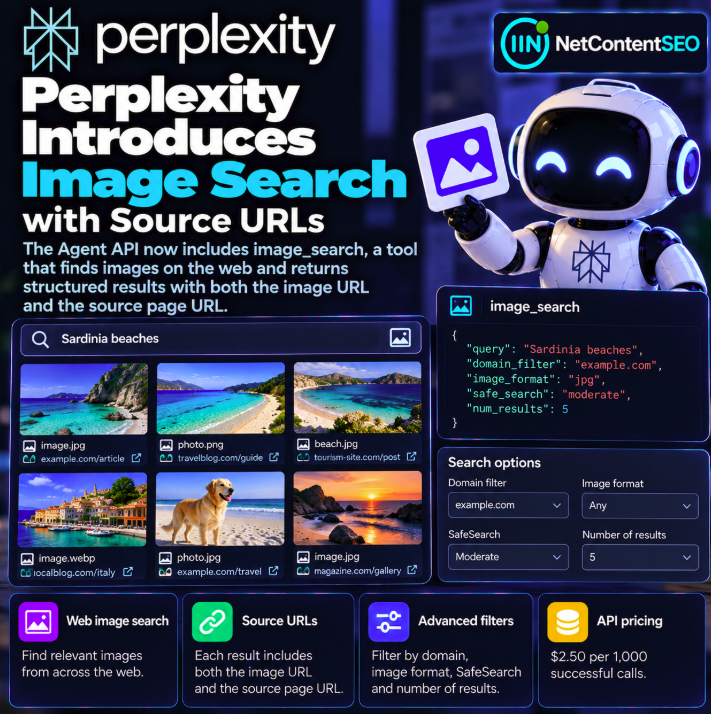

Perplexity has introduced image_search in its Agent API, allowing developers to search the web for images and receive structured results that include both an image URL and the URL of its source page. The October 2026 API changelog also describes controls for domain filtering, image format, SafeSearch and the number of results. The published price is $2.50 per 1,000 successful calls.
The most relevant detail for publishers and SEO professionals is the source-page field: an agent can receive not only a media asset location but also a reference to the web page associated with that result. However, returning a source URL does not guarantee that an AI answer will display a citation, send a click or correctly establish image ownership.
Primary source: Perplexity API Changelog.
What does Perplexity's new image_search tool do?
The Agent API tool is designed to retrieve relevant images from the web. Rather than returning only a list of image files, it provides structured results containing two distinct links: the URL of the image itself and the URL of the source page.
Those fields serve different purposes. The image URL points to the media resource, while the source page URL provides context about where the image was found. Applications can use that context to let users inspect the original page, understand surrounding content or perform further checks before using an image.
Key capabilities and pricing
| Feature | Documented capability |
|---|---|
| Tool name | image_search |
| Availability | Perplexity Agent API |
| Result fields | Image URL and source page URL |
| Domain filters | Supported |
| Image format filters | Supported |
| SafeSearch | Supported |
| Result count | Configurable |
| Price | $2.50 per 1,000 successful calls |
Developers should consult the current API reference for exact parameter names, accepted values and any applicable usage limits. The availability of a filter does not mean every result will be suitable for reuse or publication.
Why source page URLs matter
Image retrieval systems sometimes expose a direct file address without enough information about the page on which the image appeared. Including a source page URL creates an additional reference point for an agent or user to investigate.
For example, a research assistant gathering visual references for a travel article could show both a photograph and a link to the page from which it was retrieved. This can improve traceability, although the source page is not necessarily the original photographer, copyright owner or first publisher.
The distinction is crucial: source attribution, licensing permission and visible AI citations are three separate questions. A source-page URL can support attribution workflows, but it does not automatically resolve image rights or ensure that an agent cites the page in its final answer.
Domain filtering for targeted image discovery
Domain filters allow developers to narrow image searches to selected web domains. This may be useful for applications that prioritize known repositories, official publishers or approved business websites.
A domain-restricted result is not automatically trustworthy or legally reusable. The application should still verify that the page is relevant, that the image corresponds to the claimed content and that the intended use complies with applicable rights and terms.
Format, SafeSearch and result-count controls
Image format filters can help applications request media suitable for particular processing pipelines. SafeSearch offers a way to control the types of results returned, while the result-count option lets developers tune the volume of results for a task.
These controls can improve application design, but they do not replace moderation, human review or content licensing checks. Exact filtering behavior should be evaluated using representative queries.
What does $2.50 per 1,000 successful calls mean?
The announced rate corresponds to $0.0025 per successful call. At that rate, 10,000 successful calls would cost $25, and 100,000 successful calls would cost $250, before any other applicable charges.
These are illustrative calculations based on the stated tool price. The changelog describes billing per successful call; developers should check the API's billing documentation for the precise definition of success and any additional model, tool or platform costs.
Image search versus Fast Search
Perplexity has also documented a separate Agent API change that makes Fast Search the default web retrieval mode for certain presets. image_search is a distinct capability focused on finding images and exposing associated URLs. Developers should not assume that the web search price of $1 per 1,000 calls applies to image searches: the documented image_search price is $2.50 per 1,000 successful calls.
What changes for image SEO and GEO?
For publishers, the addition of source page URLs is a reason to examine how visual assets and their surrounding pages are represented in AI retrieval workflows. Clear page context, descriptive content and accessible image resources can help humans and systems interpret media, but this release does not establish a new Perplexity ranking factor.
For GEO researchers, it creates a concrete API capability to test: whether source-page links appear in retrieved image results, how consistently they map to relevant pages and whether downstream agent responses preserve that attribution. None of those outcomes should be assumed without observation.
How to evaluate image-search source attribution
- Record both URLs. Preserve the returned image URL and source page URL as separate fields.
- Check relevance. Confirm that the source page actually contains or contextualizes the returned image.
- Test filters. Compare domain, format and SafeSearch behavior using controlled queries.
- Audit attribution. Measure whether a downstream agent visibly links to the source page when presenting results.
- Respect rights. Verify licenses and permissions before reproducing retrieved images.
- Track costs. Count successful tool calls separately from model token usage.
What the announcement does not prove
The new tool does not establish that all retrieved images are licensed for reuse, that the source page is always the original owner, that every agent answer will cite a source or that Perplexity's consumer search experience uses identical image retrieval logic. It also does not establish a change to Google Images rankings.
FAQ
What is Perplexity image_search?
A tool in the Agent API that retrieves images from the web and returns structured results.
Does it return the image's source page?
Yes. The documented results include both the image URL and the source page URL.
What filters are available?
Domain, image format, SafeSearch and number of results.
How much does it cost?
$2.50 per 1,000 successful calls, according to the October 2026 changelog.
Does a source URL mean the image is free to use?
No. Copyright, licensing and permission must be checked separately.
Will Perplexity automatically cite the source page in every AI answer?
The announcement does not guarantee downstream citation behavior.
NetContentSEO analysis
Perplexity's image_search is a meaningful addition to agentic retrieval because it preserves a link between a discovered image and its associated web page. That is useful for traceability and source-aware application design. The SEO opportunity is to study whether agents retain and display those source references—not to assume that the presence of a source URL automatically delivers AI citations or traffic.
Primary source: Perplexity API Changelog, October 2026.