

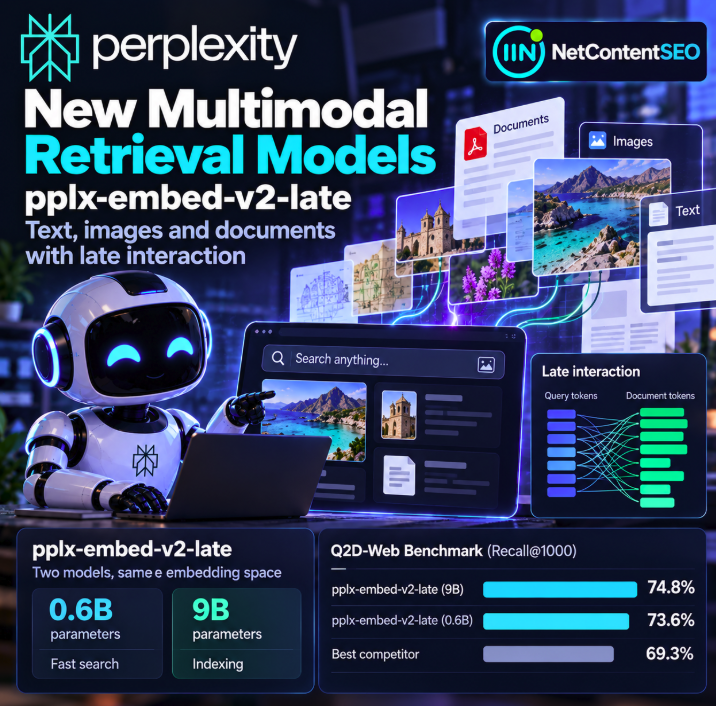

Perplexity AI has introduced pplx-embed-v2-late, a family of multimodal retrieval models designed to search across text, images and visually rich documents. The October 7, 2026 research announcement describes two model sizes—0.6 billion and 9 billion parameters—and a late-interaction approach that retains fine-grained information instead of reducing every document to a single embedding vector.
The research also reports 74.8% and 73.6% Recall@1000 on Q2D-Web for the two models, compared with 69.3% for the strongest competitor included in Perplexity's comparison. These are company-reported benchmark results, not an independent evaluation. The announcement does not establish that the models have been integrated into Perplexity's consumer-facing search engine.
Primary research source: Perplexity Research (October 7, 2026 announcement described in the supplied research brief).
What is pplx-embed-v2-late?
pplx-embed-v2-late is described as a multimodal embedding family built for retrieval: finding relevant source material in response to a query. Unlike a conventional single-vector approach that compresses a document into one representation, late interaction preserves multiple representations at token or fine-grained content level and compares them with the query during scoring.
This matters when the answer depends on a specific passage, a detail in an image or information within a complex document. A single document-level vector can summarize the overall subject but may not retain every fine distinction needed for retrieval. Late interaction is intended to preserve more of that detail.
Single-vector retrieval vs late interaction
In a simplified single-vector system, a document is mapped to one embedding, and a query is mapped to another. Retrieval compares these compact representations. This can be efficient, but it compresses a great deal of information into a single point.
Late-interaction retrieval instead retains representations for multiple elements of the content. At query time, the system can compare query elements with relevant document elements and combine those matches into a score. This allows more targeted matching without requiring a full generative model to read every candidate document from scratch.
The precise scoring function, indexing implementation and memory requirements of Perplexity's models should be taken from the full technical paper; the supplied announcement summary does not specify those details.
Two model sizes: 0.6B and 9B parameters
Perplexity's release describes two sizes within the family: 0.6B and 9B parameters. The notable design choice is that the models reportedly share the same embedding space. According to the company, this can support a workflow in which content is indexed using the larger 9B model while queries are processed more quickly with the smaller 0.6B model.
That is an interesting asymmetric retrieval architecture: a system can invest more compute when preparing its document index, then prioritize responsiveness for repeated searches. But it should not be assumed that every 9B/0.6B deployment is automatically cheaper or faster overall. Storage requirements, indexing cost, query latency, hardware and recall all need to be measured in the actual environment.
Multimodal retrieval: text, images and visual documents
The models are designed to work with multiple content types rather than text alone. That broadens the kinds of sources a retrieval system can consider:
- Text: passages in articles, technical documentation and other written sources.
- Images: visual content that may contain information relevant to a query.
- Visually rich documents: material such as illustrated reports, presentations or documents where layout and visual elements contribute to meaning.
These examples describe possible retrieval applications, not a guarantee that the models can interpret every file format or every complex diagram without errors.
Perplexity's Q2D-Web benchmark results
The supplied research brief reports the following Recall@1000 results:
| Model | Q2D-Web Recall@1000 |
|---|---|
| pplx-embed-v2-late, 9B | 74.8% |
| pplx-embed-v2-late, 0.6B | 73.6% |
| Best competing model in the reported comparison | 69.3% |
Recall@1000 measures whether relevant results are retrieved within the top 1,000 candidates under the benchmark's evaluation protocol. It is a retrieval metric, not a measure of final answer correctness, citation accuracy, user satisfaction or click-through rate.
The reported 9B score is 5.5 percentage points above the competitor figure; the 0.6B score is 4.3 percentage points higher. These are absolute percentage-point differences, not independently validated real-world performance improvements.
The relative closeness of the two model scores is notable, but the summary does not supply enough information to generalize about performance across all languages, document types or deployment configurations.
Why shared embedding space is technically significant
If the two models produce compatible representations in the same space, a retrieval system can potentially separate the expensive indexing stage from the latency-sensitive query stage. This matters for large document collections because indexing is typically performed less frequently than searching.
In practice, the advantage depends on how often content changes, how much storage token-level embeddings require, whether the index can be updated incrementally and what latency targets the service must meet. The shared-space property is an architectural capability, not proof of a specific production cost reduction.
What this means for AI Search and GEO
Multimodal late interaction could change how retrieval systems identify useful evidence within complex sources. A search system that better matches a query to individual passages, images or document elements may retrieve material that a coarser document-level representation misses.
For publishers, this makes accurate and accessible source material important across formats. Clear headings, descriptive image context, meaningful document structure and trustworthy provenance remain valuable editorial practices. However, Perplexity has not confirmed in the supplied announcement that these models power its public search results, and there is no evidence here of a new SEO ranking factor or guaranteed citation benefit.
Three questions publishers should investigate
- Which content formats are actually indexed? A model's research capabilities do not prove that a particular search product retrieves every PDF, image or visual document on the open web.
- How is attribution preserved? Better retrieval recall does not automatically ensure that an AI answer credits the correct publisher or links to the original source.
- How does retrieval translate into user-visible results? Candidate retrieval, reranking, answer generation and citation presentation are separate stages.
What developers should test before adoption
- Retrieval recall and precision on representative company documents, not only public benchmarks.
- Query latency for 0.6B versus 9B and any asymmetric indexing configuration.
- Storage overhead from retaining token-level representations.
- Behavior on mixed text-and-image documents and unusual layouts.
- Accuracy across relevant languages and domain-specific terminology.
- Source traceability from retrieved element to original document.
Availability of research models should also be distinguished from supported APIs, licensing, hosting requirements and production service guarantees; those details require confirmation from Perplexity's current documentation.
FAQ
What is pplx-embed-v2-late?
A Perplexity multimodal retrieval embedding family that uses late interaction to preserve fine-grained content representations.
How many model sizes are there?
The October 7 research summary describes 0.6B and 9B parameter models.
Can the 9B model index documents while the 0.6B model handles queries?
Perplexity reports that the models share an embedding space, enabling this type of asymmetric configuration.
What does Recall@1000 mean?
It measures whether relevant material is found within the top 1,000 retrieved results under a particular evaluation setup. It is not an answer-accuracy or citation metric.
What are the reported Q2D-Web scores?
The company reports 74.8% and 73.6% for its two models, versus 69.3% for the strongest competitor in its comparison.
Is Perplexity using these models in its public search engine?
The supplied research announcement does not confirm integration into the consumer-facing search product.
Will these models increase citations to my website?
No such effect has been demonstrated by the supplied benchmark results.
NetContentSEO analysis
Perplexity's announcement is significant because it combines multimodal retrieval, token-level matching and a shared embedding space across model sizes. Together, these features suggest ways to improve evidence retrieval while keeping query processing practical. For SEO and AI visibility research, the important next step is to test whether such retrieval advances affect which sources are found, how accurately they are attributed and what users actually see—not to assume a research benchmark has already changed public search rankings.
Source: Perplexity Research, October 7, 2026.