

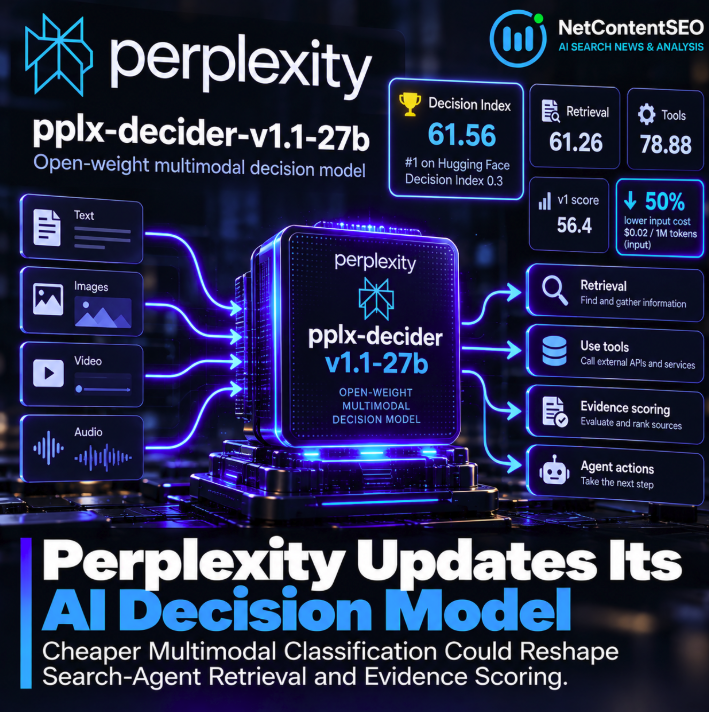

Perplexity has released pplx-decider-v1.1-27b, an updated open-weight multimodal decision model designed to make finite decisions inside AI systems rather than generate conventional long-form responses.
The October 6 release improves substantially on the original pplx-decider-v1-27b in Perplexity's published evaluation, raising its overall Decision Index score from 56.4 to 61.56. Perplexity says the new checkpoint outperforms Jev by more than 3.5 points while retaining the same underlying backbone.
For AI Search and GEO, the interesting implication is not another chatbot model. It is the growing availability of specialized decision layers that can sit between retrieval, evidence evaluation and an agent's next action.
What is pplx-decider-v1.1-27b?
The model is a specialized classifier built around a 27B Qwen3.5-family backbone and a separate decision head. Its purpose is to choose among a defined set of possible decisions according to instructions and criteria supplied by the developer.
That architecture makes it fundamentally different from asking a general-purpose LLM to generate unrestricted text and then parsing the answer.
A decision model can instead be used to route a request, classify evidence, choose a tool, select a workflow or determine which action an agent should execute next.
The new model reaches 61.56 on the Decision Index
Perplexity's model card reports an overall Decision Index score of 61.56, compared with 56.4 for the previous pplx-decider-v1-27b and 57.9 for Jev.
The published category scores for v1.1 are 48.18 for Knowledge, 69.45 for Language, 61.26 for Retrieval, 78.88 for Tools and 44.66 for Arts.
Those retrieval and tool-use categories are particularly relevant to agentic search systems, although benchmark performance should not be treated as proof of how a production search agent will rank or cite web sources.
More training data and non-causal attention drive the improvement
Perplexity attributes most of the gain to two changes: lifting the causal mask and training on more data, including data derived from Tasksource.
The model card also warns implementers that the evaluated checkpoint depends on its saved non-causal attention behavior and calibration. A generic serving configuration that ignores those details may not reproduce the published results.
Why decision models matter to AI Search
Modern AI search is increasingly a pipeline rather than a single model call.
An agent may first interpret the query, decide whether fresh web information is required, choose a retrieval tool, evaluate returned documents, decide whether more searching is necessary and finally determine which evidence should influence the answer.
Each of those stages can be represented as a constrained decision.
A cheaper and stronger decision model makes it practical to insert more classification and routing steps into that pipeline without requiring a large generative model for every choice.
Retrieval can become more selective before generation begins
This has direct consequences for GEO.
Suppose an agent retrieves twenty candidate documents. A decision layer can classify which documents satisfy the user's intent, which sources meet quality criteria, which evidence conflicts and whether another search should be performed.
The generative model may therefore never see many of the retrieved pages.
From a visibility perspective, this means the path from “indexed or retrieved” to “used in the answer” can contain additional machine-selection layers.
Evidence scoring becomes a distinct optimization layer
Traditional SEO largely asks whether a document can be discovered, indexed and ranked.
Agentic search adds another question: does the system decide that this evidence is useful enough to pass downstream?
A decision model can evaluate structured criteria such as relevance, freshness, source type, completeness or compatibility with the current task.
Perplexity has not announced that pplx-decider-v1.1-27b itself is now determining citations in Perplexity Search. That would be an unsupported conclusion.
But the model illustrates the type of component that can make evidence selection increasingly explicit and inexpensive inside search-agent architectures.
Open weights make the architecture reproducible
The model is distributed as an open-weight checkpoint under the Apache 2.0 license on Hugging Face.
That matters because developers can experiment with the same type of constrained decision architecture in their own retrieval systems rather than depending entirely on a hosted black-box model.
The published repository includes the decision head, configuration, evaluation artifacts and inference implementation needed to preserve the model's evaluated behavior.
The NetContentSEO takeaway
pplx-decider-v1.1-27b is important for AI Search not because it creates another answer engine, but because it makes the decision layer inside agents more capable and easier to deploy.
As retrieval systems become agentic, visibility can depend on a sequence of machine decisions: whether to search, which tool to use, which documents to keep, which evidence to trust and which information to pass to the final model.
That means GEO measurement increasingly needs to look beyond the final citation.
The more useful research question may become: at which decision stage did a source disappear?
Models such as Perplexity's decider make that architecture easier to build — and potentially make retrieval and evidence scoring a much more important battleground for brand visibility.