

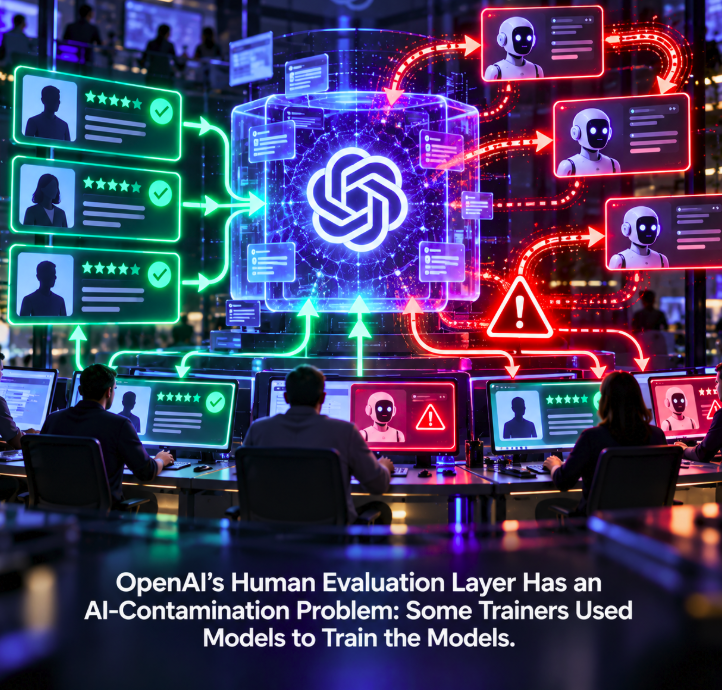

One of the most important inputs into an AI system is supposed to come from outside the AI system: human judgment. A new investigation suggests that boundary can fail in practice. Multiple contractors hired to help improve OpenAI’s models were reportedly fired after using AI tools to complete work that was intended to capture human evaluation, creating a circular quality-control problem in which models can influence the very feedback used to assess or improve models.
The reporting originates with 404 Media and was summarized by Search Engine Roundtable on September 25. Search Engine Roundtable reports that OpenAI uses thousands of contractors to help improve its AI models and that multiple contractors were dismissed for using AI in that work. This is investigative reporting rather than an OpenAI announcement, and the available public evidence does not establish that the practice was widespread across OpenAI’s entire evaluation workforce.
The value of a human evaluator is independence from the model
Human evaluation exists because model output cannot be treated as its own ground truth. People can compare answers, identify factual or stylistic failures, judge instruction following, flag unsafe behavior and provide preferences that automated metrics may miss. The usefulness of that signal depends partly on the evaluator contributing an independent judgment rather than simply reproducing another model’s answer.
If an evaluator delegates the task to AI, that independence weakens. A response that appears to represent a human preference may instead encode the assumptions, mistakes and stylistic tendencies of the model the contractor used. The resulting label can still look clean and professionally written, which makes the contamination particularly difficult to detect from the output alone.
This does not mean AI-assisted evaluation is inherently invalid. Model-based graders are widely used in AI development when they are intentionally designed into the evaluation methodology. The problem is methodological substitution: a task specified as human judgment can no longer be interpreted as human judgment if an undisclosed model produced or materially shaped the answer.
This is a provenance problem before it is a model-collapse problem
The story naturally invites comparisons with model collapse, the concern that systems repeatedly trained on synthetic material can lose information or amplify artifacts over successive generations. But the contractor issue is more immediate and more specific. The first failure is provenance: the developer believes it is receiving one type of signal and actually receives another.
Human and synthetic feedback can both be useful, but they answer different methodological questions. If a research team intentionally asks a model to grade another model, it can calibrate that judge, compare it with human raters and account for its biases. If AI assistance enters a supposedly human-only workflow without disclosure, the data is mislabeled at the source.
That distinction matters because training and evaluation pipelines depend on knowing where judgments came from. A dataset containing synthetic labels is not automatically unusable. A dataset in which synthetic labels are mistaken for independent human labels is much harder to interpret.
AI makes evaluation work unusually easy to counterfeit
Generative AI creates a structural challenge for contractors doing language-heavy evaluation. The same class of tool they are being asked to judge can often perform the surface mechanics of their job: summarize an answer, compare two responses, explain which is clearer, rewrite a justification or produce a polished rationale.
That makes unauthorized assistance difficult to distinguish from genuine work when quality control focuses only on the final text. An evaluator can potentially submit fluent reasoning without having performed the cognitive process the task was designed to measure.
The situation resembles a measurement instrument that can secretly generate its own readings. The problem is not simply worker compliance. Evaluation systems need controls that can establish whether the signal was produced under the conditions the methodology assumes.
Scale makes the human layer harder to audit
Search Engine Roundtable describes OpenAI as having thousands and thousands of contractors helping improve its models, citing 404 Media’s reporting. At that scale, human evaluation becomes an operational system of its own, with hiring, instructions, quality checks, task distribution and enforcement.
Large contractor pools can produce the volume needed to evaluate rapidly evolving models, but scale also creates heterogeneous behavior. Different workers may interpret instructions differently, use different tools or face different incentives around speed and throughput. The quality of the human signal therefore depends on the design of the evaluation operation as much as on the expertise of any individual rater.
The reported firings show that at least some enforcement existed. What the public reporting does not establish is how frequently unauthorized AI use occurred, how it was detected, how much affected work entered model-development pipelines or whether contaminated data was subsequently removed. Those unanswered questions limit how far the incident can be generalized.
Human feedback is not automatically ground truth
The episode is also a reminder that “human evaluated” should not be treated as synonymous with objective truth. Human raters can disagree, misunderstand instructions, carry biases, make mistakes or optimize for task completion. AI assistance adds another possible source of distortion, but it does not create the broader measurement problem from scratch.
Good evaluation therefore requires more than putting a person in the loop. It requires clear rubrics, calibration, agreement analysis, quality assurance and provenance. The relevant question is not simply whether humans were involved, but whether the evaluation process produced a reliable signal for the property researchers intended to measure.
This is particularly important as AI companies publish benchmark results or describe model improvements using human preference. Readers need to understand what population performed the evaluation, what instructions they received, what tools were allowed and how disagreements were handled before treating a percentage as an uncomplicated measure of quality.
Independent human judgment is becoming more valuable as AI output becomes cheaper
The economic paradox is that AI can make human evaluation both more necessary and more difficult to protect. As generated content becomes nearly free, developers can produce enormous volumes of candidate answers, reasoning traces, synthetic tasks and model variants. Evaluating those outputs remains comparatively expensive because reliable human attention does not scale at the same rate.
That gap creates pressure to automate evaluation, accelerate contractor throughput or use models as judges. Those approaches can be legitimate when they are explicit. But the remaining independent human signal becomes more valuable precisely because so much of the surrounding pipeline can already be synthetic.
NetContentSEO has seen the same distinction matter in public-facing AI experiments. In our six-model entity-recognition test, the useful result came from comparing what different systems independently reconstructed from the same prompt rather than allowing one model’s interpretation to become the reference answer for the others. Independence is part of what makes a comparison informative.
Evaluation provenance may need to become a first-class metric
AI labs already track dataset provenance because the origin of training material affects licensing, quality, duplication and contamination. Evaluation data increasingly deserves the same treatment. A label should ideally carry enough metadata to distinguish a human judgment, a model-generated judgment, an AI-assisted human judgment and a consensus produced through multiple evaluators.
Those categories need not be ranked universally. A carefully calibrated model judge may outperform a hurried human on some narrow tasks, while expert human evaluation may be indispensable for nuanced or high-stakes judgments. The critical requirement is knowing which signal is which.
Without that provenance, researchers risk drawing conclusions from evaluation results whose underlying methodology changed invisibly. A model can appear to improve against “human feedback” even when some portion of that feedback was generated by another model.
The human layer needs its own quality assurance
The reported contractor dismissals expose an uncomfortable recursion in modern AI development. Models require evaluation; evaluation requires people; and those people now have easy access to models capable of performing parts of the evaluation. Simply instructing workers not to use AI does not eliminate the structural incentive or the detection problem.
Labs therefore need to treat the human-feedback pipeline as a system that can itself fail. That means designing tasks that reveal reasoning quality, auditing unusual patterns, calibrating raters, separating intentionally synthetic judgments from human ones and preserving provenance through the downstream dataset. None of those controls guarantees perfect independence, but they make the methodology more inspectable.
The broader trust issue resembles the challenge NetContentSEO discussed in our analysis of expertise and authenticity in the AI era: once synthetic output becomes easy to produce, the origin and integrity of a signal matter more, not less. Fluent text alone cannot establish that the underlying judgment came from the source it claims to represent.
Models cannot be their own invisible control group
The irony of using AI to train AI makes for an attention-grabbing headline, but the methodological issue is more important than the irony. AI systems can absolutely participate in training and evaluation pipelines. Synthetic data, model graders and automated critiques are already central research tools. What breaks the experiment is allowing those tools into a channel that is being interpreted as independent human judgment without recording the substitution.
The 404 Media investigation, as summarized publicly, does not prove that OpenAI’s overall human evaluation program is compromised, nor does it quantify how much contractor work was affected. It does establish a credible failure mode that every large AI lab has reason to address: when evaluators can quietly outsource judgment to the technology they are evaluating, the human layer stops being reliably human.
As models become better at imitating careful analysis, provenance becomes part of quality itself. The question is no longer only whether an evaluation looks intelligent. It is whether researchers can still tell who—or what—actually made the judgment.