
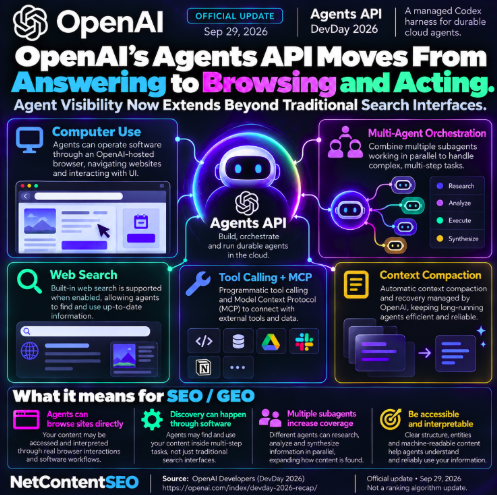
OpenAI's Agents API is pushing agentic systems beyond generating answers and into browsing, software interaction and coordinated multi-agent work. The managed API runs the Codex harness while OpenAI handles sessions, orchestration, context compaction and recovery.
For AI visibility, the important shift is that discovery can increasingly happen inside a multi-step task rather than through a conventional search interface.
Computer use lets agents operate software through the UI
Computer use allows an agent to work inside an OpenAI-hosted browser. It can navigate websites and interact with browser interfaces to collect information, test sites or use applications through their user interfaces.
This creates a discovery path that looks different from classic crawling or a search-results click: an autonomous agent can directly visit and interact with a website while completing a larger task.
Multi-agent orchestration delegates work to subagents
The Agents API also supports multi-agent orchestration. A main agent can delegate independent tasks to subagents, which maintain separate contexts and can work in parallel before their results are combined.
OpenAI highlights research across multiple sources as one of the workloads suited to parallel subagents. That means one task can potentially trigger several independent discovery paths rather than a single sequential research process.
Web search remains available inside the agent workflow
Agents can use OpenAI's built-in web search when it is enabled. The tool supports live internet search as well as cached search modes, and developers can configure parameters including allowed domains and search context size.
Search therefore becomes one tool among several: an agent can retrieve information from the web, operate software, access connected systems and coordinate other agents as part of the same broader objective.
MCP and tool calling connect agents to external systems
The Agents API supports MCP servers and programmatic tool calling, allowing developers to connect agents with external tools and data sources.
This expands the information environment beyond publicly indexed webpages. Depending on permissions and configuration, an agent can combine web information with application data and specialized tools while solving a task.
OpenAI manages context compaction and recovery
Long-running agents generate substantial histories of messages, tool outputs, retries and intermediate state. The Agents API manages context compaction and recovery so useful state can persist without continually carrying every previous interaction at full size.
This infrastructure is important for durable tasks that may involve many retrieval and action steps.
What this changes for SEO and GEO
The visibility surface is expanding. A publisher's content may now be encountered by an AI system through web search, direct browser navigation, a software workflow or research delegated to a subagent.
That does not mean OpenAI has announced a new ranking algorithm for the Agents API. It means source discovery increasingly occurs inside agent workflows whose final goal may not look like “search” at all.
The NetContentSEO view
Traditional SEO optimizes for discovery through search interfaces. Agentic systems broaden that model: machines can search, browse, inspect, delegate and act before synthesizing the information a user ultimately receives.
For publishers, accessibility and interpretability therefore matter beyond the SERP. Clear structure, reliable entities, accessible interfaces and machine-readable information can help content remain usable when agents encounter it through different retrieval paths.
The practical GEO question is becoming broader than “does this page rank?” It is increasingly: can an autonomous agent find, understand and successfully use this information while completing a task?