

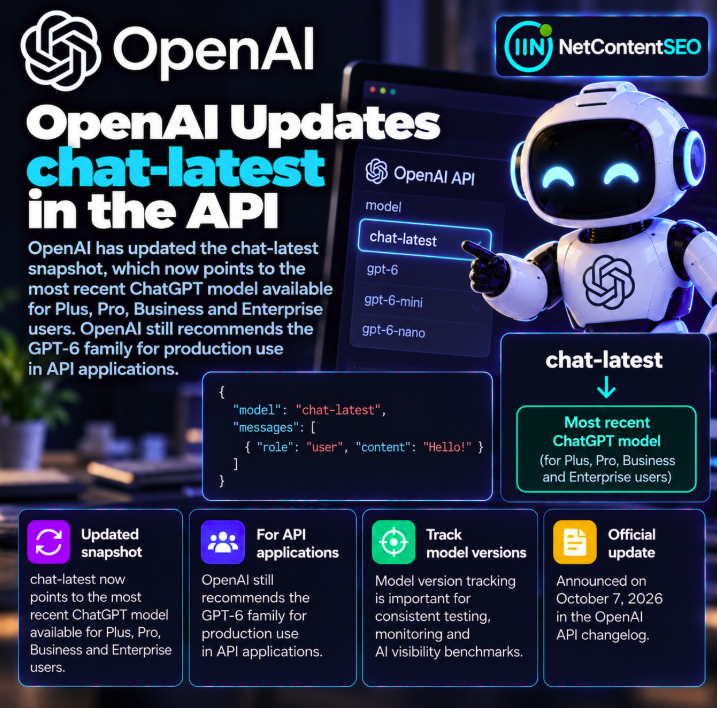

OpenAI updated the chat-latest model reference in its API on October 7, 2026, according to its official API changelog. The alias points to the latest ChatGPT model available to Plus, Pro, Business and Enterprise users. OpenAI nevertheless recommends the GPT-6 family for production API applications.
For developers and AI visibility researchers, the important distinction is between a moving model reference and a deliberately selected model version. A test using chat-latest today may not run against exactly the same underlying model as a test performed after a future update. That matters for reproducibility, especially when monitoring brand mentions, answers and citations over time.
Primary source: OpenAI API Changelog.
What changed on October 7?
The documented update concerns the chat-latest model reference. Its purpose is to track the most recent eligible ChatGPT model experience rather than serve as a permanently pinned snapshot for every experiment or production workflow.
The changelog summary does not establish a new public web search ranking algorithm, a change to ChatGPT's citation policy or a specific measured quality improvement for any SEO task.
Why a moving model alias matters
When an application calls a stable-looking alias, the string in the request may remain unchanged even if the underlying model changes. That is convenient for developers who want access to the latest behavior, but it introduces a variable into longitudinal comparisons.
For example, an AI visibility team might ask the same 100 commercial prompts each week and record which brands are recommended. If the model behind the alias changes, a shift in answers may be partly related to the model transition rather than to any change in a brand's online content.
That does not mean every update necessarily changes results. It means the model reference and the date of testing should be recorded before drawing causal conclusions.
OpenAI's recommendation for production APIs
According to the October update, OpenAI recommends the GPT-6 family for production API applications. This guidance is distinct from the purpose of chat-latest, which is to reflect the latest ChatGPT model available to the specified paid ChatGPT tiers.
Production systems often prioritize repeatability, validated behavior and change management. Teams should consult the current API model documentation for available fixed model identifiers, lifecycle policies and compatibility before selecting a deployment target.
What should AI visibility researchers record?
- Model identifier: Record the exact model string sent to the API.
- Resolved version when available: Preserve any model-version metadata the response exposes.
- Timestamp: Record when each test ran, including timezone.
- Product surface: Distinguish API calls from the ChatGPT consumer application.
- Tool configuration: Note whether web search, retrieval or other tools were enabled.
- Prompt and parameters: Keep prompts and relevant generation settings consistent.
- Evidence: Save answer text, citations and source URLs separately.
- Repetitions: Run enough samples to understand variability before claiming a trend.
Model changes and citation research
A model update may motivate new tests of how answers are phrased or which sources appear in a configured workflow. However, the update alone does not demonstrate that OpenAI changed source retrieval, citation selection or public ChatGPT search visibility. Those outcomes depend on the actual product, tools, retrieval context and test conditions.
Researchers should avoid combining outputs from different models or account tiers into a single undifferentiated 'ChatGPT visibility' metric. Instead, segment results by the actual configuration used.
How to build a more reproducible benchmark
Start with a documented prompt set and a clearly defined measurement objective: brand mention, recommendation, factual answer quality or cited-domain frequency. Select a model version appropriate for the test and retain the full configuration. If using a moving alias such as chat-latest, label the results accordingly and mark known changelog events on the reporting timeline.
When comparing periods, do not automatically attribute a changed citation rate to an SEO campaign. First check for model updates, retrieval-tool changes, prompt changes, account differences and normal response variability.
What this update does not establish
- It does not announce a new Google or Bing ranking factor.
- It does not confirm a change in ChatGPT's public search citations.
- It does not establish that every paid ChatGPT user has identical model access in every circumstance.
- It does not provide a measured before-and-after benchmark for SEO or GEO performance.
- It does not mean
chat-latestis the recommended default for all production API workloads.
FAQ
What is chat-latest?
An OpenAI API model reference that points to the latest ChatGPT model available for the paid ChatGPT tiers identified in the changelog.
When was it updated?
October 7, 2026, according to the official OpenAI API changelog.
Which model family does OpenAI recommend for production APIs?
The GPT-6 family, according to the supplied changelog update.
Can the same chat-latest identifier produce results from different underlying versions over time?
Yes. That is a core consideration when using a moving model reference.
Does the update prove ChatGPT changed how it cites websites?
No. A citation-policy or retrieval-system change is not established by this announcement.
NetContentSEO analysis
AI visibility benchmarks are only as reliable as their recorded test conditions. A moving model reference is useful for exploring current capabilities, but it should not be treated as a fixed scientific baseline. OpenAI's October chat-latest update reinforces the need to record model versions, timestamps and retrieval settings when comparing AI answers and citations across time.
Source: OpenAI API Changelog, October 7, 2026.