
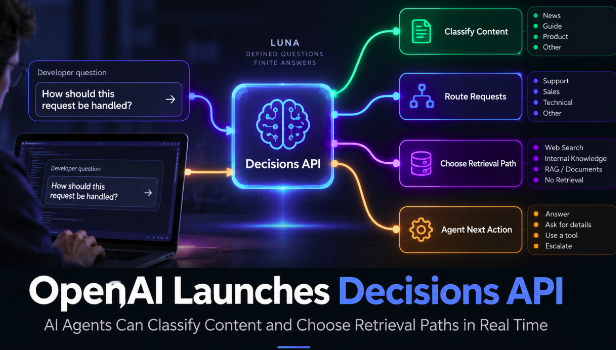
OpenAI has introduced the Decisions API, a new developer interface designed to turn AI reasoning into constrained, application-ready decisions rather than open-ended text responses.
Announced on September 29, 2026, the API focuses the intelligence of Luna on developer-defined questions with a finite set of possible answers. That structure makes the output easier to use directly inside software workflows, including content classification, request routing, retrieval selection and deciding what an AI agent should do next.
From generation to decision infrastructure
The important distinction is the output format. Instead of asking a model to generate an unrestricted response and then interpreting it downstream, developers can define the decision that needs to be made and the possible outcomes available to the model.
For agent systems, this creates a potentially useful control layer between user intent and execution. A decision could determine whether a request needs web retrieval, internal knowledge, a particular tool, a specialized workflow or no retrieval at all.
Why this matters for AI search and retrieval
Retrieval systems increasingly depend on routing before generation begins. An agent may need to decide which source set to query, whether fresh information is required, which index is relevant or whether the prompt should be handled without external retrieval.
A dedicated decision interface could make those choices more explicit and reusable. For publishers and SEO teams studying AI visibility, that matters because citation opportunities can be influenced not only by ranking inside a retrieval system but also by the earlier decision about whether and where retrieval happens.
Classification becomes part of the agent stack
The same architecture can be applied to content moderation workflows, support routing, lead qualification, document categorization and tool selection. Rather than treating classification as a separate traditional model, developers can use an AI model to evaluate context while still requiring one of a controlled set of outputs.
Limited preview first
OpenAI says the Decisions API is initially available in limited preview, with broader access expected to follow. The practical impact will depend on pricing, latency, reliability and the degree of control developers receive over decision schemas and model behavior.
The NetContentSEO view
The larger signal is that agent architecture is becoming increasingly modular. Retrieval, generation, tools and actions are separate layers, and the decision about which layer to invoke is becoming a product surface of its own.
For AI visibility research, this adds another stage worth monitoring: before a source can be retrieved or cited, an AI system may first classify the request and choose a retrieval path. Understanding those routing decisions could become increasingly important for understanding why some content enters an AI answer pipeline while other content never reaches retrieval at all.