
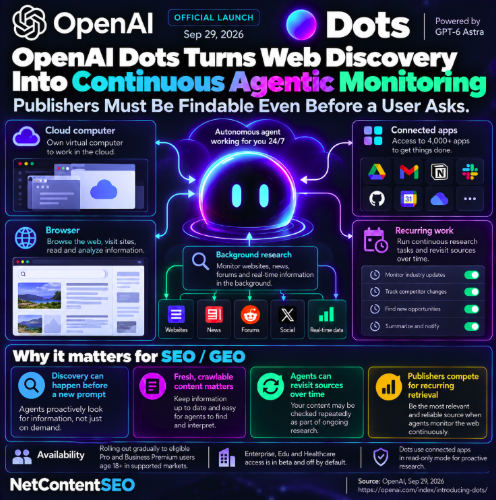
OpenAI has launched dots, persistent agents in ChatGPT designed to keep working between conversations. A dot can be given an ongoing goal, connected to the tools it needs and allowed to continue making progress without waiting for the user to initiate every individual step.
For publishers and GEO teams, the important change is the move from on-demand retrieval toward continuous agentic discovery: an AI agent can revisit information sources as part of recurring work rather than only when a person enters a fresh prompt.
Each dot has its own cloud computer
OpenAI says every dot has its own cloud computer and is powered by GPT-6 Astra. The agent can use a browser and connected tools while handling ongoing work.
This gives the agent a persistent execution environment rather than limiting it to a single conversational response.
Dots can keep working between conversations
The core product idea is persistence. OpenAI describes dots as “always-on agents” that can take on ongoing work and continue making progress between conversations.
That model is particularly suited to recurring research, monitoring and workflows where new information can appear after the original request.
Connected apps extend the discovery environment
Users can connect the apps a dot needs and define what the agent is allowed to do autonomously. Existing permissions and workspace controls determine the information and actions available to the agent.
OpenAI's launch materials also describe dots as using connected tools and handling recurring work, potentially delegating parts of a task to subagents.
Background research changes when discovery happens
In a conventional chatbot interaction, retrieval usually begins after a user asks a question. Persistent agents change that timing.
If a dot is responsible for an ongoing research objective, it can return to sources over time as part of the task. For publishers, this means content may need to be discoverable and understandable at the moment an agent checks for new information — even when no human is actively typing a query.
Freshness becomes relevant to recurring retrieval
This does not mean OpenAI has announced a new publisher-ranking algorithm for Dots. No separate citation or source-selection system has been disclosed.
But recurring research creates an obvious operational consequence: information can be revisited repeatedly. Pages that change frequently therefore need reliable crawlability, clear update signals and content that an automated system can interpret when it returns.
Availability starts with Pro and Business Premium
OpenAI says dots are rolling out gradually to eligible Pro and Business Premium users aged 18 and older in supported markets. Pro availability excludes the European Economic Area, Switzerland and the United Kingdom at launch.
Enterprise access is currently in beta and disabled by default. OpenAI's broader launch information also describes specialist dots as an Enterprise preview.
The NetContentSEO view
Dots reinforce a major shift already appearing across AI search: discovery does not have to begin with a new user query.
Persistent agents can maintain objectives, revisit the web and connected information sources and continue research over time. That creates a new visibility window for publishers: being selected during recurring retrieval rather than only during an immediate search session.
For GEO, the emerging challenge is therefore broader than ranking for prompts. Publishers need information that remains fresh, accessible, machine-readable and useful whenever an autonomous agent returns looking for what has changed.
OpenAI has not disclosed how Dots rank or choose web sources, so those mechanisms should be tested rather than assumed. But the architectural direction is clear: AI discovery is becoming increasingly persistent, proactive and agent-driven.